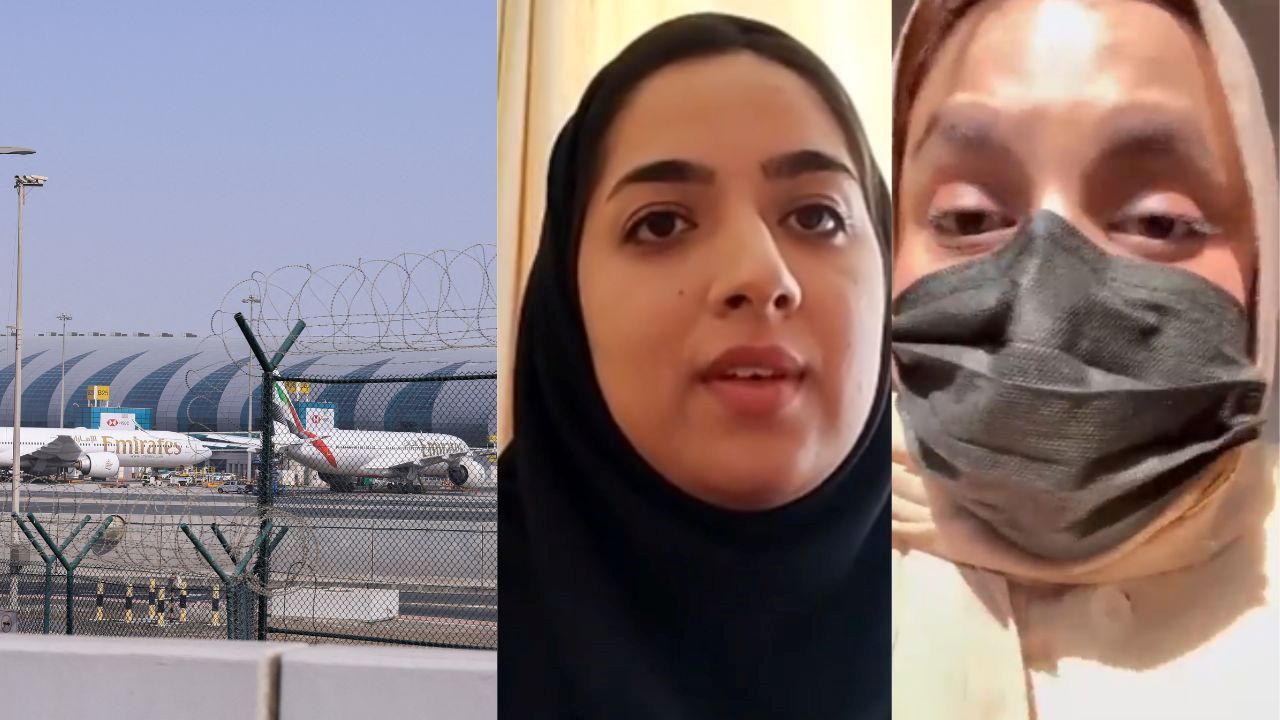
The air in Dubai International Airport usually smells of expensive oud and filtered sterility. It is a place of transit, a gilded pipe through which the world’s wealth and ambition flow without stopping. But for the small clusters of Indian students slumped against their overstuffed suitcases in Terminal 3, the air has turned heavy with the scent of recycled breath and the metallic tang of adrenaline.
They are not tourists. They are no longer travelers. They are the human friction points of a geopolitical machine that has suddenly ground its gears.
Every fifteen minutes, a sound tears through the relative silence of the terminal. It isn't the roar of an engine or the chime of a boarding announcement. It is the rhythmic, artificial thrum of alerts hitting hundreds of phones simultaneously. News of a strike. A counter-strike. A notification that another flight to Tehran or Tel Aviv has been scrubbed from the digital boards. To these students, the sound has become a metronome for their anxiety.
The Geography of a Nightmare
Consider Rahul. He is a hypothetical composite of the dozens of young men currently staring at the "Delayed" status on the monitors, but his fear is entirely real. He is twenty-two, an engineering student who saved for three years to afford a degree that promised a way out. Now, he is caught in the physical manifestation of a "no-man's land."
Dubai is often described as a bridge between the East and the West. When that bridge holds, it is a marvel of modern logistics. When it buckles under the weight of a regional conflict—specifically the escalating tensions between the United States, Israel, and Iran—it becomes a cage.
The facts are cold: airspace closures across the Middle East have turned one of the world's busiest hubs into a bottleneck. For those with high-tier passports or deep pockets, this is an inconvenience—a night in a five-star hotel, a rerouted ticket through London or Singapore. For Indian students traveling on shoestring budgets, it is a financial and legal abyss.
"I have eighty dirhams left," Rahul says, or would say, if you asked him. That is roughly twenty dollars. In Dubai, that buys a few sandwiches and a bottle of water. It does not buy a bed. It does not buy the $1,200 "emergency" fare being quoted by alternative carriers who still have a sliver of sky to fly through.
The Invisible Stakes of the Middle Sky
We often talk about war in terms of payloads, intercepted drones, and sovereign borders. We rarely talk about it in terms of the student loan interest that continues to accrue while a young woman sits on a linoleum floor in the UAE, unable to reach her exams in Europe or her family in Kerala.
The escalation between the US-Israel alliance and Iran isn't just happening in the deserts of the Levant or the facilities of Isfahan. It is happening in the bank accounts of the global middle class.
When Iran launched its barrage, and the subsequent "bomb sounds" began to echo through the headlines every quarter-hour, the immediate reaction was tactical. How many missiles were downed? What was the "Iron Dome" success rate? But the secondary explosion was economic.
The closure of Iranian airspace doesn't just stop planes from landing in Tehran; it forces every flight from India to Europe or North America to take the "long way around." This adds hours to flight times, tons to fuel consumption, and thousands of dollars to ticket prices.
Why They Can't Just Go Home
You might ask why these students don't simply turn around. If the way forward is blocked, why not retreat to the safety of Delhi or Mumbai?
The answer lies in the brutal reality of the "Single Entry Visa."
Many of these students are on transit visas or have already "exited" their home country in the eyes of the law. To go back is to admit defeat, to potentially forfeit a visa that took months to secure, or to lose a seat in a classroom that won't wait for a ceasefire. They are suspended in a state of "waithood."
They are waiting for a de-escalation that feels increasingly like a fantasy. They are waiting for their embassies to do more than issue a "travel advisory" that tells them what they already know: the world is on fire, and you are standing in the smoke.
The Sound of Fifteen Minutes
The "bomb sounds" referenced by those on the ground aren't always physical explosions. Sometimes, they are the metaphorical detonations of a life's plan.
Imagine the psychological toll of a fifteen-minute cycle.
0:00 - Refresh the news.
0:05 - Check the airline app. Still "Pending."
0:10 - Call home. Try to sound brave so your mother doesn't cry.
0:15 - A notification pings. A new threat. A new closure.
Repeat.
This is the cadence of modern displacement. It is digitized, high-frequency, and utterly exhausting. It turns the brain into a frantic bird, hitting the glass of a window it can’t see.
The Indian government has historically been a master of the "Mega-Evacuation." We saw it in Kuwait in 1990; we saw it during the early days of the Ukraine conflict. But those were clear-cut scenarios of extracting people from a war zone. This is different. This is a "Grey Zone" crisis. The students are in a safe city—Dubai—but they are trapped by the financial and logistical fallout of a war happening hundreds of miles away.
The Ghost in the Machine
The real problem isn't just the missiles. It’s the fragility of our interconnectedness. We have built a world where a student’s future depends on a clear path over a mountain range they will never walk on, in a country they will never visit.
When that path vanishes, the "holistic" (to use a word I despise for its vagueness, yet here it fits like a shroud) failure of the system becomes apparent. The airline points to the "Force Majeure" clause. The embassy points to "Ongoing Negotiations." The student points to an empty wallet.
There is a specific kind of loneliness that comes with being stranded in a crowd of thousands. You are surrounded by the luxury of the Duty-Free shops—the Chanel No. 5, the gold bars in glass cases, the Swiss chocolates—while you are calculating if you can afford to charge your phone at a paid station. It is a grotesque juxtaposition of 21st-century excess and primal survival.
Beyond the Ticker Tape
We must look past the scrolling text at the bottom of the news screen. Those "stranded Indians" are not a monolith. They are individuals with midterms, with crushes, with coughs they can’t afford medicine for, and with a growing realization that the "global village" is a neighborhood that can be evicted at a moment's notice.
The conflict between the US, Israel, and Iran is often analyzed by men in suits sitting in climate-controlled rooms in Washington or Doha. They talk about "strategic depth" and "deterrence."
They don't talk about the girl in Terminal 3 who is using her backpack as a pillow and wondering if her father’s life savings just evaporated because a flight corridor was moved ten degrees to the west.
The tragedy of the modern age is that we are close enough to see the world, but not powerful enough to move through it when the giants start to stumble.
As the sun sets over the Persian Gulf, casting long, orange shadows across the runways of Dubai, the phones will continue to chirp every fifteen minutes. Each sound is a reminder that the distance between "traveler" and "refugee" is much thinner than any of us want to admit.
It is the thickness of a boarding pass that no longer works.
The terminal lights never dim. They stay bright, humming with a relentless, uncaring energy, illuminating the faces of a generation that learned far too early that the sky is not a limit, but a battlefield.
One student picks up his phone. The screen glows. Another alert. Another fifteen minutes gone.
He looks at the person sitting next to him—a stranger, a fellow countryman, a mirror. They don't speak. They don't have to. The sound of the notification has said everything that needs to be said.
The bridge is down. The water is rising. And the Oud-scented air of the airport has never felt more like a tomb.