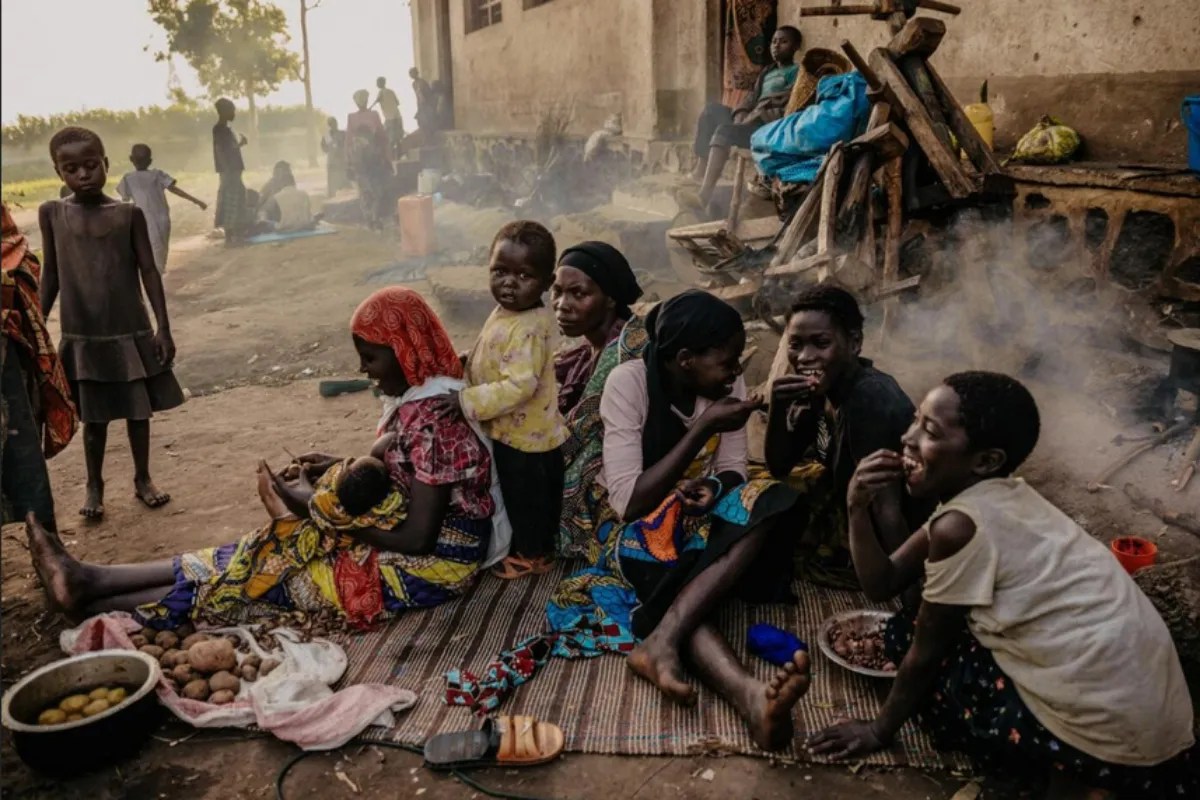
In a dusty corner of a village that doesn't appear on most digital maps, a ten-year-old boy named Samuel sits on a sun-baked stone. He isn't checking a notification or worrying about a math test. He is watching the horizon, waiting for the sheep to move so he can move with them. His hands are calloused, not from sports or play, but from the raw necessity of survival. Samuel is one of the 251 million.
Actually, the number is higher now. UNESCO recently pulled back the curtain on a global crisis that most of us have learned to ignore because the numbers are too large to feel. There are 273 million children and youth worldwide who are not in school. Also making headlines in this space: Finland Is Not Keeping Calm And The West Is Misreading The Silence.
Think about that.
If you lined those children up, shoulder to shoulder, they would circle the Earth several times. It is an entire generation of doctors, engineers, poets, and problem-solvers who are currently invisible to the global economy. They aren't just "missing classes." They are being erased from the future in real-time. More details on this are covered by Reuters.
The Mathematics of a Stolen Future
Statistics usually act as a numbing agent. We hear "millions" and our brains switch off. To understand the weight of 273 million, we have to look at the anatomy of the collapse. Since 2015, the number of out-of-school children has barely budged. We promised the world that by 2030, every child would have a seat in a classroom. We lied. Or, at the very least, we severely underestimated how gravity works in the cycle of poverty.
The gap isn't just a straight line; it’s a widening canyon. In the wealthiest nations, a child’s path to a degree is almost a conveyor belt. In the poorest regions, specifically in sub-Saharan Africa and parts of Southern Asia, that belt is broken. Only 3% of the most disadvantaged children in the poorest countries ever complete secondary education.
It is a lottery where the stakes are human lives.
Samuel doesn’t know what a "Sustainable Development Goal" is. He only knows that his sister stopped going to school because the walk became too dangerous, and his brother stopped because the family needed the three dollars a day he could earn hauling water. This isn't a lack of ambition. It is a calculated, agonizing choice between a book today and bread tonight.
The Invisible Ceiling of Gender and Geography
While the total number is staggering, the internal mechanics of who gets left behind are even more haunting. For every boy who drops out to work, there is a girl whose education is cut short by tradition or fear. In many parts of the world, a girl’s education is still viewed as a luxury—a temporary hobby before she is moved into the role of a wife or a domestic worker.
When a girl is denied an education, the cost is compounded. We know the data: an educated woman is more likely to have healthier children, earn higher wages, and lift her entire community. By keeping millions of girls out of the classroom, we aren't just failing them. We are sabotaging the very infrastructure of the future.
The geography of this crisis is equally cruel. If you are born in a conflict zone, your chances of finishing school drop to nearly zero. Schools are often the first things to be repurposed as barracks or destroyed as symbols of "Western influence." Education becomes a casualty of war long before the bullets stop flying.
The Digital Mirage
There was a moment, not long ago, when we believed technology would be the great equalizer. We thought that as long as we could beam the internet into every corner of the globe, the classroom wouldn't matter.
We were wrong.
Digital learning requires more than just a signal. It requires a device, electricity, a quiet room, and a teacher who knows how to guide the process. For the 273 million, the "digital divide" isn't a metaphor. It is a wall. While a student in London or New York complained about the lag on their Zoom call, children in rural India or Ethiopia saw their schools close and their connection to the world vanish entirely.
The "learning poverty" we see now is the hangover of those years. It is the realization that even for those who are in school, many aren't actually learning. They sit in overcrowded rooms with one textbook for every ten students, listening to a teacher who hasn't been paid in three months.
Why This Matters to You
You might be reading this from a comfortable chair, miles away from a sheep pasture or a war-torn village. You might think this is a "them" problem.
It isn't.
A world where 273 million people are illiterate and unskilled is a world that is fundamentally unstable. Economic migration, radicalization, and the collapse of local markets are all downstream effects of an uneducated population. When people have no hope of participating in the formal economy, they find other, often more destructive, ways to survive.
We are paying for this "missing education" in ways we don't realize. We pay for it in lost innovation. We pay for it in global health crises that spread faster because of a lack of basic health literacy. We pay for it in the sheer, staggering loss of human potential.
Imagine the cure for cancer sitting in the brain of a girl who is currently spending her day picking through a literal mountain of trash in a suburb of Manila. Imagine the next great energy breakthrough locked inside a boy who will never learn to read a periodic table.
The Cost of Silence
The UNESCO report is a siren, but the world is a very noisy place. We have become experts at filtering out the sound of a crisis that doesn't scream. This is a quiet catastrophe. It doesn't happen with a bang; it happens with a whimper, every time a child puts down a pencil for the last time.
Funding is the most obvious lever, but it isn't the only one. We need a radical shift in how we value the "unseen" child. We need to stop treating education as a charity project and start treating it as the ultimate global security priority.
If we don't, the number will continue to climb. The ghost of the global classroom will grow larger. And Samuel, still sitting on that rock, will eventually grow into a man who knows nothing of the world except that it had no place for him.
The sun sets on the pasture. Samuel stands up, taps his wooden staff against the ground, and starts the long walk home. He doesn't look back at the schoolhouse in the distance. To him, it isn't a temple of learning. It’s just another building with a locked door.
We are the ones with the keys. We are simply choosing not to turn them.