The air in London during the first weeks of spring usually carries the scent of damp pavement and the frantic, caffeinated energy of a city shaking off winter. But for those whose job it is to monitor the heartbeat of the capital’s streets, the atmosphere lately has been heavy with something else. It is a friction you can feel in the underside of your jaw. It is the sound of a city holding its breath.
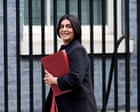
On a Tuesday that looked like any other, Shabana Mahmood, the Justice Secretary, put pen to paper. It was a bureaucratic act with the weight of a sledgehammer. She approved a formal request from the Metropolitan Police to ban the al-Quds Day march, an annual event that has, for decades, wound its way through the arteries of London.
To understand why this matters, you have to look past the ink and the legal statutes. You have to look at the street corner.
Imagine a shopkeeper in Westminster. Let’s call him Elias. For twenty years, Elias has watched the tides of protest wash past his window. He has seen the anti-war rallies of the early 2000s, the austerity marches, the celebrations, and the mournings. He knows the specific cadence of a crowd that is angry but peaceful—the rhythmic chanting, the sea of placards, the whistles.
But Elias also knows the sound of a crowd that has reached a breaking point.
Over the last few months, the Metropolitan Police have been describing a "cumulative impact." It is a clinical term for a raw reality. It means that the frequency, the intensity, and the specific rhetoric of certain demonstrations have created an environment where the risk of "serious public disorder" is no longer a theoretical footnote in a briefing document. It is a live wire.
The decision to ban a march in a democracy is a surgical strike against a fundamental right. It is not done lightly. Under Section 13 of the Public Order Act 1986, a ban is the final lever. It is only pulled when the police believe that even the most stringent conditions—moving the route, limiting the time, banning certain banners—will not be enough to prevent a catastrophe.
Metropolitan Police Commissioner Sir Mark Rowley didn't just ask for this because of one afternoon’s logistics. He asked for it because the intelligence suggested a collision course.
Consider the mechanics of a city in tension. When two groups with diametrically opposed, deeply visceral traumas are funneled into the same square mile, the police are no longer just directing traffic. They are attempting to hold back a flood with their bare hands. The al-Quds Day march, which coincides with the end of Ramadan, has historically been a flashpoint. This year, against the backdrop of the most sustained and agonizing conflict in the Middle East in a generation, the "standard" tension was replaced by something far more volatile.
The invisible stakes are found in the homes of Londoners who no longer feel they can walk through their own center on a weekend. There are families who check the protest schedules before deciding whether to take their children to a museum. There are elderly residents who see a certain flag or hear a certain slogan and feel a cold spike of historical memory.
Mahmood’s approval of the ban is a statement that, in this specific moment, the collective safety of the city outweighs the individual right to march.
It is a messy, uncomfortable trade-off.
Critics of the move argue that banning a march doesn't make the anger go away. It just pushes it underground or into smaller, more unpredictable pockets. They argue that the "chilling effect" on free speech is a price too high to pay. And they are right to worry. A democracy that becomes too comfortable with banning dissent is a democracy in retreat.
Yet, the Justice Secretary is looking at a different set of numbers. She is looking at the thousands of police shifts required to manage these events—officers pulled from local neighborhoods, from domestic violence units, from burglary investigations. She is looking at the rising tide of hate crime reports that spike every time the rhetoric on the streets crosses the line from political protest into targeted harassment.
The law isn't just a set of rules; it’s a social contract. We agree to let each other speak, even when we hate what is being said, on the condition that the speaking doesn't turn into a riot. When the police tell the government that they can no longer guarantee that condition, the contract is under threat.
I remember standing near Trafalgar Square during a particularly heated demonstration a few years ago. I watched a young police officer, probably no older than twenty-four, standing between two screaming factions. He wasn't looking at the banners. He wasn't listening to the speeches. He was looking at the ground, his knuckles white as he gripped his vest, just trying to be a human wall.
That officer represents the limit of what we can ask of our public institutions.
The ban on the al-Quds march is a temporary measure, a cooling-off period for a city that has become a pressure cooker. It is a recognition that the "human element" isn't just the person holding the megaphone. It’s also the person trying to get to work, the person afraid to wear a religious symbol in public, and the officer who just wants to go home at the end of the shift without having had to use a baton.
Justice is often depicted as a blindfolded woman holding a pair of scales. Usually, we think of those scales as weighing guilt against innocence. But in the corridors of the Home Office and the Ministry of Justice, those scales are weighing something even more delicate: the right to shout against the right to exist in peace.
The streets of London will be quieter this weekend. Some will find that silence a relief. Others will find it an insult. But for now, the pens have been put away, the orders have been issued, and the city waits to see if the absence of a march can provide the space for a different kind of conversation.
One that doesn't require a megaphone to be heard.
The silence isn't a solution. It is a breath. A long, shaky, necessary breath before the city has to find a way to live together again in the noise.