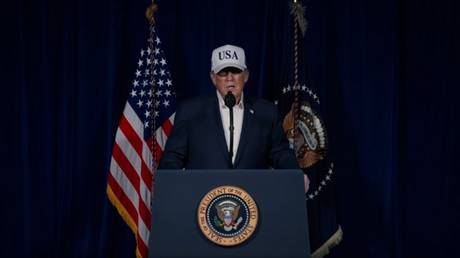
Donald Trump thinks the best way to keep Americans safe is by hitting Iran before they hit us. It’s a bold, high-stakes gamble that has defined his approach to the Middle East for years. When the news broke about recent strikes, the rhetoric didn't change. He claims these actions aren't about starting a war, but rather stopping one before it reaches American soil.
You’ve seen the headlines, but the reality is much more complicated than a simple "us versus them" narrative. To understand why this matters right now, you have to look at the history of these tensions and what's actually happening on the ground in 2026.
Why Trump Believes in Preemptive Action
The core of the argument is simple. Trump argues that by striking Iranian interests or their proxy groups, the U.S. sends a message of strength that prevents larger attacks. He’s essentially saying that if you don't show teeth, the other side will keep biting. It's a "peace through strength" philosophy that his supporters love and his critics find incredibly dangerous.
During his first term, the 2020 drone strike on Qasem Soleimani was the ultimate example of this. At the time, the world held its breath. People thought World War III was starting. It didn't. Trump uses that moment as proof that being aggressive actually keeps the peace. He believes that Iran only understands one language—force.
But does it actually work? Or does it just create a cycle of revenge that never ends?
The Defense of the American People Argument
When Trump says he's defending the American people, he’s referring to a few specific threats. First, there's the physical safety of U.S. troops stationed in Iraq and Syria. These bases get harassed by rocket fire and drone strikes from groups backed by Tehran. By hitting back, the U.S. tries to "restore deterrence." That’s a fancy way of saying they want to make the cost of attacking Americans too high to be worth it.
Then there's the broader issue of regional stability. If Iran gains too much influence, it threatens oil flow through the Strait of Hormuz. That hits your wallet at the gas pump. Trump’s logic links global energy security directly to the safety and prosperity of the average American family. He isn't just talking about missiles; he's talking about the economy.
What the Critics Get Wrong
Most critics say these strikes are reckless. They worry about an all-out war. While that’s a fair concern, many overlook the fact that a "shadow war" has been going on for decades. Iran and the U.S. have been trading blows in the dark for a long time. Trump’s approach is just taking that conflict out of the shadows and putting it into the spotlight.
Some argue that diplomacy is the only way forward. We saw the Iran Nuclear Deal (JCPOA) attempt this. Trump famously walked away from it, calling it a disaster. He thinks you can't negotiate with a regime that's actively funding groups like Hezbollah or the Houthis. From his perspective, a piece of paper doesn't stop a drone. Only a missile stops a drone.
The Role of Proxy Groups in 2026
It's rarely a direct fight between Washington and Tehran. Instead, it’s a messy web of militias. Iran uses these groups so they can have "plausible deniability." They can attack U.S. interests without technically starting a war between two nations.
Trump’s recent rhetoric suggests he's done playing that game. He’s holding the "head of the snake" responsible for what the "fingers" are doing. This is a massive shift in foreign policy. It means if a militia in Iraq kills an American, the response might land in Iran, not just Iraq. It’s a strategy designed to make Tehran rethink its entire support system for these groups.
The Economic Impact of a Confrontation
War is expensive. Even "limited" strikes cost millions. But Trump argues the cost of inaction is higher. If the U.S. retreats from the Middle East, he believes China or Russia will fill the vacuum. That would give America's biggest rivals control over the world's most important energy corridor.
If you’re wondering how this affects you, look at the markets. Every time tensions spike, oil prices jump. This creates a weird paradox. Trump wants to protect the economy, but the very actions he takes to "defend" it can cause short-term pain for consumers. It’s a tightrope walk.
Navigating the Fog of War
It's hard to get a straight story. The Pentagon says one thing. Tehran says another. Trump says something else on social media. To stay informed, you need to look past the political theater.
- Watch the movements of U.S. carrier strike groups. They tell the real story of escalation.
- Pay attention to the rhetoric from Iran's Supreme Leader, not just their foreign minister.
- Look at how Israel and Saudi Arabia react. They are the ones living in the neighborhood.
The situation is fluid. One miscalculation on either side could turn a "defensive strike" into a regional conflagration. Trump is betting that his reputation for being unpredictable will keep the Iranians off balance. It’s a high-stakes poker game where the chips are human lives and global stability.
Taking Action to Stay Informed
Don't just rely on 280-character outbursts or 30-second news clips. If you want to understand the true state of U.S.-Iran relations, you need to dig into the reports from places like the Institute for the Study of War or the Council on Foreign Relations. They provide the context that politicians often leave out.
Check the latest updates on troop deployments in the Middle East. If the numbers are creeping up, the situation is getting worse, regardless of what the "defending the people" headlines say. Keep an eye on the price of Brent Crude oil. It's often a more accurate barometer of geopolitical tension than any press conference. Stay skeptical and look for the patterns behind the strikes.