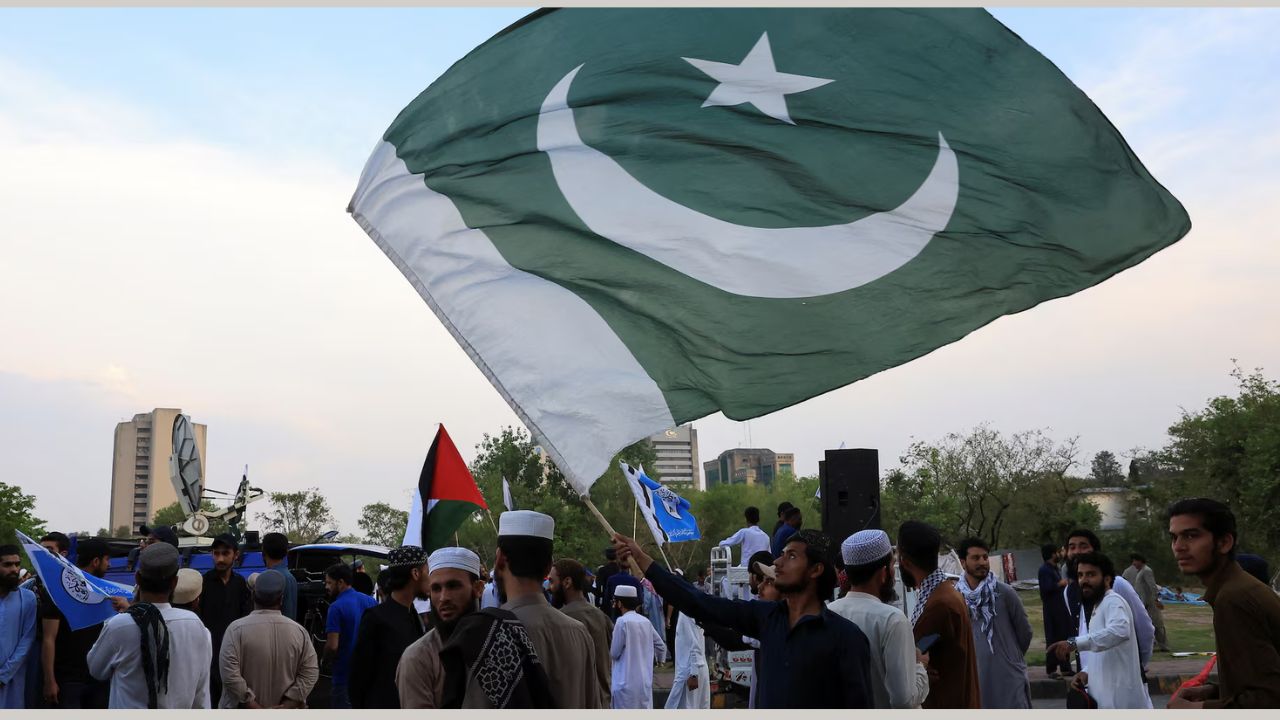
In the early hours of the morning in Panjgur, the air usually carries the scent of dust and diesel, punctuated by the rhythmic static of a transistor radio. But today, the static is different. It is absolute.
Consider a young student named Amina. She is hypothetical, but her frustration is mirrored in thousands of households across Balochistan this week. She wakes up, reaches for her phone to check a lecture schedule, and finds a "No Service" notification staring back at her. She tries the router. Dead. She looks out the window toward the local school, expecting the usual swarm of blue and white uniforms, only to see the gates chained shut.
This is not a technical glitch. It is a deliberate, state-mandated void.
The Pakistani government recently shuttered schools and severed mobile internet services across seven key districts in Balochistan. The official reason is security—a catch-all term that carries immense weight in a province scarred by decades of insurgency and geopolitical friction. To the officials in Islamabad, this is a tactical maneuver, a way to disrupt the communication lines of militants and protect children from potential crossfire. To the people living within the blackout zone, it feels like being buried alive in the digital age.
The Geography of Disconnection
Balochistan is a land of breathtaking, brutal vastness. It makes up nearly half of Pakistan’s landmass but holds a fraction of its population. When you cut the internet in Kalat or Kech, you aren't just stopping people from scrolling through social media. You are severing the only tether many have to the modern economy.
Imagine a shopkeeper trying to process a digital payment. A doctor trying to consult a specialist in Karachi via a messaging app about a complicated birth. A family trying to reach a relative working in the Gulf to confirm a wire transfer.
The blackout hits the districts of Kalat, Kech, Panjgur, Pishin, Washuk, Mastung, and Surab. These aren't just names on a map; they are hubs of precarious survival. By turning off the towers, the state effectively pushes these regions back into the twentieth century. The silence is heavy. It creates a vacuum where rumors grow faster than facts, and where the absence of information becomes its own kind of terror.
The High Cost of "Safety"
Security is a fundamental human right. No one disputes that. In recent weeks, the province has seen a sharp uptick in violence, with coordinated attacks targeting infrastructure and security forces. The logic from the interior ministry is straightforward: if the insurgents cannot communicate, they cannot coordinate. If the schools are closed, they cannot become targets.
But there is a secondary effect to this strategy. When you close a school to save a child’s life, you are also pausing their future. Education in Balochistan is already a hard-won prize. Literacy rates here lag far behind the rest of the country. Every day the gates are locked is a day a child learns that their development is secondary to the state’s inability to maintain order.
The invisible stakes are found in the lost momentum. A week of missed classes in a resource-poor environment often turns into a month. For some, it becomes the moment they drop out entirely to help their parents in the fields or the markets. The "security" gained today is paid for by the intellectual poverty of tomorrow.
The Digital Ghost Town
We often talk about the internet as a luxury, but in a place like Balochistan, it is a lifeline. In the absence of physical libraries, YouTube is the classroom. In the absence of a functional banking system, mobile wallets are the bank.
The government’s decision to cut mobile data while leaving some landline services active creates a class divide. Those with the means to afford expensive, wired fiber optics—mostly government offices and the elite—remain connected. The average worker, the student, and the small business owner who rely on cheap mobile data are left in the dark.
This isn't just a Pakistani phenomenon. We see it in various parts of the world where "kill switches" are used to quell unrest. It is a blunt instrument used to perform surgery. It might stop the bleeding, but it often kills the nerves in the process.
The Human Signal
If you were to walk through the streets of Mastung right now, you would see people holding their phones high in the air, searching for a ghost of a signal that isn't coming. There is a specific kind of anxiety that comes with being cut off from the world. It is a feeling of being forgotten.
The authorities argue that these measures are temporary. They are "precautionary." But "temporary" is a flexible word in Balochistan. The residents have seen temporary measures turn into permanent realities before. They have lived through "missing persons," "checkpoints," and "development projects" that never seem to benefit the local population.
When the internet goes out, the world stops looking at Balochistan. Without digital eyes, what happens in the shadows? This is the fear that keeps parents awake at night. It isn't just the fear of a bomb; it is the fear of an unaccountable silence.
The Weight of the Chained Gate
There is a profound irony in closing schools to protect the people. A school is more than a building; it is a symbol of a functioning society. It represents the promise that the next generation will have it better than the last. When the state chains those gates, it admits a terrifying truth: it cannot guarantee the safety of its most vulnerable citizens in their places of growth.
The children of Kech or Pishin aren't just missing math lessons. They are learning a much harsher lesson about where they sit in the national priority list. They are learning that their lives are lived in a "sensitive area," a euphemism that justifies the suspension of their rights.
Data from recent years suggests that these shutdowns rarely have the intended effect on long-term security. Militants often use sophisticated radio equipment or satellite phones that don't rely on the local towers. The people who suffer are the civilians. The mother who can't call an ambulance. The student who misses a scholarship deadline. The journalist who can't report on a human rights violation.
Beyond the Blackout
The silence will eventually break. The towers will be hum back to life, and the school gates will be unchained. The government will likely claim victory, citing a period of "calm" achieved through these measures.
But the "calm" of a graveyard is not the same as the peace of a thriving community.
Every time the internet is cut, a bit of trust is eroded. Every time a school is closed, the distance between the periphery and the center grows wider. You cannot build a nation by switching it off whenever things get difficult.
Amina, our student in Panjgur, will eventually get back to her lectures. But she will remember the day the screen went dark. She will remember that her education was a switch that someone else could flip.
The true cost of the Balochistan blackout isn't measured in lost megabytes or missed school days. It is measured in the quiet, simmering realization that in the eyes of the state, your connection to the world is a privilege that can be revoked at any moment, for your own good, leaving you alone in the dust.
The sun sets over the rugged hills of Kalat, and for another night, the only things moving across the border are the shadows. No pings. No notifications. Just the wind.