The milkman sees the world before it wakes up. He knows the specific blue of 4:00 AM, the way the streetlights hum just before they flicker out, and the precise weight of a neighborhood’s silence. But on a nondescript stretch of pavement where the curb meets the cold morning air, the silence was different. It wasn't the quiet of sleep. It was the heavy, suffocating stillness of something that shouldn't be there.
A young woman lay in the street.
She was found by a passerby, someone just starting their day, perhaps thinking about a grocery list or a morning meeting. In an instant, that mundane internal monologue shattered. When the emergency calls went out and the sirens began their long, mournful climb toward the scene, a life that had been full of private jokes, favorite songs, and future plans became a "fatality." A "discovery." A "crime scene."
We talk about crime in the abstract. we read headlines about "four held in inquiry" and our brains categorize the information as a data point. We check the location to see if it’s near our commute. We look at the age to see if it mirrors our own children. Then we move on. But for this woman—whose name hasn't yet been released to the public but is currently being screamed or whispered in a living room somewhere—the abstract has become an absolute.
The Anatomy of a Cordon
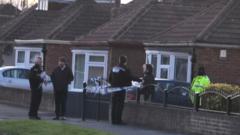
By midday, the street was no longer a street. It was a grid. Yellow tape doesn't just keep people out; it cordons off a piece of reality and marks it as broken. Police officers stood guard, their faces set in that practiced mask of professional detachment. Behind them, forensic investigators in white suits moved with agonizing slowness.
Every grain of grit on that asphalt mattered now. A discarded cigarette butt, a scuff mark, the way a jacket was folded—these are the sentences in a story the police are trying to read backward. They are looking for the moment the trajectory of a night out or a walk home veered into the unthinkable.
When news broke that four individuals had been taken into custody, the narrative shifted. The "unexplained" death gained the jagged edges of a "murder inquiry." In the cold language of the law, "held in custody" means four people are currently sitting in small, brightly lit rooms. They are being asked about their movements, their associations, and the final hours of a woman who is no longer here to speak for herself.
Consider the sheer gravity of that shift. One minute, you are a person with a Saturday planned. The next, you are a person of interest in the permanent erasure of another human being. The investigation isn't just about finding a culprit; it's about reconstructing a shattered mirror. Each of the four people held holds a piece of the glass. Some pieces might be sharp. Some might be fake. The detectives have to bleed a little to find out which is which.
The Invisible Stakes of a Neighborhood
For the people who live behind the windows overlooking that street, the world has tilted. There is a specific kind of trauma that comes with a murder inquiry on your doorstep. You look at the pavement where you usually park your car, and you realize it is now a monument to a tragedy.
I remember talking to a man who lived near a similar scene years ago. He told me he couldn't stop thinking about the sounds he didn't hear. Did she cry out? Was there a car door slamming? Or was it a quiet, terrifying transition from life to shadow? That is the haunting core of these events. We want there to have been a sign. We want to believe that the world gives us a warning when the light is about to go out.
Often, it doesn’t.
The suspects—two men and two women, or perhaps a different configuration, the details are often withheld early on to protect the integrity of the interviews—represent the "why." But the "why" is usually smaller and more pathetic than we want it to be. We want Shakespearean motives. We usually get a flash of temper, a tragic mistake, or a calculated cruelty that defies logic.
Beyond the Police Report
The standard news report will tell you the age of the victim. It will tell you the time the body was found. It will list the charges if and when they are brought. But it won't tell you about the half-finished cup of coffee sitting on a bedside table in her apartment. It won't tell you about the text message she never replied to, or the shoes she bought last week because she thought they’d be perfect for the summer.
Those are the facts that matter.
When the police "appeal for witnesses," they aren't just looking for someone who saw the act. They are looking for the peripheral details. Did you see a car driving too fast three blocks away? Did you hear an argument that sounded just a bit too sharp for a Friday night? We are the eyes and ears of our communities, yet we spend so much of our time looking down at our phones, ignoring the vibration of the world around us.
This investigation is currently in its most volatile stage. The first 48 hours are a frantic race against the fading of memory and the cleaning of evidence. The four people in those cells are the focus, but the real work is happening in the lab and on the doorsteps of neighbors.
It is a grueling, clinical process to honor a life that was anything but clinical.
The Weight of the Aftermath
Eventually, the tape will come down. The white suits will pack up their kits. The cars will drive over the same spot where she was found. To the world, the street will return to normal. But "normal" is a ghost.
The death of a young woman in the street is a tear in the fabric of a city. You can stitch it back together with arrests, trials, and verdicts, but the scar remains. Every person who walked past that cordon today carries a piece of that weight now. They are reminded of the fragility of the routine. They are reminded that the distance between a quiet night and a headline is thinner than we dare to admit.
As the sun sets on the first day of the inquiry, the sirens have stopped, replaced by the low murmur of a neighborhood trying to make sense of the senseless. Four people are waiting in the dark of a station. A family is waiting for a phone call they never thought they’d receive.
And on a street that looks like any other, the silence is no longer empty. It is full of questions that may take a lifetime to answer.
The light in the hallway is still on. Someone is waiting for her to come home.