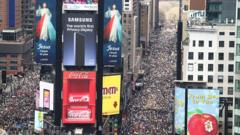
The air in Philadelphia doesn't just get cold in March; it turns brittle. It is the kind of damp, teeth-chattering chill that seeps through wool coats and settles into the marrow. On a Tuesday evening that felt less like a protest and more like a collective holding of breath, a woman named Elena stood near Independence Hall. She wasn’t a career activist. She was a retired schoolteacher who had spent thirty years explaining the separation of powers to bored eighth graders.
In her gloved hand, she held a piece of cardboard with three words scrawled in Sharpie: No More Kings.
Elena represents a pulse currently thrumming through the American body politic. It is a vibration born of deep, historical anxiety. Across the United States—from the neon-drenched sidewalks of Manhattan to the rainy plazas of Seattle—thousands of people have begun gathering under this specific, singular banner. They aren't just protesting a policy or a tax bracket. They are protesting a concept that most Americans thought was buried in 1776.
The "No Kings" movement ignited following a series of legal and political maneuvers surrounding Donald Trump’s return to the spotlight and the specific judicial arguments regarding executive immunity. To the casual observer, it looks like just another partisan skirmish. To those on the ground, it feels like an existential glitch in the American experiment.
The Ghost of 1776
We often treat the Constitution like a dusty museum piece, something static and safe behind glass. But for the crowds gathering in Washington D.C., that document has suddenly become a living, breathing casualty. The core of the "No Kings" sentiment lies in a visceral reaction to the idea that any individual, by virtue of their office, could exist above the reach of the law.
Imagine a high-stakes poker game where one player is allowed to keep an extra card up their sleeve, not because they earned it, but because they used to own the casino. The other players—the citizens—realize the game isn't just rigged; the rules have been deleted entirely.
This isn't hyperbole for the sake of drama. It is a reflection of the legal reality currently being debated in the highest courts of the land. When the argument was made that a President could theoretically order a military strike on a political rival without facing criminal prosecution, something snapped in the public consciousness. It wasn't just a "liberal" or "conservative" snap. It was a foundational one.
History is a heavy ghost. The men who gathered in Philadelphia centuries ago weren't just guessing; they were reacting to the suffocating weight of a monarchy that viewed the law as a suggestion rather than a mandate. They built a system of checks and balances specifically to ensure that no single person could ever claim the divine right to rule without consequence.
Now, as protesters march past the very buildings where those ideas were forged, the irony is thick enough to choke on. They see a shift from a government of laws to a government of men.
The Geography of Discontent
The protests aren't localized. They are a fractured, flickering map of a country trying to remember its own name.
In New York City, the demonstrations often take on a theatrical, jagged energy. There, the "No Kings" slogan competes with the roar of subways and the aggressive pace of the city. People like Marcus, a 24-year-old gig worker, join because the stakes feel personal.
"I get a ticket if my taillight is out," Marcus says, shivering in a thin hoodie. "I lose my job if I'm late three times. If I lived like the rules didn't apply to me, I'd be under the jail. Why is the most powerful person in the world the only one who doesn't have to look over his shoulder?"
In the Midwest, the tone changes. In cities like Des Moines and Madison, the gatherings are smaller, quieter, and arguably more intense. Here, the focus is often on the long-term erosion of trust. When the law becomes a shield for the powerful rather than a sword for the just, the social contract doesn't just tear; it dissolves.
The Invisible Stakes
What happens to a society when the "Referee" is no longer bound by the rulebook?
The psychological impact is profound. We operate on a system of "mutual assurance." I follow the speed limit because I trust you will too. I pay my taxes because I believe the infrastructure serves us all. I respect the results of an election because I believe the process is larger than my personal preference.
When the "No Kings" protesters rally against Donald Trump, they are targeting him as the avatar of a broader legal theory—the Unitary Executive theory pushed to its absolute, logical breaking point. This theory suggests that the President holds nearly total control over the executive branch, shielded from interference.
If this shield becomes impenetrable, the very nature of American citizenship changes. We cease to be participants in a democracy and become subjects of an administration.
The protesters aren't just shouting at a man; they are shouting at a mirror, asking if we still recognize ourselves. They are worried that the "Golden Age" of American accountability is being traded for a cult of personality where loyalty outweighs legality.
The Counter-Narrative of Power
It is a mistake to view these protests in a vacuum. There is a reason the "No Kings" message is meeting such fierce resistance from the other side. For supporters of the former President, the legal battles aren't seen as an attempt to bypass the law, but as a defense against a "weaponized" system.
They see the "No Kings" movement as a clever branding exercise for a political hit job. From their perspective, the true "royalty" are the unelected bureaucrats and career politicians who have held power for decades—the so-called "Deep State." In this narrative, the quest for immunity isn't about being above the law; it’s about being protected from a law that has been twisted into a political tool.
This is where the tragedy of the moment lies. Both sides claim to be the true defenders of the Republic. Both sides believe they are fighting against a form of tyranny.
But for Elena, the teacher in Philadelphia, the math is simpler.
"You can't have a democracy where the exit door is locked for some people and wide open for others," she says. "If the President can't be prosecuted for an official act, then the 'official act' becomes whatever the President wants it to be. That's not a Presidency. That's a throne."
The Sound of One Voice
The media often focuses on the scale of these events—counting heads, estimating crowd sizes, looking for the loudest shouter. But the real story is in the quiet conversations at the edges.
It's in the way a father explains to his daughter why people are carrying signs of a crown with a red line through it. It's in the way strangers share hand-warmers and thermoses of coffee while discussing the nuance of appellate court rulings.
There is a strange, somber dignity to these gatherings. They lack the celebratory, festival-like atmosphere of a campaign rally. Instead, there is a sense of duty. A sense of "we shouldn't have to be doing this, but here we are."
The "No Kings" movement is a reminder that the most important parts of a country are the things you can’t see: the precedents, the norms, the unwritten agreements that we all stay within the lines.
When those invisible lines start to vanish, people start to show up. They show up because they realize that once a king is made, it is nearly impossible to unmake him without breaking the country in the process.
The Long Walk Home
As the sun sets and the crowds begin to thin, the signs are folded up and tucked into car trunks or left in neat piles near trash cans. The chants fade, replaced by the normal hum of city life.
But the questions don't go away.
Is the law a cage for the weak or a boundary for the strong?
Can a nation survive if its leaders are granted the very thing its founders fought a revolution to escape?
What happens the morning after the law is officially declared optional for the few?
Elena walks back toward her car, her breath blooming in the cold air like a small, white flag. She looks back at the silhouette of Independence Hall, dark against the purple sky. She knows that tomorrow, the news will report on the "No Kings" protests as a political event, a data point in a polling cycle.
She knows better.
She knows it was a vigil for a dying idea, or perhaps, a desperate attempt to breathe life back into a cold one. She walks away, a single person in a vast, complicated country, hoping that the cardboard sign she held for four hours was enough to remind the world that in this place, the only thing that is supposed to wear a crown is the truth.
The street is quiet now, but the silence feels heavy, like the pause before a gavel strikes wood.
Would you like me to analyze the historical precedents of executive immunity mentioned in this narrative?


