The air in the south used to smell of scorched earth only in the peak of summer, a dry heat that promised the relief of the harvest. Now, the scent is different. It is the chemical tang of white phosphorus and the heavy, metallic odor of pulverized concrete. In villages like Dhayra and Aita al-Shaab, the silence isn't peaceful. It is heavy. It is a physical weight that presses against the eardrums of the few who remain, a silence born from the sudden absence of life.
When a border dissolves, it doesn’t happen on a map first. It happens in the kitchen. It happens when the morning ritual of brewing coffee is replaced by the calculated scramble to pack a life into the trunk of a battered sedan.
Imagine a man named Elias. He is not a combatant. He is a third-generation olive farmer whose hands are mapped with the same deep grooves as the bark of his trees. For Elias, the "threat of a ground invasion" isn't a headline or a geopolitical talking point discussed in air-conditioned studios in Beirut or Tel Aviv. It is the sound of the sky tearing open.
The Geometry of Ruin
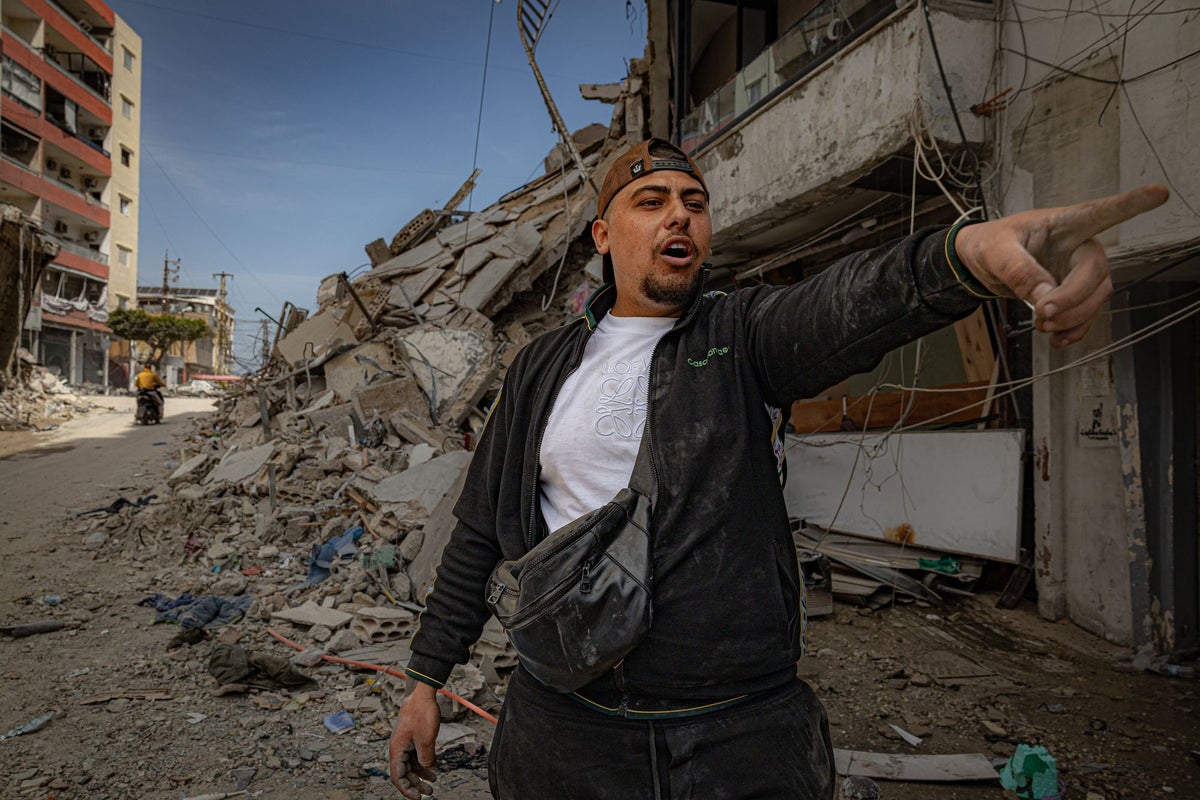
Modern warfare in the 21st century has a specific aesthetic. It is jagged. It is grey. When an Israeli airstrike hits a multi-story apartment building in a village like Meiss el-Jabal, the structure doesn't just fall. It folds. It becomes a "pancake collapse," a term engineers use to describe floors stacking upon each other, crushing everything in between—the wedding photos, the schoolbooks, the hand-woven rugs, and the people.
Since October 2023, the statistics have been climbing like a fever. Over 90,000 Lebanese civilians have been displaced from the south. That is not just a number. It is the population of a mid-sized city suddenly rendered homeless, drifting north toward Beirut or Sidon, cramming into classrooms-turned-shelters where privacy is a luxury of the past. They are the "internally displaced," a clinical term for people who have lost their anchors.
The destruction isn't collateral; it is total. Entire swaths of agricultural land, the literal lifeblood of the southern economy, have been incinerated. The use of incendiary weapons has turned ancient groves into blackened skeletons. This isn't just about the loss of this year’s crop. An olive tree takes twenty years to reach full productivity. To burn a grove is to delete twenty years of a family's future. It is a form of temporal warfare.
The Ghost Towns of the Frontier
Walking through these villages now feels like moving through a film set after the crew has vanished. In many towns within five kilometers of the Blue Line—the UN-demarcated border—the evacuation rate is nearly 100 percent.
The shops are shuttered, their metal grates scarred by shrapnel. In the squares where men used to play backgammon and argue over the price of diesel, there are only stray dogs and the occasional patrolled rumble of a Lebanese Army vehicle or a UNIFIL white truck. The Blue Helmets are still there, observing a peace that no longer exists, recording violations that no one seems able to stop.
The threat of a ground invasion hangs over the landscape like a coming storm that refuses to break. It creates a psychological Limbo. If you knew the house was gone for good, you could begin the grueling process of mourning. But when the house is still standing—yet unreachable, or perhaps missing its roof—you live in a state of suspended animation. You are a ghost haunting your own life from fifty miles away.
The Invisible Stakes
Why does this strip of land matter so much? To the strategist, it is a "buffer zone." To the politician, it is a "security necessity." But to the person who grew up there, it is the only place where the soil knows their name.
The tension between Israel and Hezbollah has turned the south into a laboratory of escalation. Each side measures their moves in a macabre dance of "proportionate response." A rocket here, a drone there, a targeted assassination in a moving car. But the "proportions" are lost on the grandmother who cannot find her heart medication in a crowded school basement in Beirut.
The real cost of the conflict isn't just the rubble. It is the erosion of the social fabric. South Lebanon has always been a mosaic of faiths—Shiite, Christian, Sunni, and Druze villages tucked into the folds of the hills. War has a way of sharpening the edges of identity, making neighbors look at each other through the lens of political affiliation rather than shared history. When the dust finally settles, the challenge won't just be rebuilding the bridges made of steel and stone, but the bridges made of trust.
The Logistics of Despair
Consider the reality of displacement. It is expensive to be poor, and it is even more expensive to be a refugee in your own country. Lebanon was already reeling from one of the worst economic collapses in modern history. The Lebanese Pound had lost over 95 percent of its value before the first rocket was even fired.
Now, families who were already skipping meals to pay for electricity are forced to rent apartments in the north at "war prices." Landlords, sensing the desperation, have hiked rents in safer areas. A one-bedroom apartment in a drab Beirut suburb that once cost $300 a month now goes for $800, cash only, paid in "fresh" US dollars that most southerners don't have.
Education has stopped for thousands of children. Schools in the south are either closed, damaged, or serving as dormitories for the displaced. A generation is missing its formative years, replaced by the education of the street and the siren.
The Looming Shadow
The rhetoric from the south of the border—from the Israeli government—has become increasingly focused on "clearing" the area to allow their own displaced citizens to return to Northern Israel. This creates a tragic symmetry. On both sides of the line, tens of thousands of people are staring at their homes from across a fence they cannot cross, victims of a geography they didn't choose.
A ground invasion would not be a surgical operation. The terrain of South Lebanon is a nightmare for conventional armies—a labyrinth of limestone caves, deep valleys, and dense brush. It is a landscape designed for guerrilla defense. If the tanks cross the line, the current destruction will seem like a prelude. The "nothing" that is left now will be replaced by a permanent scar.
Elias, the farmer, doesn't care about the high-level diplomacy in New York or Doha. He cares about the irrigation pipe he left unhooked. He worries about the goats he had to leave behind, wondering if anyone fed them or if they succumbed to the hunger. He sits on a thin mattress in a crowded hallway in Sidon, closing his eyes and trying to remember the exact shade of green his hills turn just before the sun dips into the Mediterranean.
He knows that even if the war ends tomorrow, he isn't going back to the home he left. He is going back to a memory. The walls might still be there, but the life that filled them has evaporated, scattered like ash in the southern wind.
The Mediterranean continues to lap at the shore of Tyre, indifferent to the madness a few miles inland. The waves don't care about borders. They don't care about "red lines" or "security corridors." They only know the rhythm of the earth, a rhythm that the people of South Lebanon are desperately trying to hear over the sound of the falling sky.
A scorched lemon tree stands in a courtyard in Dhayra, its fruit blackened and shriveled, clinging to a branch that no longer draws water from the earth.

.png?width=1200&auto=webp&trim=0%2C0%2C0%2C0)