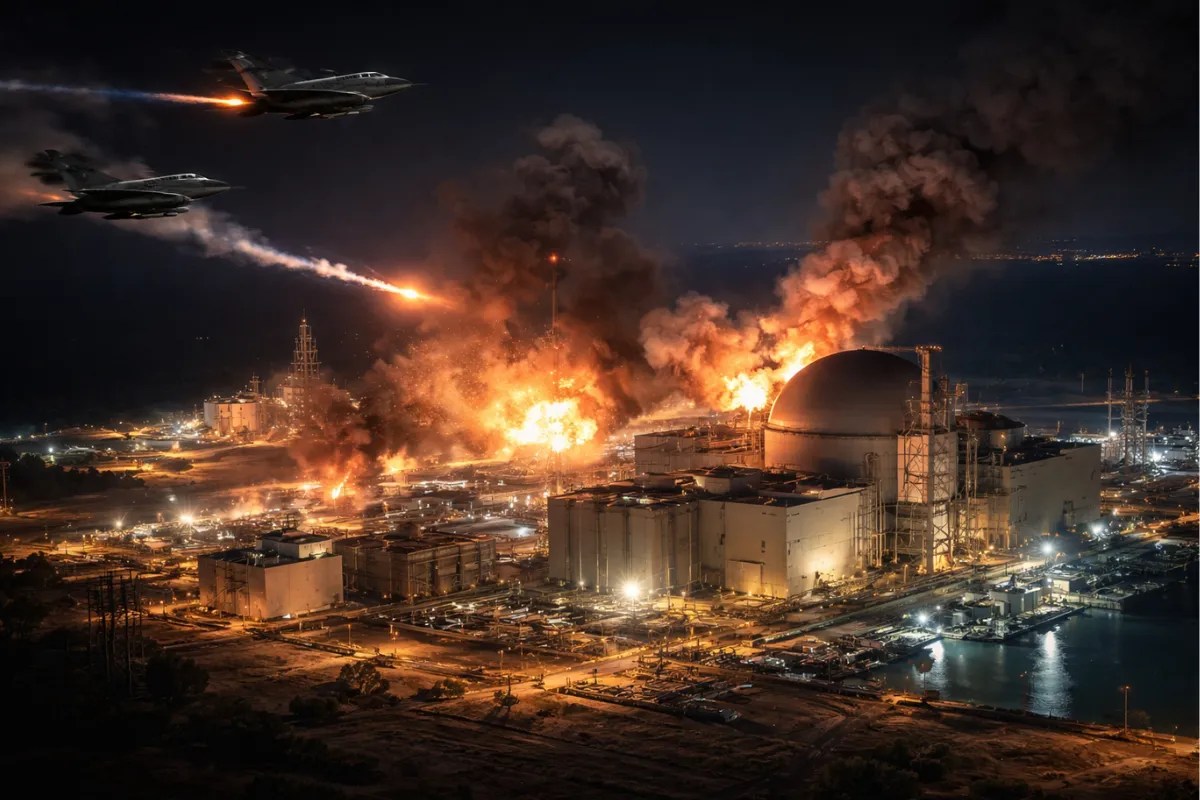
The air over the Karaj centrifuge facility usually tastes of dry dust and industrial exhaust. On that particular morning, it tasted of ozone and failure. When the quadcopter drones descended—angry, buzzing insects with a singular purpose—they didn't just strike a building. They shattered a fragile equilibrium that had kept the region’s shadow war from spilling into the sunlight.
Tehran didn't just see broken concrete or scorched machinery. They saw a signature. They saw the ghost of an adversary that moves through walls and bypasses radar. In the windowless rooms where Iranian military strategists gather, the map of the Persian Gulf changed that day. It stopped being a waterway of commerce and started looking like a series of pressure points.
The response was not a diplomatic cable. It was a list. Seven targets. Seven bridges. Seven ways to make the world bleed if the strikes on Iranian soil didn't stop.
The Geography of Retaliation
Imagine a merchant sailor standing on the deck of a tanker near the Strait of Hormuz. He is thinking about his family in Manila or Mumbai. He isn't thinking about uranium enrichment or the intricate dance of regional hegemony. Yet, he is the one standing on the bullseye.
Iran’s doctrine of "bridge for bridge" is a chillingly literal translation of the old law of lex talionis. If a centrifuge site in Karaj is crippled, then the infrastructure of the neighbors—those perceived to be providing the staging grounds or the intelligence for such strikes—becomes fair game. The logic is brutal. It says: If we cannot have our technology, you shall not have your stability.
The list leaked through Iranian media channels wasn't just a threat; it was a blueprint for a controlled regional heart attack.
Consider the King Fahd Causeway. It is a 15-mile stretch of steel and concrete connecting Saudi Arabia to Bahrain. On a Friday evening, it is a lifeline of tourists, workers, and goods. To a strategist in Tehran, it is a "soft target." It is a way to sever a kingdom from its island neighbor with a single, well-placed kinetic event. They aren't looking to win a war in the traditional sense. They are looking to prove that the cost of silence is higher than the cost of confrontation.
The Invisible Stakes of the Waterway
When we talk about "targets" in the Gulf, we often treat them as dots on a map. We forget the hum of electricity and the flow of water.
In the desert, water is more valuable than oil. Desalination plants dot the coastline of the United Arab Emirates and Saudi Arabia like glittering jewels. They are the only reason these cities exist. Without them, Dubai and Abu Dhabi return to the sand in a matter of days. Iran knows this. By listing these facilities as potential targets, they aren't just threatening infrastructure. They are threatening the very biological survival of millions of people who have nothing to do with the Mossad or the IRGC.
This is the psychological weight of the "Bridge for Bridge" policy. It is designed to create a specific kind of dread in the hearts of Gulf monarchs. It whispers: Your skyscrapers are glass, and we have the stones.
The technology used in the Karaj strike—likely small, agile drones that can be launched from within a country's borders—has democratized destruction. You no longer need a squadron of F-35s to cause a national crisis. You just need a backpack, a few lithium batteries, and a grudge. This shift in the "landscape" of warfare—though I loathe that word—is better described as the "gravity" of modern conflict. Everything is falling toward the cheap, the deniable, and the devastating.
The Human Cost of a Shadow Strike
Let’s look at a hypothetical engineer named Omar working at a refinery in the UAE’s Port of Fujairah.
Omar knows his facility is on the list. He watches the news reports from Karaj and sees the charred remains of the centrifuge parts. He understands that in the eyes of a distant general, his workplace is now a tit-for-tat variable. Every time a drone is spotted over an Iranian nuclear site, Omar’s hands shake a little more as he adjusts the valves on his pipeline.
This is how modern conflict works. It doesn't start with a declaration of war. It starts with the slow, agonizing erosion of a person's sense of safety. It is the realization that you are a pawn in a game played by people who will never know your name.
The Iranian list includes the Sheikh Jaber Al-Ahmad Al-Sabah Causeway in Kuwait. It includes the Port of Jebel Ali. These are symbols of the "Gulf Miracle," the rapid ascent of desert tribes to global financial powerhouses. By targeting them, Iran is attempting to strike at the ego and the bank accounts of its rivals. They are saying that the modern world is a fragile web, and they have the scissors.
The Paradox of Protection
The tragedy of this escalation is that there is no perfect shield.
The Gulf states have spent billions on Patriot missile batteries and sophisticated radar systems. But these are designed to stop high-flying scuds and fighter jets. They are less effective against a low-flying "suicide drone" that blends in with the thermal signatures of the desert heat.
When the Karaj facility was hit, it proved that even the most guarded sites in Iran were vulnerable. The "Seven Targets" list is Iran’s way of saying that they have mapped the vulnerabilities of their neighbors with equal precision. It is a Mexican standoff where everyone is holding a grenade with the pin already pulled.
The tension isn't just military. It's existential. The Gulf countries have spent decades rebranding themselves as centers of luxury, tourism, and "cutting-edge" (forgive the term) tech hubs. That brand relies entirely on the perception of absolute safety. You don't take a vacation to a city that might lose its water supply tomorrow because of a drone strike in a distant Iranian province.
The Logic of the Cornered
We often make the mistake of thinking of state actors as purely rational machines. They aren't. They are driven by pride, fear, and the need to save face.
The Karaj strike was an embarrassment for the Iranian security apparatus. To regain their standing at home, they had to project a terrifying level of strength abroad. The "Bridge for Bridge" rhetoric serves a domestic audience as much as an international one. It tells the Iranian public that their government can strike back, even if they choose not to do so immediately.
But what happens when the next drone hits?
What happens when the "shadow" part of the shadow war disappears?
If Iran follows through on even one of the seven targets, the cycle of escalation becomes a spiral. A strike on a Saudi bridge leads to a strike on an Iranian port. A strike on a port leads to the closing of the Strait of Hormuz.
Suddenly, the price of gas in a suburb in Ohio jumps by two dollars. The global supply chain, already wheezing, collapses. The "invisible stakes" become very visible, very fast.
The Echoes of Karaj
The ruins at Karaj have been cleared by now. New centrifuges are likely being moved in, perhaps deeper underground, perhaps protected by even more layers of steel. But the damage to the regional psyche is permanent.
We live in an age where the distance between a local sabotage and a global catastrophe is measured in millimeters. The "Seven Targets" list is a reminder that in the Middle East, there is no such thing as an isolated incident. Every action triggers a reaction that is often disproportionate and intentionally cruel.
The bridges of the Gulf are beautiful structures. They represent the ability of humanity to conquer the sea and connect disparate lands. But today, they look less like pathways and more like hostages.
The sailor on the tanker, the engineer at the refinery, and the commuter on the causeway are all waiting. They are looking at the sky, wondering if the next sound they hear will be the wind or the buzz of a motor. They are living in the gap between the strike and the retaliation.
It is a quiet, terrifying place to be.
The map is drawn. The coordinates are saved. The world watches the Persian Gulf not for the beauty of its sunsets, but for the smoke that might follow them. In this game of architectural chess, the next move won't be made with a pen, but with a trigger.
The bridges are standing. For now.