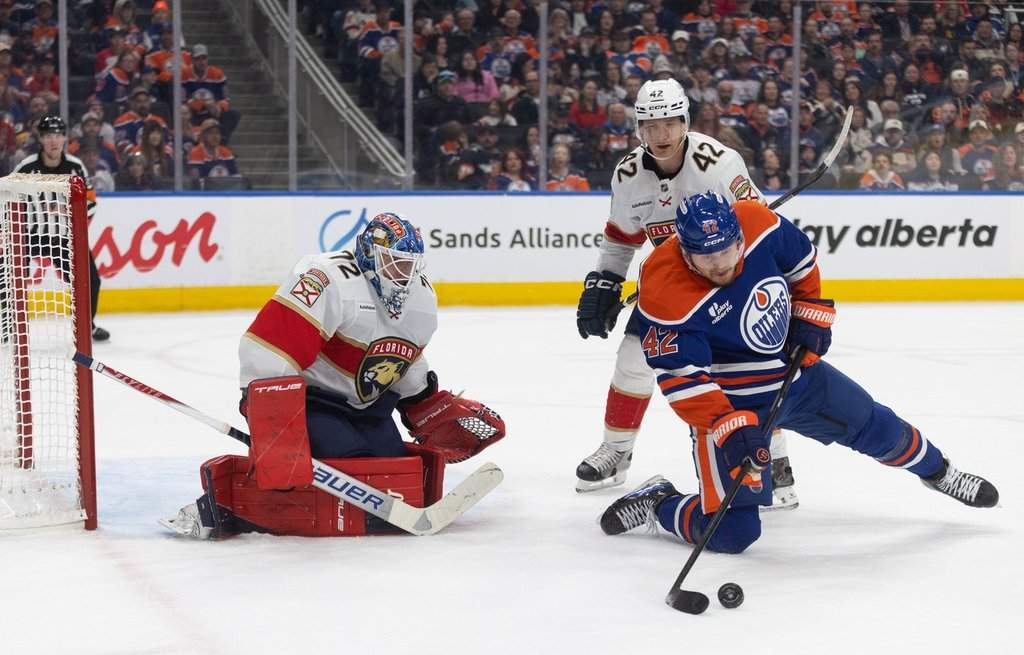
The scoreboard says 4-0. The box score says Sergei Bobrovsky is a god. The headlines say the Florida Panthers "blanked" the Edmonton Oilers.
They are all lying to you.
If you watched that game and came away thinking Bobrovsky put on a masterclass of goaltending, you fell for the oldest trick in hockey broadcasting. You fell for the "highlight reel" bias. You watched a series of desperate, sprawling saves and mistook them for elite performance. In reality, what we witnessed wasn't a goaltending clinic. It was a structural failure by Edmonton masked by a goaltender playing a high-stakes game of Russian roulette—and winning.
We need to stop praising "brick walls" and start analyzing the mechanics of how pucks actually reach the net.
The Myth of the Unbeatable Goaltender
Mainstream sports media loves a narrative. It’s easy to sell a "wall" or a "thief." It’s much harder to explain shot suppression metrics and defensive layering. The consensus after Game 1 of the 2024 Stanley Cup Final was that Bobrovsky "stole" the game.
He didn't steal it. Edmonton gave it away through shot selection that would make a junior varsity coach weep.
Bobrovsky made 32 saves. On paper, that’s impressive. On the ice, 20 of those were "low-danger" perimeter shots that any professional goaltender is paid to stop in their sleep. When you look at the Expected Goals ($xG$) for that game, Edmonton should have scored at least three times. But $xG$ is a measure of probability, not a guarantee of intelligence.
The Oilers didn't lose because Bobrovsky was perfect. They lost because they played directly into the specific type of chaos that Bobrovsky thrives on. He is an instinctual, reactionary goalie. He isn't a "positional" master like Carey Price was or Henrik Lundqvist. Bobrovsky is a scrambler. When you shoot from the point with no screen, or you take a weak backhand from the circle, you aren't "testing" him. You are helping him find his rhythm.
The Structural Illusion of the Florida Panthers
Everyone talks about Florida’s "suffocating defense." I’ve spent years breaking down defensive zone exits and neutral zone traps. Florida doesn't suffocate; they bait.
They allow a high volume of shots from specific, non-threatening areas to funnel the game into a predictable flow. They know that if they can keep the opposition on the outside, Bobrovsky’s save percentage will skyrocket, and the opposing stars will grow frustrated.
- The Perimeter Trap: Florida gave Edmonton the wings. They said, "Take all the 40-footers you want."
- The High-Slot Vacuum: They collapsed their defensemen into the "house," ensuring that even if Bobrovsky gave up a rebound—which he does, constantly—there was a Panther there to clear it.
- The Frustration Factor: Connor McDavid and Leon Draisaitl are used to picking corners. When they see a goalie making "miracle" saves, they start over-passing. They start looking for the "perfect" play instead of the dirty one.
The "4-0" scoreline is a farce. It suggests a blowout. It was actually a game of inches where Florida’s defense hid Bobrovsky’s biggest weakness: his lack of rebound control.
High Danger vs. High Volume
If you want to understand why the "Bobrovsky was perfect" narrative is dangerous, you have to look at the Shot Quality Spectrum.
Imagine a scenario where a goalie faces 50 shots. Forty-nine are from center ice. One is a breakaway. He stops all 50. Is he a legend? No. He’s a guy who did his job once and stood still for the rest.
In Game 1, Edmonton had several high-danger chances. But let’s be honest about what those "chances" looked like. Most were individual efforts where the shooter didn't change the angle or force Bobrovsky to move laterally. A goaltender’s greatest enemy is lateral movement ($X-axis$ displacement). If you don't make Bobrovsky move across the crease, he is statistically one of the best in history. If you make him move, he becomes a league-average backup.
Edmonton played a "north-south" game against a goalie who is built to stop "north-south" pucks. It wasn't greatness; it was a mismatch in tactical philosophy.
Why the Oilers Are Actually in a Better Spot Than You Think
The "People Also Ask" section of your brain is probably wondering: "How can the Oilers win if they can't beat Bobrovsky?"
The premise of that question is flawed. They can beat him. They already did—they hit posts, they missed open nets, and they forced him into positions where he was beat. The puck just didn't go in. Variance is a brutal mistress in the NHL playoffs.
If I were in the Oilers' locker room, I wouldn't be talking about Bobrovsky at all. I’d be talking about the "Third Man In" on the forecheck. Florida’s defense is aggressive because they trust the "wall" behind them. If Edmonton stops shooting for the chest and starts shooting for the pads to create chaotic rebounds, that "wall" will crumble.
The Problem With Modern Goaltending Analysis
We have become lazy. We see a shutout and we stop thinking. We see a 0 on the scoreboard and we assume the defense was flawless.
True expertise requires looking at the "Hidden Goals." These are the plays where a defenseman ties up a stick, or a forward blocks a shooting lane, or a goalie is simply lucky that a puck took a weird bounce off a skate. In that 4-0 game, Bobrovsky had at least three "lucky" moments where the puck was behind him and simply didn't cross the line.
- Moment A: The scramble in the first period where the puck sat in the crease for two seconds.
- Moment B: The cross-bar ring that would have changed the momentum entirely.
- Moment C: The missed tap-in on the power play.
None of those have anything to do with Bobrovsky’s skill. They are the product of the "Chaos Variance" that sports fans refuse to acknowledge because it ruins the "destiny" narrative.
The Professional’s Take on "The Wall"
I’ve seen teams burn $10 million a year on goalies because of one hot playoff run. It’s the fastest way to ruin a franchise. You don't pay for the shutouts; you pay for the consistency. Bobrovsky is the most inconsistent elite goalie in the modern era. He can be a Vezina winner one night and a sieve the next.
By crowning him after one game, the media creates a psychological "boogeyman." They make the Oilers believe they are playing against a ghost. They aren't. They are playing against a 35-year-old man who relies on athleticism that is inevitably fading.
If you want to win, you don't "try harder" to beat the goalie. You ignore him. You play the system. You force the defense to move. You create 2-on-1s in the low slot.
The Brutal Truth
The Florida Panthers didn't win 4-0 because of Sergei Bobrovsky. They won 4-0 because they are a more disciplined team that understands how to exploit the ego of "superstar" shooters. They let Edmonton feel like they were dominating while quietly ushering them into the low-percentage zones.
Stop looking at the glove saves. Start looking at the feet of the defensemen. That’s where the game was won.
Bobrovsky didn't blank the Oilers. The Oilers blanked themselves.
Stop worshiping the mask and start watching the game. If you think Game 1 was a goaltending masterclass, you aren't an insider; you're a spectator. And spectators are the ones who lose money in Vegas.
The next time you see a "perfect" performance, ask yourself one question: How many times did the goalie actually have to think? Against Edmonton in Game 1, Bobrovsky didn't have to think once. He just had to react to a team that forgot how to play smart hockey.
Change the angle. Change the narrative.
Shoot for the five-hole. It’s open. It’s always been open. Luck just hasn't noticed yet.