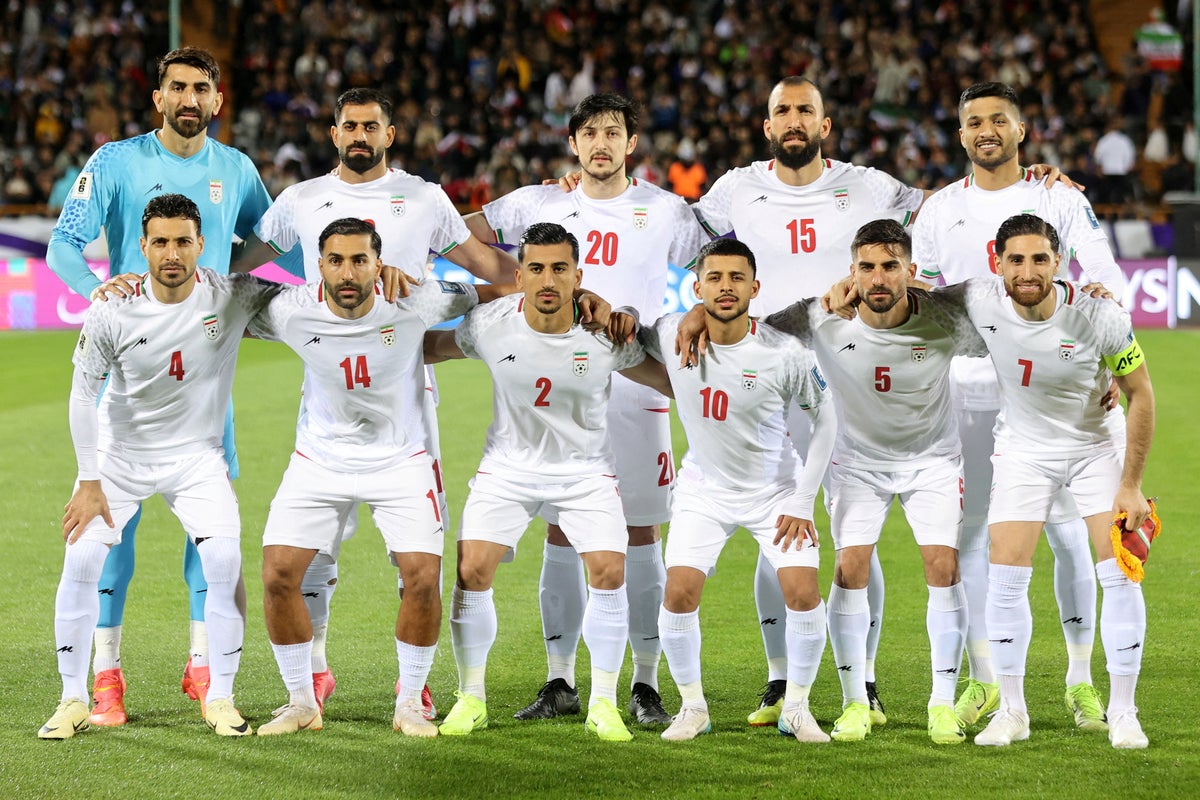
The removal of Sardar Azmoun from the Iranian national football team represents a case study in the tension between individual brand equity and state-managed athletic assets. While media reports frequently characterize such dismissals as "disloyalty," an objective analysis reveals a systematic collision between two irreconcilable models: the decentralized, globalized athlete and the centralized, ideological state apparatus. This friction is not merely a matter of personality; it is a structural failure of alignment between the player's external socio-political obligations and the domestic federation's internal stability requirements.
The Triad of State-Athlete Alignment
For high-profile athletes representing nations with centralized governance, participation in international competition is governed by three primary pillars of alignment. When an athlete deviates from these, the state often perceives the deviation as a net loss in soft-power utility, leading to removal.
- Ideological Uniformity: The expectation that the athlete serves as a silent vessel for the state’s preferred narrative.
- Operational Subordination: The requirement that team hierarchy and federation directives override personal stances or external pressures.
- Risk Mitigation: The calculation of whether an athlete's presence creates more domestic unrest or international embarrassment than their performance on the pitch provides in value.
In the instance of Azmoun, his social media activity and public stances regarding civil rights in Iran directly compromised the first two pillars. This forced the Iranian Football Federation (FFIRI) into a cost-benefit calculation where the "Sporting Output" was weighed against "Political Liability."
The Performance-Liability Function
The decision to exclude a premier talent like Azmoun—a striker with a proven goal-scoring record in European leagues—follows a predictable logic of diminishing returns. We can conceptualize this through a Performance-Liability Function:
$$V = P - (L \times S)$$
In this equation, $V$ represents the net value of the player to the state, $P$ is their sporting performance (goals, assists, marketability), $L$ is the political liability they generate, and $S$ is the sensitivity of the current domestic climate.
When domestic social tension ($S$) is high, the weight of any political liability ($L$) is amplified. Even if $P$ is exceptionally high—as is the case with a player of Azmoun's caliber—the negative value generated by $(L \times S)$ can exceed the sporting benefit. The federation’s move to label the exclusion as a result of "disloyalty" or "disciplinary issues" is a strategic attempt to frame a political calculation as an operational necessity.
Mechanisms of Institutional Control
The Iranian national team, often referred to as Team Melli, serves as a significant cultural pillar. The federation uses several mechanisms to maintain control over this asset, which were evidently applied or bypassed in the Azmoun scenario.
- The Code of Conduct as a Variable Constraint: National teams utilize "codes of conduct" not as static rules, but as elastic tools for selective enforcement. Actions that might be ignored during periods of political stability become grounds for dismissal during periods of unrest.
- Media Filtration: By leaking reports of "disloyalty" to semi-official news agencies, the institution controls the initial framing of the conflict. This forces the athlete into a defensive posture, where they must choose between silence (acceptance of the narrative) or further dissent (which reinforces the "disloyal" label).
- Asset Isolation: By removing a star player, the federation signals to the rest of the squad that the "system" is more important than any individual "part." This creates a chilling effect designed to restore operational subordination across the remaining roster.
The Conflict of Globalized Brand Equity
Azmoun’s career in the Russian Premier League and the German Bundesliga provided him with a level of financial and social autonomy that domestic-based players lack. This "Globalized Brand Equity" creates a specific type of leverage.
For an athlete restricted to domestic leagues, the federation is a monopsony—the sole buyer of their labor and the sole gatekeeper of their career. For Azmoun, the federation is merely one of several stakeholders. His primary economic value is generated in Europe, meaning the "Cost of Dissent" is lower for him than for a teammate playing in Tehran. This economic reality creates an inherent instability in the state-athlete relationship; the state can no longer use professional ruin as a primary deterrent.
Calculating the Sporting Opportunity Cost
The exclusion of a top-tier striker introduces a specific set of tactical and statistical deficits that the FFIRI must now mitigate. Azmoun’s role in the national team was defined by high-efficiency finishing and a specific spatial intelligence that allowed him to interact with midfielders like Mehdi Taremi.
- Conversion Rate Erosion: Azmoun’s career goals-per-game ratio for the national team is significantly higher than the domestic replacements. His absence creates a statistical "Goal Gap" that requires the team to increase its total "Chances Created" by approximately 25% to maintain the same expected goals (xG) output.
- Tactical Rigidity: Without a mobile, elite-level striker, the team is forced into a more defensive, counter-attacking posture. This reduces their ability to dictate the tempo of matches against high-tier international opponents.
- Psychological Dissonance: The removal of a popular figure creates a rift within the squad’s internal chemistry. The remaining players must navigate a high-stress environment where their focus is split between tactical execution and political self-preservation.
The Limits of Selective Enforcement
The primary limitation of the federation's strategy is the "Sunk Cost of Talent." While removing Azmoun solves a short-term political friction, it degrades the long-term probability of sporting success. If the team fails to perform in upcoming qualifiers or tournaments, the narrative of "disloyalty" will likely flip, with the public viewing the federation’s decision as an act of self-sabotage.
Furthermore, this strategy assumes that the "Liability" ($L$) can be removed by simply removing the player. In the digital age, an excluded athlete often becomes a more potent symbol of dissent precisely because they are no longer bound by the team’s media protocols. The federation risks transforming a "managed distraction" into an "unmanaged icon."
Strategic Recommendation for National Sporting Bodies
Organizations facing similar athlete-activist challenges must shift from a model of Punitive Exclusion to a model of Managed Integration. The current Iranian approach relies on a binary "Compliance or Removal" logic that is increasingly ineffective against globalized athletes.
A more sophisticated framework would involve:
- Direct Dialogue Channels: Establishing non-public avenues for athletes to express grievances, reducing the need for public social media outbursts.
- Neutral Branding: Decoupling the national team’s identity from specific government policy, allowing the team to exist as a "cultural neutral" space.
- Objective Disciplinary Benchmarks: Transitioning from vague concepts like "loyalty" to specific, quantifiable performance and behavior metrics to ensure that any disciplinary action is viewed as legitimate by the public and the squad.
The immediate strategic play for the Iranian Football Federation is to establish a "Pathway to Reinstatement." By defining specific, non-political conditions under which Azmoun could return (such as a focus on "sporting unity"), the federation can regain leverage without appearing to capitulate. Failure to create this bridge will result in a permanent degradation of the team’s competitive ceiling and a continued escalation of the PR deficit.