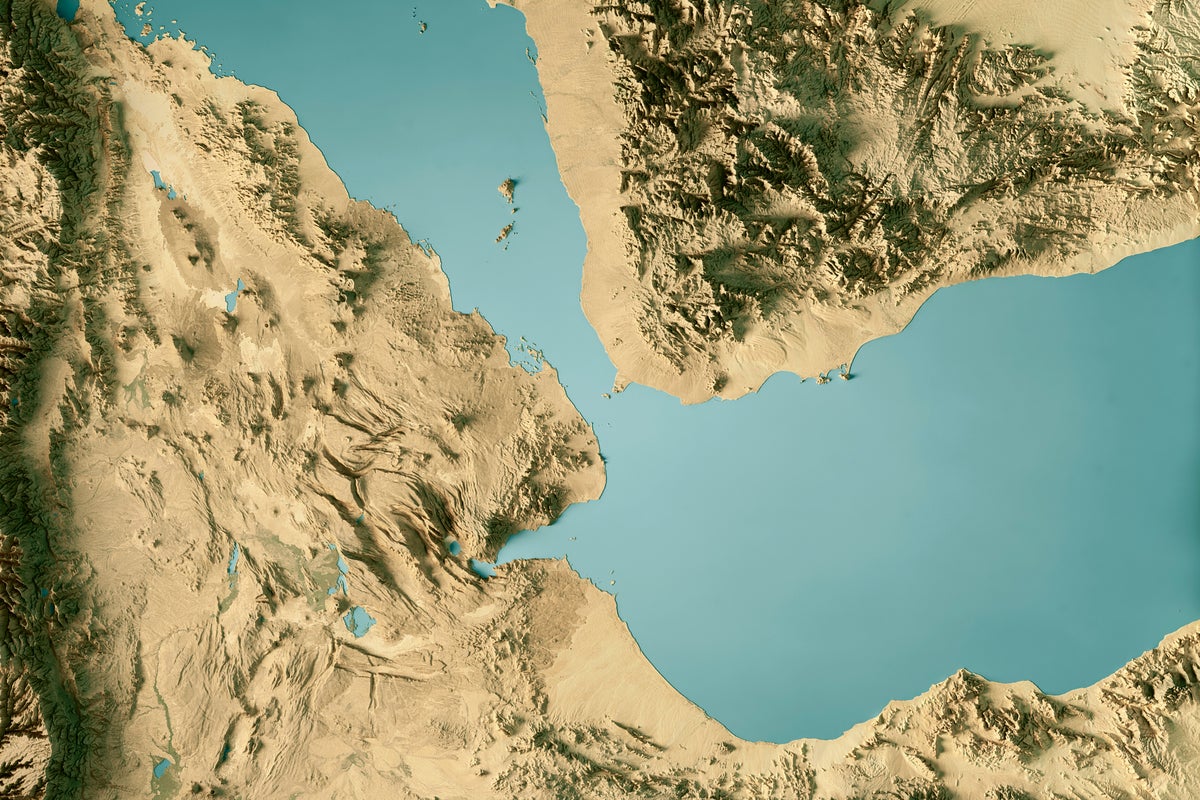
The Bab el-Mandeb Strait is a narrow strip of water that handles roughly 12% of global trade and 30% of container traffic. When Houthi rebels began launching drones and anti-ship missiles at commercial vessels, they didn't just target steel hulls; they punctured the myth of a friction-less global economy. For decades, the shipping industry operated on the assumption that the high seas were a neutral, safe common. That era is over. The immediate impact is a massive spike in freight rates and insurance premiums, but the deeper crisis is a structural breakdown in the "just-in-time" manufacturing model that defines modern life.
The Geography of Vulnerability
The Strait is a tactical nightmare. At its narrowest point, it is only 18 miles wide. This proximity to the Yemeni coast allows a relatively low-tech insurgency to hold the world’s most advanced logistics networks hostage. By forcing ships to divert around the Cape of Good Hope, the Houthis have effectively added 3,500 nautical miles and 10 to 14 days to every voyage between Asia and Northern Europe.
This isn't just about longer wait times for consumer electronics. It is about fuel. A massive container ship burning heavy fuel oil for an extra two weeks creates a staggering increase in overhead. When you multiply that by thousands of diverted vessels, the cost is passed directly to the consumer. We are seeing a forced decoupling of markets that were previously inseparable.
The Mathematical Collapse of Just In Time
Modern supply chains are built on thin margins and precise timing. Companies like IKEA or Tesla don't keep months of inventory sitting in warehouses; they rely on the ocean being a conveyor belt. When that belt jerks or stops, the ripple effects are non-linear.
Consider the math of a standard vessel diversion.
- Transit Time Increase: 40%
- Fuel Consumption Increase: Approximately $1 million per round trip
- Container Availability: Decreases because boxes are stuck on ships for longer durations, creating a shortage at export hubs like Shanghai.
The result is a "phantom" inflation. Even if demand for goods remains flat, the cost of moving them rises so sharply that price hikes become inevitable. This is how a local conflict in the Gulf of Aden turns into a price hike at a grocery store in Berlin or a car dealership in New Jersey.
Why Naval Escorts Aren't a Magic Bullet
The U.S.-led "Operation Prosperity Guardian" was intended to restore confidence. It hasn't. The reason is simple economics and physics. An interceptor missile used by a destroyer to down a Houthi drone can cost $2 million. The drone itself might cost $20,000. This is an asymmetrical war where the defenders are being bled dry financially while the attackers only need one lucky hit to shut down the route for a week.
Insurance companies understand this math. They have hiked "war risk" premiums to the point where sailing through the Red Sea is a gamble that many boards of directors are no longer willing to take. It’s not just about the ship sinking; it’s about the legal and environmental liability of a catastrophic oil spill or the loss of $500 million in cargo. The maritime industry is notoriously conservative. Once a route is deemed "unstable," it takes years of sustained peace to bring the old traffic volumes back.
The Illusion of Alternative Routes
There is a lot of talk about the "Middle Corridor" or rail links through Central Asia. These are distractions. Rail cannot handle the sheer volume of a single Triple-E class container ship, which can carry 20,000 twenty-foot equivalent units (TEUs). To move the cargo of one ship by train, you would need dozens of locomotives and thousands of rail cars, all crossing multiple borders with different customs regulations.
The only real alternative is the Cape of Good Hope, which is currently seeing a gold-rush style surge in bunkering demand in South African ports. But those ports weren't built for this. They are clogged. Ships are waiting for days just to refuel. This creates a secondary bottleneck that the initial market projections failed to account for. We are looking at a permanent shift in how companies calculate risk.
The Energy Security Trap
While containers get the headlines, tankers move the world. Europe, having spent the last two years trying to wean itself off Russian gas, is now heavily reliant on Middle Eastern LNG and oil. Much of that flows through the Suez Canal. If the Bab el-Mandeb remains a no-go zone, the energy security of the Eurozone is tied to a 10-day longer shipping route. This makes the energy market hypersensitive to any news out of Yemen.
The real danger is a "normalization" of this chaos. If shipping companies decide that the Red Sea is permanently high-risk, they will stop building ships optimized for the Suez Canal's dimensions and start building for the open, rougher waters of the South Atlantic. This would be a generational shift in naval architecture and global trade routes, effectively shrinking the global economy by making every transaction more expensive and slower.
Software Can't Fix Hardware Problems
Silicon Valley likes to claim that AI-driven logistics and predictive analytics can "optimize" away these disruptions. That is a fundamental misunderstanding of the physical world. You cannot optimize a ship through a zone where missiles are flying. You cannot use an algorithm to make a vessel travel faster than its hull speed allows without burning through your entire profit margin in fuel.
The crisis has exposed the fragility of the digital-first mindset. We have spent twenty years optimizing for speed and efficiency while ignoring resilience. Now, the bill is due. Companies are being forced to move from "Just in Time" to "Just in Case," which means holding more inventory, which means higher costs, which means the era of cheap, globalized goods is effectively hitting a wall.
The New Maritime Reality
The Houthis have provided a blueprint for any non-state actor or small nation sitting on a maritime chokepoint. They have proven that you don't need a billion-dollar navy to disrupt the global order; you just need a few hundred drones and the willingness to use them. This is the democratization of commerce destruction.
Ship owners are now looking at the Strait of Malacca, the Strait of Hormuz, and even the Panama Canal with new eyes. The Red Sea is not an isolated incident; it is a proof of concept. The global economy is currently built on a foundation of safe passage that no longer exists.
Move your manufacturing closer to your end-market or prepare to pay a "chaos tax" on every component you import. The era of the long-distance supply chain is being dismantled by low-cost munitions and the cold reality of geography. Diversifying your suppliers doesn't matter if they all have to send their goods through the same 18-mile-wide target.
Stop looking for a return to the old normal. That version of the world required a level of global cooperation and naval dominance that has evaporated. The future of trade is regional, expensive, and far more precarious than any spreadsheet currently accounts for.