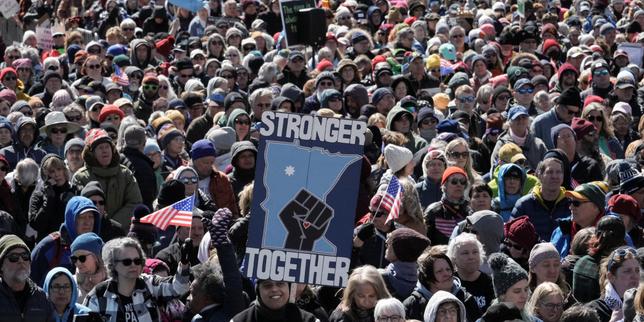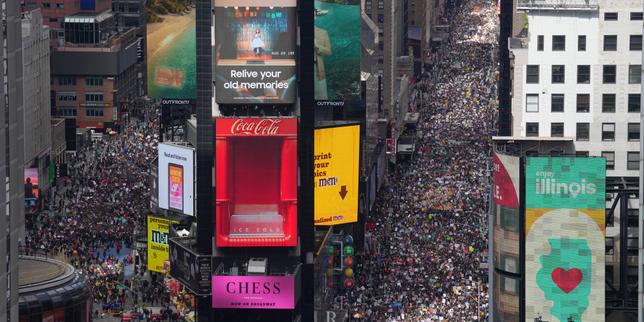
The largest coordinated protest in American history did not start with a manifesto. It started with a crown. On March 28, 2026, millions of Americans flooded the streets of over 3,000 cities in the third "No Kings" mobilization, a movement that has metastasized from a niche progressive outcry into a broad, multi-class rejection of the second Trump administration. While the images of papier-mâché effigies and paper crowns suggest a carnival atmosphere, the reality on the ground is far more grim.
The "No Kings 3" rallies were triggered by a volatile cocktail of state-sanctioned violence, an unpopular war in Iran, and a pervasive sense that the constitutional guardrails have finally snapped. What the headlines often miss is that this isn't just about partisan tribalism. It is a desperate, decentralized response to "elite collapse"—the perceived capitulation of traditional institutions like the judiciary and the media to an unchecked executive branch.
The Architecture of Defiance
The No Kings movement is intentionally designed to be a "container." It lacks a singular leader, a central headquarters, or even a unified list of policy demands. Instead, it serves as a massive, amorphous framework that allows disparate groups—from labor unions in Minnesota to immigrant rights activists in Los Angeles—to plug in their specific grievances under one banner.
The name itself is a direct jab at the Supreme Court’s landmark 2024 immunity ruling and the subsequent "monarchical" rhetoric from the White House. This wasn't a choice made for aesthetics. It was a strategic branding move by the 50501 movement and Indivisible to simplify a complex legal crisis into a visceral, American instinct: the rejection of a throne. By framing the struggle as "Presidents vs. Kings," organizers tapped into a historical narrative that resonates even in traditionally conservative pockets of the country.
Why Minnesota became the Epicenter
While Washington D.C. saw massive crowds, the true heart of this iteration was the Twin Cities. The choice of St. Paul as the flagship site was a calculated move. Minnesota has become a flashpoint for the movement following Operation Metro Surge and a subsequent general strike in January. The deaths of Renée Good and Keith Porter during immigration enforcement operations turned a political protest into a funeral march.
In the Twin Cities, an estimated 200,000 people surrounded the state capitol. This wasn't just a coastal elite phenomenon. The presence of figures like Bruce Springsteen and Bernie Sanders provided the star power, but the energy came from the rank-and-file workers and students who had spent weeks organizing mutual aid and "ICE watch" networks. This shift from symbolic marching to direct, local organizing is what makes this movement different from the 2017 Women’s March.
The Cost of the Iran Front
Foreign policy rarely drives domestic protests in the United States, but the one-month-old war in Iran has changed the math. The No Kings 3 protests were the first major rallies since the conflict began. For many, the war is the ultimate proof of the "king" narrative—an executive launching a massive military operation with minimal congressional oversight and a high human cost.
Protesters in Philadelphia and Boston were not just carrying signs about democracy; they were shouting about the funding of war while domestic budgets for medical research and education face deep cuts. The "No kings, just vaccines" slogans outside the NIH headquarters in Bethesda highlight this pivot. The movement has successfully linked the "authoritarian" style of governance at home with "senseless war" abroad, creating a unified theory of opposition that is harder for the administration to dismiss as mere "woke" activism.
The 3.5 Percent Rule
Organizers are obsessed with the "3.5% rule," a political science theory suggesting that no government can withstand a challenge from 3.5% of its population if they are actively and nonviolently engaged. With the October 2025 rallies reportedly drawing 7 million people, the movement is approaching that threshold.
However, the lack of a formal hierarchy is a double-edged sword. While it makes the movement harder to "decapitate" through arrests or intimidation, it also makes it difficult to negotiate. Unlike the Civil Rights Movement, which had clear leaders who could sit at a table and demand specific legislative wins, the No Kings rebellion is currently a roar without a specific ask. It is an expression of pure, unadulterated rejection.
The Crackdown and the Fallout
The administration's response has been characteristically blunt. In previous rounds, the deployment of the National Guard to cities like Los Angeles and the use of tear gas in Seattle only served as recruitment tools for the movement. The irony is that the more the executive branch acts with "monarchical" force to suppress the protests, the more it validates the "No Kings" premise.
The movement is now facing a pivotal transition. Mass mobilizations are exhausting. They are expensive, logistically taxing, and carry the constant threat of escalation. There is already a growing divide between those who want to maintain the "big tent" of peaceful protest and more radical factions pushing for general strikes and tax resistance.
The success of the No Kings movement won't be measured by the size of the crowds in March 2026, but by what happens when the people go home. If this energy can be funneled into the "relay race" of local organizing—voter registration, legal defense, and labor actions—it could fundamentally reshape the American political landscape. If it remains just a series of weekend marches, it risks becoming another footnote in a history of missed opportunities.
The millions in the streets are betting that the crown is heavier than it looks.