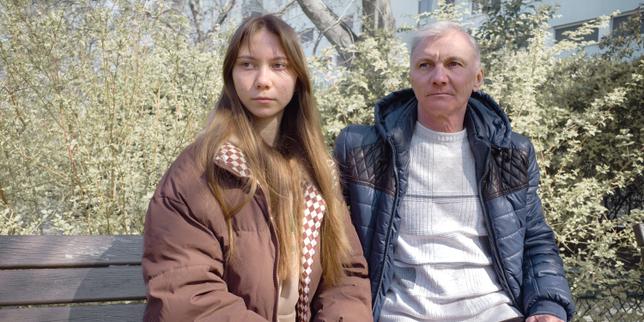
Western media loves a martyr. They especially love one with a crayon. The story of Aleksei Moskalyov and his daughter Masha—fleeing Russia after a "subversive" school drawing—is the perfect narrative fuel for a news cycle addicted to moral clarity. It fits the script: a cruel regime, an innocent child, a heroic escape to France. But if you think this is a story about a drawing, you’ve been played.
The "drawing that broke the camel's back" is a convenient fiction. It simplifies the brutal, grinding machinery of geopolitical friction into a Disney-esque struggle between art and autocracy. We are being sold a sentimentalized version of reality that ignores the cold mechanics of how modern states actually operate—and how the West uses these stories as low-cost ideological ammunition while ignoring the systemic failures at home.
The Fetishization of the "One Brave Act"
We need to stop pretending that a single sketch of a rocket and a flag caused the collapse of a family's life in Russia. To believe that is to fundamentally misunderstand how the Russian internal security apparatus works. In my years tracking geopolitical shifts and state-level surveillance, I’ve seen thousands of "political" incidents. The FSB doesn't move its heavy machinery for a sixth-grader’s doodle unless there is already a file open.
The drawing was the trigger, not the cause. By focusing on the art, the media hides the reality of cumulative dissent. Moskalyov was already on the radar for social media comments. The state wasn't scared of a picture; they were looking for a pretext to enforce social cohesion during a period of existential conflict.
When we frame this as "The Girl Who Drew Peace," we strip the situation of its political weight. We turn a complex struggle for survival in a high-pressure state into a viral headline. It’s lazy journalism. It’s cheap empathy.
The Asylum Aesthetic vs. The Asylum Reality
France welcoming the Moskalyovs is a PR victory for the Quai d'Orsay. It’s a way for a Western power to signal its "values" without actually changing a single line of its increasingly restrictive immigration policy.
Let's look at the numbers. While the media celebrates this one high-profile case, thousands of other Russian dissidents—people without a viral backstory—are stuck in bureaucratic limbo in Georgia, Armenia, or Kazakhstan. They don't have a "drawing" to sell to the press. They just have a quiet, persistent refusal to live under a war footing.
France’s "generosity" here is selective. It is performed humanitarianism.
- The Hero Narrative: High visibility, fast-tracked paperwork, photo ops.
- The Statistical Reality: Thousands of legitimate asylum seekers rejected annually because their stories lack "media potential."
I’ve seen this pattern repeat from the Cold War to today. We pluck the most "marketable" victims from the fire and leave the rest to burn, all while patting ourselves on the back for our enlightened stance. If you think the Moskalyovs’ arrival in France represents a win for human rights, you’re missing the forest for the one tree the cameras are pointed at.
The Sophistry of "Free Speech" Abroad
The irony of this coverage is staggering. Western pundits use the Moskalyov case to decry Russian censorship while simultaneously pushing for tighter controls on "misinformation" and "hate speech" in their own backyards.
In Russia, the red line is "discrediting the army." In the West, the red line is constantly shifting, managed by algorithmic shadow-banning and social ostracization. The mechanisms are different—prison vs. de-platforming—but the goal is identical: the maintenance of the prevailing narrative.
Don't mistake this for a "both sides" argument. Russia’s physical repression is objectively more brutal. However, the smugness with which we consume these stories suggests we believe we are immune to state-enforced conformity. We aren't. We just have better aesthetics for our propaganda.
The Myth of the "Exile" Paradise
The article you read likely ends with the family finding "freedom" in France. This is where the story actually gets dark, and it’s the part the media won't touch.
Exile is a slow death for the political soul. When a dissident leaves their home country, they lose their leverage. They stop being a thorn in the side of the regime and start being a data point for a foreign government.
- Irrelevance: Once the initial press cycle dies down, the Moskalyovs will become just another immigrant family struggling with a language barrier and a foreign bureaucracy.
- Instrumentalization: They will be trotted out for anniversaries of the war to say the "right things" for Western audiences.
- Isolation: The Russian state wins the moment they leave. The dissent is exported. The problem is solved.
By encouraging and celebrating the flight of every visible dissident, we are effectively helping the Kremlin purge its internal opposition. We are providing a safety valve for the regime. Every "heroic escape" is a win for Putin’s internal security, because it removes the friction from the gears.
Why You Are Asking the Wrong Questions
People keep asking: "How could they do this over a drawing?"
The better question: "Why do we only care when there is a drawing?"
We have been conditioned to respond to individual tragedies because systemic failures are too hard to grasp. We want a face to pity because it makes us feel superior to the "barbaric" culture that produced the tragedy.
If you actually cared about the people trapped in Russia, you wouldn’t be cheering for their escape. You would be questioning why the international community has no strategy for supporting internal dissent other than "run away and tell your story to a French journalist."
The refugee status is a consolation prize. It is not a victory.
The Hard Truth About Geopolitical Storytelling
We need to stop consuming these stories as "news." They are morality plays designed to reinforce our existing biases. They tell us that we are the "good guys" and they are the "bad guys."
But in the real world, the "good guys" are currently weaponizing the plight of a father and daughter to distract from their own geopolitical inconsistencies. We are using their trauma as a low-cost way to claim the moral high ground while doing nothing to address the actual power structures that make such persecution possible.
Stop looking for the "drawing." Start looking at the budgets. Start looking at the visa statistics. Start looking at the reality of what happens to these families three years after the cameras stop clicking.
The next time you see a headline about a "persecuted artist" or a "brave child," ask yourself: who benefits from me feeling this specific emotion right now?
It’s almost never the refugee.
Burn the script. Stop buying the sentiment. The world isn't a gallery of political art; it’s a meat grinder of state interests. If you want to help, stop falling for the PR and start demanding a foreign policy that doesn't rely on turning human suffering into a Sunday supplement feature.
The Moskalyovs didn't escape a system. They just switched to a different part of the machine.