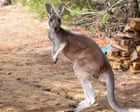
A 16-month-old kangaroo named Chesney escaped from a Necedah, Wisconsin petting zoo after scaling an eight-foot fence, triggering a frantic, multi-day search involving heat-seeking drones before his safe recovery on Saturday.
The story reads like a classic piece of small-town Americana. A beloved exotic pet gets spooked, bolts into the wild, the community rallies, and after a few days of tension, a happy ending is secured. But treating this as a simple feel-good animal interest piece misses a much larger, and significantly more complex, reality regarding the possession of exotic wildlife in the United States.
Chesney's flight from Sunshine Farm was not a random act of wanderlust. He was terrified. Two unfamiliar dogs rushed his enclosure and began barking aggressively, triggering a primal fight-or-flight mechanism. For a kangaroo, that means jumping. High.
The animal cleared a barrier that most would assume was insurmountable. This singular event exposes the massive gap between the natural defenses of wild animals and the artificial environments we construct to contain them.
The Illusion of Domestication
We like to think that raising an animal from a young age or keeping it in a home environment strips away its wild nature. Chesney lives in a house. He frequently wears diapers. He shares his living space with another kangaroo named Kenny, several dogs, and his caretaker, Debbie Marland.
To the human eye, this looks like domestication. To a biologist, it is a high-stakes balancing act.
Kangaroos are not domesticated animals. Domestication is a genetic process taking place over thousands of years and countless generations. It alters both the physical and behavioral traits of a species to make them more compatible with humans. Dogs are domesticated. Cats are domesticated. Livestock are domesticated.
Kangaroos are simply wild animals kept in captivity.
No matter how many diapers you put on a marsupial, you cannot override millions of years of evolutionary programming. When those dogs barked, Chesney did not look to his human keepers for protection. He relied on the explosive, powerful hind legs designed by nature to carry him away from predators in the Australian outback. He cleared an eight-foot fence because his biology demanded it.
The Search Grid and Technology Limits
Once Chesney cleared the fence, the true difficulty of managing exotic wildlife in rural America became glaringly obvious. Local law enforcement is not equipped to track a 40-pound marsupial capable of moving at 20 mph.
The search effort quickly turned to modern technology. Heat-sensing drones were deployed by Midwest Aerial Drone Services to scan the dense Wisconsin woods.
While the drones proved useful in narrowing down the search radius, they were not a magic bullet. Chesney eluded capture multiple times. On one occasion, the terrified animal even leaped into a freezing river to escape his pursuers, momentarily breaking the thermal lock the drone operator held on him.
This highlights a critical point often ignored in romanticized accounts of animal recoveries. Technology can find a displaced animal, but it cannot make that animal cooperate.
For days, searchers walked tens of thousands of steps. They tracked sightings. They surrounded him on Friday night, only to watch him bound away effortlessly. It was not high-tech gear that finally brought Chesney home on Saturday. It was scent, familiar voices, and sheer exhaustion.
When the searchers were ready to pack up and call off the immediate effort, Chesney simply walked up to them. He was hungry, tired, and likely realized that the woods offered far less comfort than the home he had known.
Regulatory Swiss Cheese
The legal structure surrounding the ownership of animals like Chesney is a patchwork of confusing, often contradictory local, state, and federal laws.
In some states, owning a kangaroo requires strict licensing, regular inspections, and insurance. In others, it requires little more than the purchase price and a willing seller.
The United States Department of Agriculture (USDA) regulates businesses that exhibit animals to the public, like petting zoos. But the standards for enclosures and security often focus on preventing the public from getting in, rather than preventing the animal from getting out.
Consider a hypothetical scenario where a small farm operates in a state with zero regulations on private possession of exotic pets. A person could legally buy a tiger, keep it in a chain-link fence, and as long as they do not charge people to look at it, they fall outside the purview of many federal exhibition laws.
This is the regulatory gray area that animal welfare advocates have been screaming about for decades.
Sunshine Farm appears to have a deep, genuine affection for its animals. Marland was clearly devastated during the search, putting in marathon walking sessions to find Chesney. They are now adding a mesh top to the kangaroo enclosure to prevent a repeat performance. But the question remains. Should a high-jumping wild animal from the Southern Hemisphere be held in a climate like Wisconsin in the first place?
The True Cost of the Exotic Aesthetic
The internet has fueled a massive demand for exotic animal content. Videos of kangaroos in clothing, playing with puppies, or acting like house pets generate millions of views and lucrative ad revenue.
This creates a dangerous feedback loop. People see these curated, adorable moments and decide they want an exotic pet of their own. They rarely see the destruction, the specialized dietary needs, the veterinary bills from specialized doctors, or the absolute terror an animal experiences when its wild instincts collide with human infrastructure.
Let's look at the financial reality of the situation at Sunshine Farm. Marland noted that a fan has written a children's book about Chesney's adventures. She hopes to publish and sell this book specifically to recoup some of the massive costs incurred during the three-day search.
Keeping exotic animals is not just a heavy emotional lift; it is a financial drain. When things go wrong, the costs skyrocket.
Chesney is lucky. He didn't get hit by a car on a dark Wisconsin road. He wasn't torn apart by a pack of local coyotes. He didn't die of hypothermia in a freezing river. He is back home, and by all accounts, healthy.
But the happy ending in Necedah should not be used to justify the practice. It should be used as a warning. We dodged a bullet this time. The next community might not be so lucky when a wild animal decides to remind us exactly what it is.