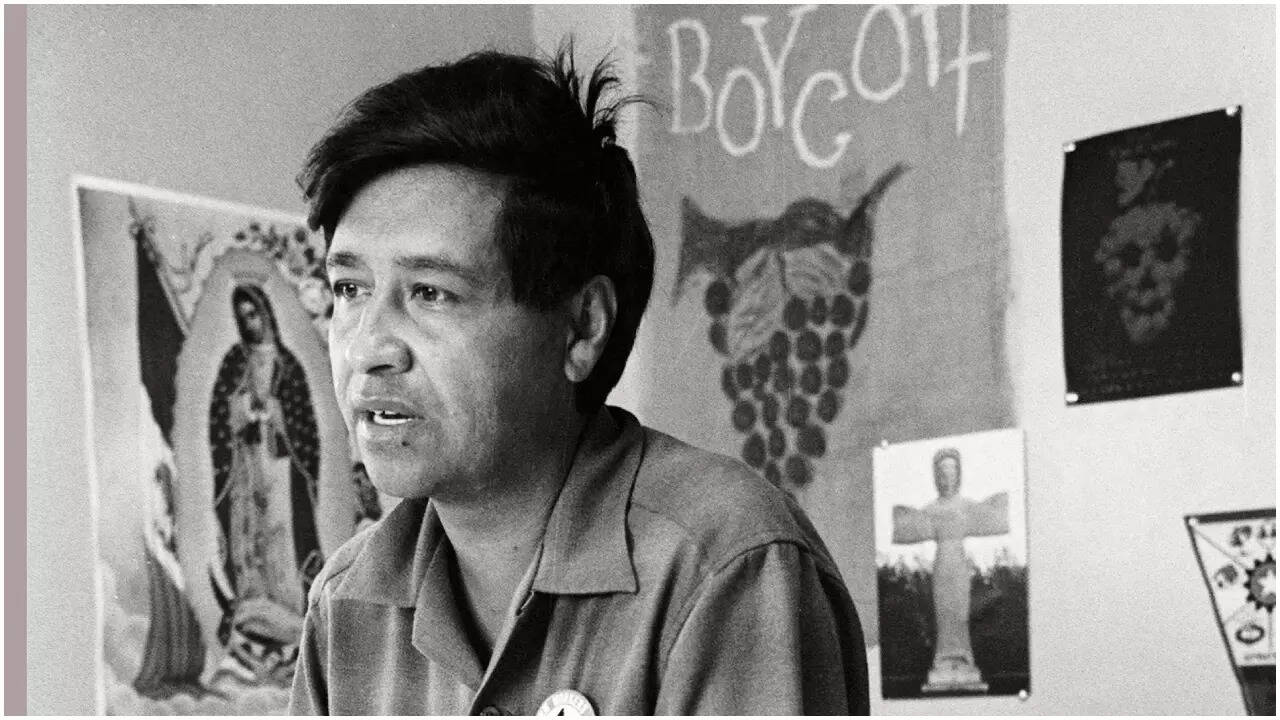
Walk down certain corridors in California today and you'll notice something missing. The vibrant reds and blacks of United Farm Workers (UFW) murals are fading, not just from sun exposure, but from a deliberate shift in how cities curate their history. It’s a strange moment. While the state celebrates Cesar Chavez Day every March, the physical markers of his legacy are being quietly dismantled or painted over. We’re witnessing a slow-motion erasure that says more about California’s current political priorities than it does about its past.
This isn't just about old paint. It's about who owns the narrative of the Central Valley and the coastal cities that once championed the labor movement. When a mural of Chavez is replaced by a modern, "neutral" geometric design, or when a statue is moved to a less prominent location under the guise of "renovation," a specific type of history is being archived permanently.
Why the Symbols are Vanishing
The removal of these icons usually happens behind the scenes. It’s rarely a loud, televised event with protesters. Instead, it’s a bureaucratic decision made during a city council meeting or a property sale. New developers often view these murals as "dated" or too "politically charged" for the luxury apartments they want to build. They want a blank slate.
In cities like San Jose and Los Angeles, the gentrification of historic Latino neighborhoods has turned Chavez's image into a point of contention. To a new resident paying $4,000 a month for a loft, a mural of a 1960s labor strike feels like a relic. To the families who have lived there for three generations, it’s a heartbeat. When those murals go, the soul of the neighborhood usually follows.
It’s also about the changing face of labor. The UFW doesn't hold the same massive institutional power it did in the 1970s. As the union’s influence shifted, so did the protection of its imagery. Without a strong, vocal organization to fight for the preservation of every single mural, they become easy targets for "urban renewal" projects.
The Complicated Reality of the Chavez Legacy
We have to be honest about why some people aren't fighting to save these monuments. History is messy. Chavez was a human being, not a saint. In recent years, more people have started talking about his stance on undocumented immigration during the 1970s—specifically his opposition to "strikebreakers" crossing the border.
For some younger activists, this complicates the hero worship. They see a conflict between Chavez’s labor protectionism and modern intersectional movements. This tension creates a vacuum. When the older generation loses its grip on local politics and the younger generation feels disconnected from the specific tactics of the 1960s, the statues lose their defenders.
But erasing the man doesn't solve the complication. It just hides it. Removing a statue doesn't reconcile the history of the farmworker movement; it just makes it easier to forget the conditions that made the movement necessary in the first place.
More Than Just Paint on Brick
Murals in the Chicano movement weren't just art. They were newspapers for people who were ignored by the mainstream press. They documented the Delano grape strike, the hunger strikes, and the March to Sacramento. They were visual proof that the people working in the fields had power.
When you remove a Chavez mural from a school or a community center, you're telling the students there that their history is temporary. You're saying that the struggles of their grandparents are "aesthetic choices" that can be swapped out for a fresh coat of beige paint.
I’ve seen this happen in real-time. A local business owner decides to "freshen up" a wall. They don't think they're being anti-labor. They just want something that looks better on Instagram. But in the process, they're killing a piece of the city's identity.
The Selective Memory of Urban Planning
Look at how cities choose what to preserve. We spend millions restoring Victorian homes and gold-rush era saloons. These are seen as "objective" history. Murals of labor leaders are categorized as "political art," which makes them expendable in the eyes of many city planners.
There is a double standard here. If a statue of a colonial figure is removed, it’s a national debate about "cancel culture." If a mural of a Mexican-American labor leader is painted over to make room for a Starbucks, it’s just "business." This disparity shows exactly where the power lies in California today.
We’re seeing a shift toward a sanitized version of California history—one that highlights the glamour of Hollywood and the innovation of Silicon Valley while scrubbing away the grit of the labor movements that built the state’s middle class.
How to Actually Preserve Labor History
If you care about this, don't just post a quote on Cesar Chavez Day. Look at your own backyard.
Check the local registers. Many of these murals aren't officially designated as historical landmarks. That’s a mistake. Without that designation, they have no legal protection. You can work with local historical societies to get these sites recognized before a developer buys the lot.
Support the artists who are still around. Many of the original muralists from the 1970s are still alive and can help lead restoration efforts. They know the techniques and the stories behind every brushstroke. Funding a restoration is significantly more effective than complaining after a mural is already gone.
Demand transparency from your city council. Ask about the "Art in Public Places" policies. Ensure there are clauses that require community input before any culturally significant artwork is altered or removed.
The erasure of Cesar Chavez isn't inevitable. It’s a choice. And it’s a choice being made by people who bet on our apathy. If we stop paying attention, the only place you'll see the history of the farmworkers is in a textbook—and even those are being rewritten every day.
Take a walk through your neighborhood. Identify the landmarks that tell the real story of your community. Document them. Protect them. Once that history is painted over, you can't just scrape the new layer off and expect the old one to be perfect underneath. It’s gone for good.