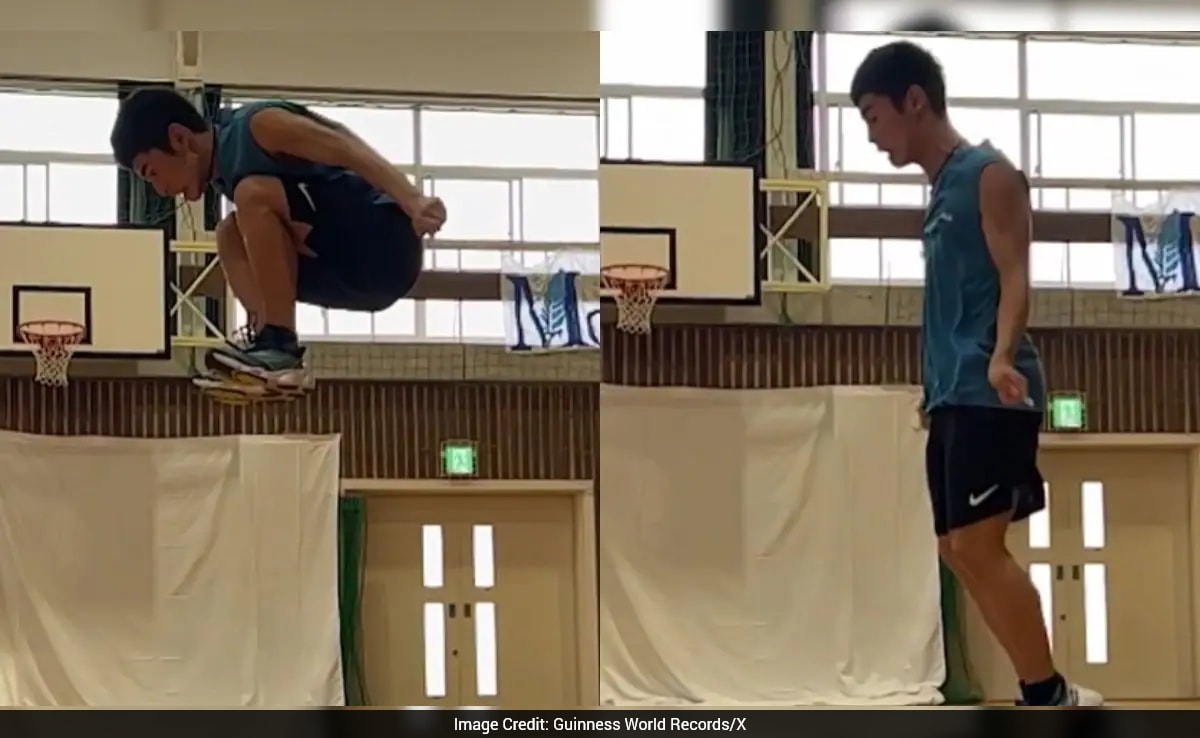
Gravity is an absolute. It is the silent, heavy partner in every human movement, the constant downward pull that reminds us we belong to the earth. Most of us negotiate with it daily in small, unthinking ways. We lift a coffee mug. We climb a flight of stairs. We succumb to the couch at the end of a long shift. But for Kirato Hitaka, gravity isn't a neighbor. It is an opponent.
In a quiet gym in Yamaguchi, Japan, the air carries the faint, rhythmic whipping sound of plastic meeting atmosphere. It is a sharp thwack-thwack-thwack that accelerates until the individual strikes blur into a single, high-pitched hum. To the untrained eye, Hitaka is merely jumping rope. To the physicist, he is attempting to hack the briefest window of temporal possibility.
The record for a "sextuple under"—six rotations of a jump rope in a single leap—stood as a monument to human limitation for years. To achieve it, a person must jump high enough to remain airborne for roughly 0.7 seconds, while their wrists rotate the rope at a speed that defies the eye’s ability to track motion. It is a feat of explosive power and terrifyingly precise fast-twitch muscle fibers.
Hitaka didn't want six. He didn't even want seven. He was looking for eight.
The Anatomy of a Single Second
Think about a second. It is the time it takes to blink twice. It is the gap between heartbeats when you are resting. Within that sliver of existence, Hitaka had to leave the floor, maintain a rigid, aerodynamic verticality, and whip a thin cord beneath his feet eight times before his heels touched the hardwood.
If he mistimed the jump by a millisecond, the rope would lash against his shins, leaving a stinging red welt. If his wrists slowed by a fraction of a degree, the centrifugal force would collapse, and the rope would tangle. This isn't just cardio. This is a ballistic launch followed by a frantic, mechanical symphony of the upper body.
The human body is not naturally built for this. Our shoulders are designed for reaching and pulling, not for becoming high-speed rotors. Our calves are meant for walking across savannas, not for acting as pressurized pistons that fire with the intensity of a sprinter but the verticality of a dancer. When Hitaka prepares for a world-record attempt, he isn't just warming up his muscles. He is calibrating a machine.
The Invisible Stakes of a Niche Obsession
There is a specific kind of madness required to pursue a goal that the rest of the world perceives as a playground game. We celebrate the marathon runner for their endurance. We idolize the heavy-weight lifter for their raw power. But the jump-roper? They occupy a strange space in the cultural imagination, somewhere between a boxer’s training montage and a middle-school recess.
Yet, the stakes for Hitaka were deeply personal. In the pursuit of the "octuple under," he was chasing a ghost of what is biologically possible. Every failed attempt—and there were thousands—was a lesson in failure. Imagine spending months training for a movement that lasts less than one second. Imagine the mental fortitude required to reset, breathe, and try again after the rope catches your toe for the five-hundredth time that week.
The "why" is often the hardest part to explain. Why push for eight? Because eight represents the edge of the map. It is the point where the math starts to break down. To get eight rotations, the rope must travel at speeds that create significant air resistance. It becomes a physical weight, a wall of wind that the jumper must punch through using nothing but the strength of their forearms and the flick of their wrists.
The Moment the Clock Stopped
On the day of the record, the atmosphere in the room was sterile, almost clinical. There were no cheering crowds, no stadium lights. There was only Hitaka, a few witnesses, and the high-speed cameras required to verify a feat that occurs too quickly for the human nervous system to process in real-time.
He took a breath. He began the "cycle-in," the preliminary jumps used to build the rope's momentum.
One. Two. Three.
Then, the explosion.
Hitaka launched. His body became a stiff, vibrating column. His hands became a blur, a frantic shadow circling his hips. In that moment, he wasn't a man anymore. He was a frequency. The rope whistled—a terrifying, metallic shriek—as it whipped through the air at a velocity that would make a professional pitcher wince.
He landed. The room stayed silent for a heartbeat. Then, the realization set in. He hadn't just cleared the rope; he had mastered it. The video playback, slowed down to a crawl, revealed the truth: one, two, three, four, five, six, seven... eight.
The rope passed under his feet eight times before gravity reclaimed him.
The Weight of the Feat
We often look at world records as mere numbers in a book, a way to categorize who is "the best." But Hitaka’s eight skips represent something more profound. They are a testament to the specialized evolution of the human spirit. He took a simple tool—a length of rope—and used it to measure the absolute limits of human reaction time and power.
Consider the physical toll. The impact on the joints during these high-intensity jumps is equivalent to several times a person's body weight. The neurological demand to coordinate eight rotations in under a second is akin to a pianist playing a complex concerto in a fraction of the time, but with the added requirement of jumping over the piano while doing it.
Hitaka’s success wasn't a stroke of luck. It was the result of a grueling, lonely path of repetition. He had to learn how to minimize his profile, how to tuck his chin to reduce drag, and how to stay perfectly centered so that the rope’s arc wouldn't oscillate. It was a victory of engineering as much as athleticism.
Beyond the Hardwood
The world is full of people doing things that don't seem to matter. We climb mountains because they are there. We dive into the deepest trenches of the ocean. We spend decades trying to shave a tenth of a second off a race time. At first glance, jumping a rope eight times in one go seems like a curiosity—a "did you see that?" clip for a Tuesday afternoon.
But there is a beauty in the hyper-specific. Hitaka found a tiny corner of human experience and decided to own it completely. He looked at the 0.7 seconds we all get when we hop in the air and decided he could fit an entire lifetime of effort into it.
He didn't just break a record. He redefined the capacity of the human frame. He proved that even when gravity demands we stay down, and even when time tells us there isn't enough room to move, we can find a way to spin faster.
The rope eventually stops. The jumper eventually lands. But for those eight rotations, Kirato Hitaka was flying. He was a blur of motion in a world that usually moves too slowly to notice. He showed us that the limits we see are often just the limits of our own imagination.
The next time you see a child jumping rope on a sidewalk, or a boxer skipping in a dim gym, look closer. Look at the wrists. Look at the feet. There is a silent war being waged against the earth, and for one brief moment in Japan, a man won that war eight times over before he ever hit the ground.