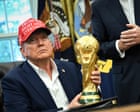
Donald Trump has made it clear that the presence of the Iranian national football team on American soil this summer is a matter of profound indifference to his administration. In a characteristically blunt exchange this week, the President dismissed concerns over Iran’s participation in the 2026 World Cup, labeling the nation "defeated and depleted." His stance effectively leaves FIFA, the world’s most powerful sporting body, staring down a logistical and diplomatic nightmare. With the tournament less than 100 days away, the host nation is in active military conflict with a qualified participant, a situation that has no precedent in modern sporting history.
The friction is not just rhetorical. Over the weekend, U.S. and Israeli forces conducted significant airstrikes inside Iranian territory, targeting high-level leadership. In the immediate aftermath, Iran was the only nation absent from a high-profile FIFA planning summit in Atlanta. The silence from Tehran has been deafening, broken only by Mehdi Taj, head of the Iranian Football Association, who admitted that expecting a hopeful World Cup appearance under the current bombardment is "far from expectations."
A Tournament Under Fire
When the United States, Mexico, and Canada won the bid to host the 2026 World Cup, the pitch was built on the idea of a "United" tournament. That unity has evaporated. Instead of a celebration of global sport, the build-up to the opening match on June 11 has become a game of geopolitical chicken. Iran is currently drawn into Group G, with scheduled matches against New Zealand and Belgium in Los Angeles—home to the world's largest Iranian diaspora—and a third game against Egypt in Seattle.
The prospect of Team Melli playing in Southern California while the U.S. military is engaged in strikes against their home country creates a security vacuum that local law enforcement is ill-equipped to fill. While the Trump administration has technically carved out visa exemptions for athletes and coaching staff, it has maintained a strict travel ban on Iranian spectators and media. This creates a surreal scenario where an international team could take the pitch in a stadium where their own citizens are legally barred from entering.
The Visa Weapon
The White House World Cup Task Force, led by Andrew Giuliani, has remained firm on the administration's "Security First" policy. Giuliani noted that while players might get through the gates, the "standard entry process" is dead for anyone else associated with the Iranian delegation. This includes sponsors, secondary officials, and the small army of support staff required to run a modern national team.
- Full Travel Ban: Currently applies to 20 nations, including Iran, making it nearly impossible for fans to secure B-2 tourist visas.
- Athletic Exemptions: Only the "minimum necessary" personnel for the team are granted entry, a definition the State Department holds the right to tighten at any moment.
- Diplomatic Cold Front: No government-linked officials from Tehran are expected to receive clearance, effectively isolating the team from its own governing body while abroad.
This isn't just about football; it’s about the mechanics of international law and the "government guarantees" that host nations sign when they take on a FIFA tournament. These guarantees usually include promises of visa-free entry for all qualified participants and their supporters. By ignoring these, the U.S. is essentially daring FIFA to move the matches or sanction the host—something the organization is notoriously hesitant to do given the billions of dollars in revenue at stake.
The Dallas July Third Problem
The most volatile scenario remains a potential knockout-stage clash between the U.S. and Iran in Dallas on July 3. If both teams finish second in their respective groups, they are on a collision course for a match just twenty-four hours before American Independence Day. For an administration that thrives on high-stakes optics, a "Home Soil" showdown against a nation it is actively bombing is the ultimate flashpoint.
The President’s "I really don't care" comment suggests he views the Iranian team not as a diplomatic bridge, but as a non-factor from a "defeated" state. This dismissive attitude ignores the reality that sports have historically been the only place where these two nations actually meet. In 1998, the U.S. and Iran famously exchanged roses before their match in France. In 2026, they are more likely to exchange legal filings and security threats.
Financial and Contractual Rupture
Host cities like Los Angeles and Seattle are caught in the crossfire. They have signed binding contracts with FIFA that require them to provide safety and operational excellence. However, the federal funding intended to cover these multi-million dollar security costs is currently frozen due to a partial government shutdown and shifting DHS priorities.
Local host committees are now being asked to prepare for high-risk matches involving a "hostile" nation without the federal dollars promised to them. If Iran withdraws or is forced out, the financial fallout for these cities would be catastrophic. FIFA regulations state that any team withdrawing within 30 days of the tournament faces a minimum fine of €550,000, but the loss in ticket sales, broadcasting rights, and local economic impact would reach into the hundreds of millions.
FIFA has "declined to comment" on the specific military escalations, but internal reports suggest a crisis committee is already evaluating replacements. Iraq is currently the top candidate to take Iran’s spot should they withdraw or be barred. Yet, replacing a team doesn't solve the underlying issue: the 2026 World Cup is no longer an olive branch. It is a mirror reflecting a world where the "beautiful game" is being suffocated by the very real business of war.
If the administration continues to treat the participation of foreign adversaries as a nuisance rather than a sovereign obligation, the "United" World Cup will be remembered only for its divisions. The President may not care if Iran plays, but the cities, the fans, and the very structure of international sport certainly do.
Would you like me to analyze the specific FIFA host city contracts to see if Los Angeles or Seattle have legal grounds to refuse matches based on these security concerns?