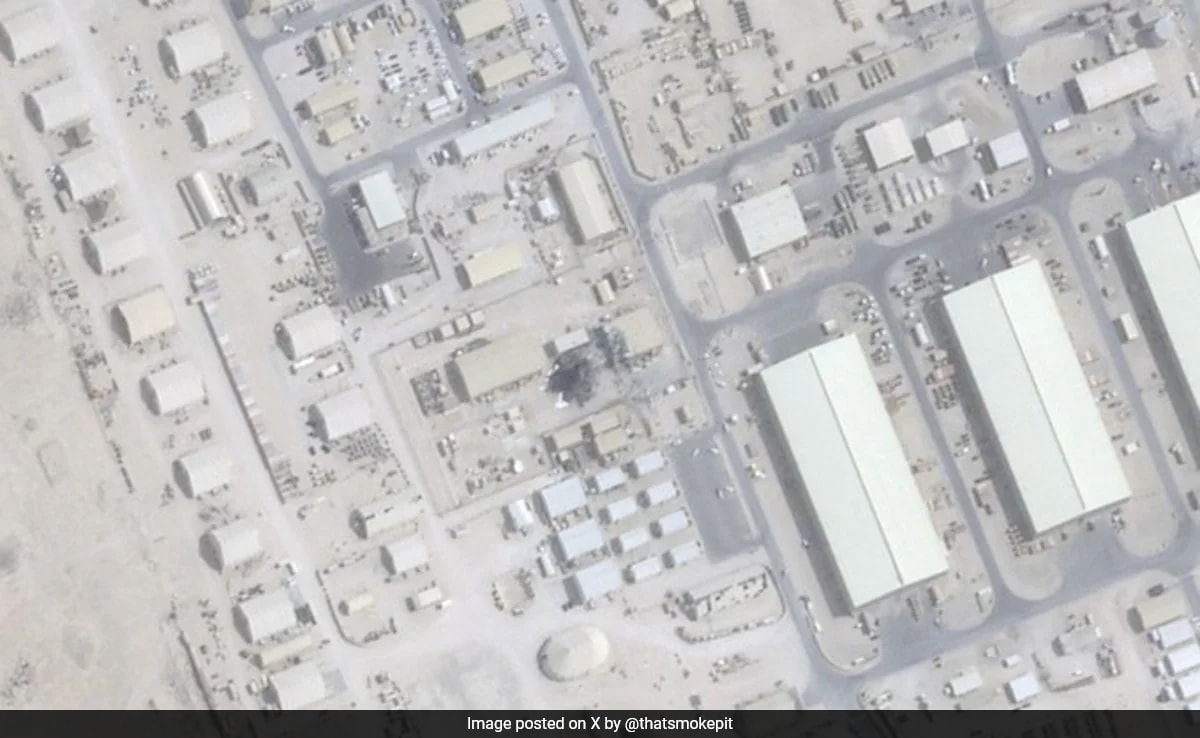
The relocation of United States military personnel from established regional bases to commercial hospitality infrastructure represents a significant shift in the tactical risk-to-utility ratio. While media reports focus on the optics of troops staying in hotels, a structural analysis reveals this is not a luxury upgrade but a desperate maneuver to solve for distributional vulnerability. When fixed military installations become "locked-in" targets for asymmetric munitions—specifically Unmanned Aerial Systems (UAS) and short-range ballistic missiles—the military must choose between hardening a static point or diffusing the target set.
The Geometry of Vulnerability
Military bases function as high-density nodes. In the Middle East, these nodes are often relics of legacy geopolitical footprints, designed for power projection against conventional nation-states rather than defense against low-cost, high-frequency attrition. The current threat environment is defined by three primary variables that render traditional basing suboptimal:
- Detection-to-Impact Compression: The proximity of hostile launch sites to US bases reduces the early warning window to seconds. This nullifies many traditional mid-course interception strategies.
- The Cost-Imbalance Ratio: It costs a state-sponsored proxy roughly $20,000 to $50,000 to launch a standardized attack drone. A single interceptor missile from a Patriot or NASAMS battery can cost between $2 million and $4 million. The math favors the aggressor in a prolonged war of attrition.
- Predictability of Patterning: Fixed coordinates allow adversaries to refine their targeting data through iterative strikes. Every "miss" provides the attacker with telemetry data to calibrate the next "hit."
Relocating to hotels introduces spatial ambiguity. By moving personnel into the civilian urban fabric, the military forces the adversary to solve a new targeting problem. The adversary must now account for collateral damage risks that carry high political costs and navigate a much larger, less predictable set of coordinates.
The Operational Logic of Dispersal
The decision to utilize hotels reflects an application of the Distributed Maritime Operations (DMO) concept, but applied to land-based personnel. The objective is to transform a concentrated target into a "noisy" environment where the signal-to-noise ratio is too low for effective targeting.
Kinetic Hardening vs. Statistical Avoidance
Hardening a base involves physical barriers: T-walls, bunkers, and Integrated Air and Missile Defense (IAMD) systems. This is a "hard-shell" strategy. However, once the shell is breached, the internal density of personnel ensures high casualty rates. Dispersing to hotels is a "soft-tissue" strategy. It relies on the statistical improbability of an adversary successfully tracking and hitting dozens of disparate, non-military buildings simultaneously.
The Friction of Urban Integration
While dispersal solves for kinetic risk, it introduces Command and Control (C2) fragmentation. A centralized base provides a "closed-loop" ecosystem for communication, logistics, and rapid response. In a hotel environment:
- Communication Security (COMSEC): Standardized military networks must be bridged over civilian or portable infrastructure, increasing the surface area for electronic warfare (EW) and signals intelligence (SIGINT) interception.
- Logistical Latency: Moving troops from scattered hotels to an airfield or operations center for a mission introduces a time lag. In high-readiness scenarios, this latency can be the difference between a successful interception and a failed sortie.
- Force Protection Limits: Unlike a base with a clear perimeter and "kill zones," a hotel is a public space. The military loses control over the "human terrain," requiring a higher reliance on local host-nation intelligence services, which may have varying levels of reliability or may be compromised by the very groups launching the attacks.
The Psychological Burden of the "Hotel Garrison"
The move to hotels is often misinterpreted as a relief for troops. From a psychological operations (PSYOP) perspective, however, it signals a lack of dominance. A military that cannot secure its own perimeters and must hide in civilian infrastructure is a military signaling defensive posture.
This shift impacts the Operational Tempo (OPTEMPO). Soldiers in a base environment exist in a state of constant readiness. The transition to a "civilianized" environment can lead to a degradation of the combat mindset, a phenomenon known as "environmental softening." Maintaining discipline, physical readiness, and mental focus becomes exponentially harder when the physical cues of the military environment are stripped away.
The Financial and Political Cost Function
The fiscal impact of housing thousands of troops in commercial hotels is substantial. This is not merely about the "nightly rate." It involves:
- Contractual Overhead: Rapid-response procurement of hotel blocks often involves premium pricing and non-disclosure agreements.
- Redundant Infrastructure: The military must pay for the hotel while still maintaining the (now empty or skeleton-crewed) base.
- Compensatory Logistics: Providing food, medical care, and equipment maintenance across twenty hotels is significantly more expensive than doing so at a single central galley or motor pool.
Politically, the use of hotels creates a Host Nation Dilemma. The presence of US troops in a civilian hotel makes that hotel, and by extension the surrounding neighborhood, a legitimate military target in the eyes of the adversary. This risks alienating the local population and creating friction with the host government, which may face domestic backlash for "endangering" its citizens to protect foreign forces.
Assessing the Adversary's Response
When the target disappears into the city, the adversary does not stop attacking; they evolve. If the goal of the attacks is to force a US withdrawal, the move to hotels can be claimed as a tactical victory by proxy groups. It proves they can deny the US the ability to operate safely from its own installations.
We can expect the adversary to pivot toward:
- Intelligence, Surveillance, and Reconnaissance (ISR) Expansion: Utilizing local informants and technical means to identify which hotels house the most high-value assets.
- IED and Small Arms Ambush: Shifting from long-range drone strikes to "closeness" attacks. If troops must travel from hotels to a central work site every day, they become predictable targets on public roads. This replaces the drone threat with an arguably more difficult-to-defend ambush threat.
- Economic Attrition: Understanding that the US cannot sustain "hotel-based basing" indefinitely due to the sheer cost and logistical strain.
The Structural Limits of the Strategy
The relocation strategy is a temporary fix for a foundational flaw in US Middle East posture. The US currently operates in a Permanent Contingency State. The bases were built for a different era, and the technology of the adversary has evolved faster than the physical infrastructure of the Pentagon.
The limitation of the hotel strategy is that it is reactive. It buys time but does not change the strategic calculus. The US is essentially trading physical security for obscurity, but in the age of pervasive digital footprints and satellite imagery, obscurity is a rapidly depreciating asset.
Strategic Path Forward: The Pivot to Mobile Basing
To move beyond the vulnerability of both fixed bases and civilian hotels, the military must accelerate the transition to Agile Combat Employment (ACE). This requires:
- Expeditionary Basing Kits: Modular, rapidly deployable shelters that can be set up in remote, non-commercial, non-fixed locations. This provides the dispersal of a hotel without the C2 and security compromises of a civilian environment.
- Autonomous Defense Perimeters: Investing in AI-driven, automated "point defense" systems that can be deployed at any location to neutralize drone threats without requiring a massive footprint of specialized personnel.
- Hardened Logic: Accepting that the era of the "Mega-Base" is over. Future operations in contested environments must be predicated on a "plug-and-play" model where no single location houses enough personnel or equipment to be a decisive target.
The move to hotels is the final warning shot for modern military logistics. It confirms that the traditional footprint is obsolete. The next phase of force protection will not be found in better concrete or plusher lobbies, but in the ability to remain invisible while remaining lethal. The military must now prioritize the procurement of high-mobility modular housing and decentralized power grids to ensure that the next move isn't into a civilian hotel, but into a tactical configuration that the adversary cannot track, let alone hit.
Would you like me to analyze the specific economic impact of commercial hotel procurement on military readiness budgets in the Middle East?