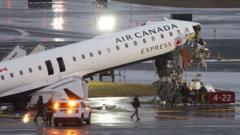
The failure of an aircraft to maintain the runway environment during a landing or takeoff sequence at LaGuardia Airport (LGA) is not a singular event of "bad luck" but the inevitable output of a high-utilization system operating at the edge of its physical and safety margins. To understand the mechanics of the recent incident, one must deconstruct the interplay between LGA’s unique geographical constraints, the kinetic energy dissipation requirements of modern jet aircraft, and the psychological stressors inherent in short-field operations. Aviation safety is governed by the defense-in-depth model; when a crash occurs, it signifies that multiple independent layers of protection—technological, procedural, and environmental—have been breached simultaneously.
The Triad of Environmental Constraints
LaGuardia represents one of the most challenging operational environments in the National Airspace System. Its limitations are defined by three fixed variables that leave zero margin for pilot error or mechanical variance. If you enjoyed this piece, you might want to read: this related article.
- Hydrological Isolation: Surrounded on three sides by the Flushing and Bowery Bays, the airport lacks the "safety buffer" of soft earth found at inland hubs. Any significant excursion from the paved surface results in an immediate transition from a terrestrial incident to a maritime recovery operation.
- Short-Field Geometric Limits: With runways 4/22 and 13/31 both measuring approximately 7,000 feet, LGA is significantly tighter than the 10,000-to-12,000-foot runways typical of international gateways like JFK or EWR. This creates a "compressed decision window" where the transition from a stabilized approach to a full stop must occur with mathematical precision.
- The Deck Infrastructure: Parts of the runway are built on pier-supported structures over the water. This adds a structural failure risk to the kinetic risk of the aircraft, as the runway surface itself has a weight-bearing limit and a distinct vibration profile that can affect tire-to-ground friction coefficients during heavy braking.
Kinetic Energy Dissipation and the Braking Equation
The primary objective of any landing is the safe conversion of kinetic energy into thermal energy. The formula for kinetic energy, $E_k = \frac{1}{2}mv^2$, dictates that velocity is the most dangerous variable, as it is squared. A 10% increase in touchdown speed results in a 21% increase in the energy the braking system must absorb.
At LaGuardia, this dissipation relies on three primary mechanisms: For another look on this story, refer to the latest coverage from Reuters.
- Aerodynamic Drag: Flaps and spoilers create high-drag configurations to slow the airframe before and immediately after touchdown.
- Mechanical Friction: The aircraft’s carbon or steel brake stacks.
- Reverse Thrust: Redirecting engine exhaust forward to provide decelerative force without relying on wheel-to-runway friction.
When a runway is "contaminated" by rain, slush, or ice, the friction coefficient ($\mu$) drops precipitously. If $\mu$ falls below the threshold required for the aircraft’s weight and speed, the aircraft enters a state of hydroplaning. At this point, the pilot loses directional control because the tires are no longer in contact with the macadam, but are instead riding on a thin film of fluid. In the LaGuardia context, even a minor lateral drift during a hydroplane event leads to a bulkhead or water strike due to the narrowness of the safety overruns.
EMAS: The Final Mechanical Barrier
The Engineered Material Arresting System (EMAS) is the most critical technological intervention at LGA. Since the airport lacks the standard 1,000-foot Runway Safety Area (RSA) required by the FAA, it utilizes beds of cellular-cement blocks designed to crumble under the weight of an aircraft.
The physics of EMAS is a study in controlled energy absorption. As the landing gear sinks into the material, the drag force increases linearly, decelerating the aircraft at a rate that prevents structural breakup while stopping it before it enters the bay. An EMAS deployment is, by definition, a successful failure; the aircraft is damaged, but the kinetic energy is neutralized. Analyzing the depth and length of the tire tracks in the EMAS provides investigators with an immediate data point regarding the aircraft's "entry velocity," allowing them to reverse-engineer whether the incident was caused by a late touchdown, excessive speed, or a failure of the onboard deceleration systems.
Human Factors and the Stabilized Approach Criteria
Data from the Flight Safety Foundation suggests that the vast majority of runway excursions are preceded by an "unstabilized approach." Pilots operate under a strict set of "gates." If the aircraft is not at the correct altitude, speed, and configuration by 1,000 feet (in instrument conditions) or 500 feet (in visual conditions), a "go-around" is mandatory.
The psychological pressure at LaGuardia, however, introduces a "get-there-itis" variable. Because the airspace is so congested, a go-around often results in a 20-to-30-minute delay as the aircraft is re-sequenced into the flow. This creates a subconscious bias toward "planting" the aircraft on the runway even when the parameters are marginal. This "operational press" is a systemic flaw where efficiency goals conflict with the physics of the short-field landing.
Mechanical Variables and Sensor Integrity
We must differentiate between pilot-induced excursions and mechanical failures. The modern avionics suite relies on the Pitot-static system and Angle of Attack (AoA) sensors to provide the crew with accurate airspeed data. In cold or inclement weather, icing of these sensors can lead to "unreliable airspeed" indications.
If the flight computer receives a false "high speed" reading, it may command a lower power setting, leading to a stall or a hard landing short of the runway. Conversely, a false "low speed" reading can cause the crew to increase thrust, leading to a high-speed touchdown that exceeds the braking capacity of the 7,000-foot runway. The investigation must look at the "Air Data Inertial Reference Unit" (ADIRU) logs to determine if the crew was reacting to reality or to a corrupted digital representation of reality.
The Cost Function of Runway 13/31
The economic impact of a LaGuardia runway closure is asymmetrical. Because the airport operates near 100% capacity during daylight hours, the loss of one runway reduces the airport’s throughput by 50% or more, causing a ripple effect across the entire Northeast Corridor.
- Direct Costs: Aircraft hull loss, EMAS replacement (millions of dollars), and civil penalties.
- Indirect Costs: Fuel burn for diverted aircraft, crew timing out of their legal duty hours, and the massive logistical burden of re-protecting thousands of stranded passengers.
- Reputational Risk: For the carrier involved, the incident serves as a "brand tax," raising insurance premiums and triggering intrusive FAA audits of their flight standards department.
Strategic Operational Mandate
To mitigate future kinetic incidents at LaGuardia, the industry must move beyond reactive investigations and adopt a predictive posture.
The immediate strategic requirement is the implementation of Dynamic Runway Condition Assessment. Currently, runway friction is reported by airport ops using "Mu" values or Braking Action reports from previous pilots. This is subjective and lagging. Real-time, sensor-based friction telemetry—streamed directly from the aircraft's antiskid system to the following aircraft—would eliminate the guesswork.
Furthermore, airlines must mandate "Auto-Brake Max" settings for all LGA arrivals regardless of weather, removing the variability of human foot-braking. The "short-field" designation of LGA should carry a distinct certification for flight crews, similar to the requirements for Aspen (ASE) or London City (LCY), ensuring that only the most experienced pilots with specific high-stress simulator training are permitted to command the "compressed decision window" of the Flushing Bay approach.