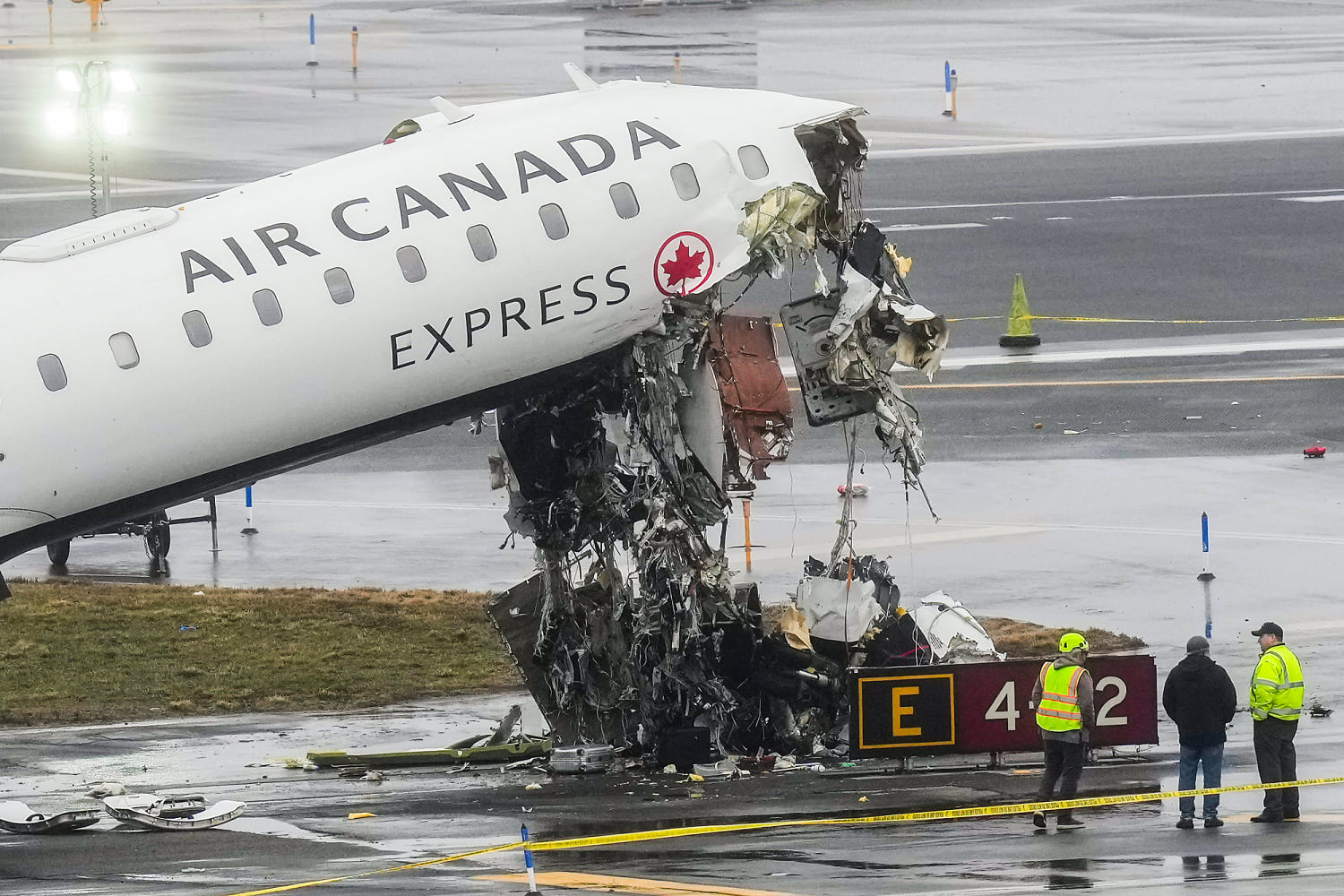
Ground movement at high-density aviation hubs like LaGuardia Airport (LGA) operates on a margin of error that approaches zero. When a fatal collision occurs between ground support equipment (GSE) and personnel or aircraft, the resulting systemic shock is not merely a tragedy but a massive failure in the spatial-temporal coordination of the airfield. The immediate aftermath of such an event reveals the friction between three competing vectors: the necessity of forensic preservation, the rigid demands of the FAA-mandated Part 139 safety standards, and the economic pressure of maintaining throughput in one of the most constricted geographic footprints in global aviation.
The Kinetic Architecture of Ground Fatalities
A fatal collision on the ramp is rarely the result of a single mechanical failure. It is the culmination of a "drift into failure" where incremental deviations from standard operating procedures (SOPs) become normalized. In the context of the recent LaGuardia incident, the analysis must move beyond "operator error" to examine the Kinetic Energy Differential involved in ramp operations.
Ramp environments are uniquely hazardous because they lack the structured traffic separation found in civil roadway engineering. A standard tug or belt loader operates in close proximity to "no-go" zones—invisible boundaries surrounding an aircraft's engines and fuselage. The physics of these interactions are governed by:
- Sightline Occlusion: The structural design of aircraft and the height of GSE create massive blind spots. At LGA, where Terminal B and C reconstructions have altered traditional paths, these occlusions are dynamic rather than static.
- Acoustic Masking: The ambient noise floor of a running jet engine—often exceeding 100 decibels—renders auditory warnings like backup beepers or shouts effectively useless.
- Surface Friction Variability: Tarmac conditions, affected by de-icing fluids or precipitation, drastically alter the stopping distance of heavy machinery that lacks the advanced anti-lock braking systems found in modern consumer vehicles.
The Regulatory Interregnum and Evidence Sequestration
Following a fatal impact, the airfield transitions from an operational zone to a forensic site. This shift triggers a hierarchy of jurisdiction involving the Port Authority Police Department (PAPD), the National Transportation Safety Board (NTSB), and the Occupational Safety and Health Administration (OSHA). The "updates" provided by officials serve as a preliminary mapping of the Evidence Chain.
The first 24 hours focus on data extraction from two primary sources. First, the Digital Metadata, which includes Airport Surface Detection Equipment (ASDE-X) data. This system uses a combination of surface movement radar and multilateration to track the position of transponder-equipped vehicles. If the vehicle involved was not transponder-equipped—a common gap in older GSE fleets—investigators must rely on secondary CCTV and "breadcrumbs" from gate-integrated sensors.
Second, the Mechanical Forensic State. Investigators examine the "dead man's switch" functionality, brake line pressure, and throttle linkages. In many ramp collisions, the variable of "unintended acceleration" or "braking lag" is scrutinized to determine if the equipment met the SAE International standards for ground support vehicles.
Spatial Constraints as a Risk Multiplier
LaGuardia’s specific geography acts as a force multiplier for risk. Unlike sprawling hubs like Denver (DEN) or Dallas-Fort Worth (DFW), LGA occupies 680 acres. This density creates a Congestion Coefficient that is significantly higher than its peers.
When a gate is closed for an investigation, the ripple effect is non-linear. Because LGA operates near peak capacity, the loss of a single "hard stand" or gate forces aircraft into "penalty boxes"—holding areas where they wait for gate availability. This increases the taxi-time-to-gate ratio, which in turn pressures ground crews to accelerate their "turn" times once the aircraft finally arrives. This Pressure-Efficiency Trade-off is where the next accident is often born. Crews working under a 20-minute turn-around window are statistically more likely to bypass "chock-and-cone" safety protocols to recover lost schedule time.
The Human-Machine Interface (HMI) Gap
The updates from officials often cite "training" as a corrective measure, but this misses the structural flaw in ramp HMI. Most GSE lacks the Proximity Detection Systems (PDS) that have been standard in the automotive industry for a decade.
The implementation of LiDAR or Ultrasonic sensors on baggage tugs and fuel trucks would create a "safety cocoon," capable of de-activating the drive motor if a human shape is detected within a 5-meter radius. The barrier to this is not technology, but the Legacy Fleet Amortization. Airlines and ground handling contractors often sweat assets for 15 to 20 years. Replacing or retrofitting thousands of units of equipment across a hub like LGA requires a capital expenditure that current razor-thin handling margins do not easily support.
Quantifying the Cost of Operational Stasis
The economic impact of a fatal collision extends beyond the immediate tragedy and the potential legal liabilities. It manifests as a Systemic Friction Cost:
- Insurance Premium Escalation: Fatalities trigger a re-rating of the airport's liability profile, impacting every tenant.
- Labor Attrition: The psychological impact on ground crews leads to "burnout-induced turnover," exacerbating the existing shortage of experienced ramp leads who understand the "rhythm" of the airfield.
- Regulatory Fines: OSHA "Willful Violation" citations can reach six figures per instance, but the real cost is the subsequent "Consent Decree" which may mandate external safety auditors for years.
Strategic Transition to Autonomous Ground Flow
The only logical path toward eliminating ramp fatalities is the decoupling of human operators from high-risk kinetic tasks. This requires a transition from manual GSE to Automated Ground Support Equipment (A-GSE).
In an automated ecosystem, every vehicle is a node in a mesh network. A tug would "know" the position of every worker via wearable transponders and would be physically incapable of entering a high-risk zone when a human is present. This removes the variable of human fatigue and the "sunk cost" of manual training that fails under high-pressure scenarios.
The transition requires a three-stage integration:
- Geo-Fencing: Hard-coding GPS boundaries into all powered equipment to prevent unauthorized movement in high-traffic taxiway crossings.
- Telemetry-Linked Governance: Real-time monitoring of vehicle speed and braking behavior, with automated "lock-outs" for operators who exceed safety thresholds.
- Full Autonomy for Repetitive Loops: Automating baggage lateral transport—the move from the sorting room to the aircraft—which accounts for the highest volume of ramp vehicle movements.
Airports must stop viewing safety as a compliance checkbox and start viewing it as a Data Engineering Challenge. The "updates" provided after a tragedy are a post-mortem on a system that allowed a predictable collision to occur. True optimization lies in the predictive modeling of ground movements, where "near-misses" are captured by AI-driven video analytics and used to redesign the flow of the ramp before the next kinetic failure occurs.
The immediate mandate for airport authorities is the universal adoption of transponder-based tracking for every motorized asset on the airfield, regardless of age or function. Without a digital twin of ground operations, officials are merely reacting to shadows on a terminal wall. The data exists to prevent these collisions; the failure lies in the lack of a centralized platform to act on that data in real-time. Operators must now pivot toward a "Zero-Trust" ramp architecture where no vehicle moves without verified clearance from a centralized ground-flow algorithm.
Would you like me to develop a specific risk-matrix template for evaluating ground support equipment (GSE) fleet safety based on these kinetic variables?