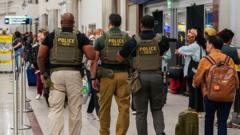
The headlines are screaming about a "border crisis" spilling into the Delta terminal. You’ve seen the photos: miles of luggage, weary families slumped against Cinnabon counters, and the sudden, jarring presence of Immigration and Customs Enforcement (ICE) badges patrolling alongside TSA blue. The common narrative is simple, digestible, and wrong. The media tells you that shifting federal agents to airports is a desperate band-aid for a broken immigration system. They say the queues are a resource problem.
They are lying. Or, at best, they are missing the mechanical reality of how "security" actually functions in a post-efficiency world.
The presence of ICE at major US hubs like JFK, O'Hare, and LAX isn't a logistical failure. It is a feature of a system that has realized it can no longer manage the friction it created. If you think an extra three hundred agents in windbreakers is going to shave forty minutes off your wait time to Denver, you don't understand the math of the funnel.
The Myth of the Resource Gap
Let’s dismantle the "not enough boots on the ground" argument. I have spent fifteen years consulting for logistics firms that handle high-capacity throughput. In any complex system, adding more checkpoints without optimizing the flow rate at the narrowest point—the "bottleneck"—simply moves the crowd ten feet forward. It does not dissipate it.
The current airport chaos is cited as a personnel shortage. It isn't. It is a protocol surplus. Every time a new "threat" is identified, a new layer of friction is added. These layers never go away. They are cumulative. We are currently operating under a security architecture designed in 2002, layered with the technological debt of 2012, trying to process the passenger volume of 2026.
ICE isn't there to check your shoes. They are there because the administrative burden of modern travel has become so heavy that the TSA can no longer handle the "exception" cases—the visa discrepancies, the expired documentation, the secondary screenings—without the entire line grinding to a halt. ICE is the "garbage collection" script for a crashing operating system.
The Security Theater Tax
We have been conditioned to believe that "more visible authority equals more safety." This is the core of the Security Theater.
Consider the "People Also Ask" obsession: Why are airport lines so long right now? The honest, brutal answer: Because the system is designed to prioritize 100% compliance over 1% efficiency. In a world of infinite variables, the government chooses the slowest common denominator.
When the media reports on ICE agents deploying to airports, they frame it as an "emergency surge." In reality, it is a rebranding of enforcement. By moving internal enforcement to the point of transit, the state effectively turns every domestic terminal into a border crossing. This isn't about the queue; it's about the data.
- The Data Trap: Every person in that "three-hour line" is generating a digital footprint that is being cross-referenced in real-time.
- The Compliance Squeeze: We accept the wait because we are told it is for our protection. It isn't. It's for their cataloging.
I have watched airports spend $50 million on "biometric scanners" that actually increase processing time by 12 seconds per passenger. Multiply that by 80,000 passengers a day. You don't need a math degree to see why you're missing your flight. The ICE deployment is the distraction that keeps you from asking why the "cutting-edge" scanners don't actually work.
Why Your "TSA PreCheck" is a Scam
You paid $85 to skip the line. You thought you were buying efficiency. You were actually buying a temporary pass into a slightly less broken lane that is now being throttled by the same "resource shifts" people are complaining about.
When federal agents are moved from one sector to another, the "premium" experience is the first thing to be cannibalized. The government has no contractual obligation to give you a fast line; they only have an obligation to provide a "secure" one. By introducing ICE into the airport ecosystem, the distinction between "domestic traveler" and "person of interest" blurs.
If you are waiting four hours in a line at ATL, it is because the system has decided your time has zero value compared to the perceived value of a 100% "clean" manifest.
The Logistics of the Surge
Let’s look at the numbers the competitor pieces ignore. The "surge" usually involves a few hundred agents. In a hub that processes 200,000 people a day, a few hundred agents is a rounding error. They aren't there to move people.
Imagine a scenario where a pipe is leaking. The "lazy consensus" says we need more buckets (more agents). The contrarian reality is that we need to fix the pressure in the pipe. The "pressure" in this case is the insane amount of redundant documentation required for modern flight.
$$T = \frac{P \times (S + D)}{C}$$
Where:
- $T$ is Total Wait Time
- $P$ is Passenger Volume
- $S$ is Screening Time per person
- $D$ is Documentation/Exception handling time
- $C$ is Number of active Channels
By adding ICE, the government thinks they are increasing $C$. In reality, they are increasing $D$. Every time an ICE agent pulls someone aside for a secondary status check, they create a "dead zone" in the flow. They are adding friction, not removing it.
Stop Asking for More Agents
The most common "solution" offered by pundits is "more funding for border and airport security."
This is the worst possible move.
More funding in a broken system just buys more of the things that broke it. It buys more biometric cameras that don't sync, more agents who aren't trained in flow dynamics, and more PR campaigns telling you to "arrive four hours early."
If you want to fix the airport, you have to stop treating travel as a privilege granted by the state and start treating it as a high-volume logistics problem.
- Eliminate the Exception Handlers: Stop doing deep-dive status checks at the gate. If a passenger has a ticket and a basic ID, the "security" portion should be finished in under 30 seconds.
- Decouple Immigration from Aviation: ICE has no business in a security queue. Their presence is a political statement, not a tactical necessity.
- Privatize the Throughput: Look at airports in Singapore or Doha. They don't have "surges" because they treat passengers like customers, not suspects.
The Harsh Reality of the "New Normal"
We are witnessing the "Borderization" of everything. The airport is just the first laboratory. The ICE agents you see today aren't there because of a temporary spike in travel. They are there to normalize the presence of high-level federal enforcement in everyday civilian spaces.
The lines aren't long because of a lack of staff. The lines are long because the line itself is a tool of control. It keeps you stationary. It keeps you compliant. It makes you grateful when the line finally moves, even if you’ve been standing there for the length of a director's cut movie.
The next time you’re stuck behind a family of five struggling with their shoes while an ICE agent stares blankly at the crowd, don't wish for more agents. Wish for a system that isn't terrified of its own shadow.
The resource isn't the problem. The philosophy is.
Stop arriving early. Start demanding the removal of the layers. Anything else is just asking for a faster-moving treadmill in a cage.