The tea was still warm when the windows began to rattle. In the border provinces of southern Turkey, a rattle is rarely just a rattle. It is a language of vibration that the locals have learned to decode over decades of regional friction. But this was different. This wasn't the low, rhythmic thrum of a distant generator or the familiar heavy roll of a passing truck. This was a screech that tore the silk out of the night air.
Then came the flash. It wasn't the white-blue of a summer storm, but a dirty, chemical orange that bruised the horizon.
Somewhere high above the quiet olive groves of Hatay, the invisible architecture of global security had just buckled. A long-range ballistic missile, launched from Iranian soil and hurtling toward a distant target, met a kinetic interceptor fired by a NATO air defense battery. They collided in a vacuum of cold logic and Mach speeds. For the generals in climate-controlled bunkers, it was a "successful intercept." For the people on the ground, it was raining fire.
The Physics of a Near Miss
When we talk about missile defense, we often use clean, antiseptic terms. We speak of "envelopes," "interception windows," and "kill vehicles." We treat the sky like a digital game board where a hit simply deletes the target from the screen.
Reality is messier.
A ballistic missile is not a soap bubble; it is several tons of high-grade alloy, volatile propellant, and a heavy warhead. When an interceptor strikes it, the energy released is staggering. However, the law of conservation of mass is a cruel roommate. That metal doesn't vanish. It fragments. It turns into a thousand jagged, glowing shards of titanium and steel that have nowhere to go but down.
On this particular night, those shards found their way into Turkish soil.
Imagine standing in your backyard, the same place where you hung laundry that morning, and watching a piece of an international crisis—smoldering, twisted, and smelling of ozone—embed itself in your garden. This isn't just "debris." It is the physical manifestation of a shadow war, a piece of a geopolitical chess match that has literally crashed through your ceiling.
The Invisible Shield and Its Price
The NATO air defense system is often described as a shield. It is a comforting metaphor. It implies a solid, impenetrable surface that deflects harm. But a more accurate comparison would be a glass wall. It protects you from the wind, but when something hits it hard enough, everyone nearby gets sprayed with the glass.
For Turkey, a NATO member sitting at the most volatile crossroads on the planet, this shield is a necessity of survival. The geography of the region dictates that any escalation between Tehran and its adversaries will likely pass through Turkish airspace. This puts the civilian population in a strange, psychological limbo. They are protected by the most advanced technology humanity has ever devised, yet that very protection turns their sky into a scrapyard.
Consider the technical miracle required to make this happen. A radar array, perhaps hundreds of miles away, must identify a speck of metal traveling at several kilometers per second. It must distinguish that speck from birds, clouds, and civilian aircraft. It must then launch a counter-missile that calculates a lead-point interception—essentially hitting a bullet with another bullet in the dark.
When it works, we celebrate the brilliance of the engineers. We rarely discuss the farmer in Hatay who now has to explain to his children why a piece of an Iranian engine is sitting in their wheat field.
The Geography of Anxiety
There is a specific kind of exhaustion that comes from living in the "intercept zone." It is a quiet, underlying hum of anxiety. You learn to watch the news not for information, but for atmospheric cues. You look at the political posturing in distant capitals—Washington, Tehran, Brussels—and you translate their rhetoric into the likelihood of metal falling on your roof.
To the analysts, the fall of debris in Turkey is a "collateral technicality." It is a footnote in a briefing. But to the human element, it represents the shrinking of the world. The distance between a laboratory in Iran and a quiet street in Turkey has been reduced to a few minutes of flight time.
We are living in an era where the front lines of war are no longer trenches or clear borders. The front line is now vertical. It is the space directly above our heads.
The incident in Turkey serves as a stark reminder that "defense" is not a zero-sum game. You can stop the explosion, but you cannot stop the gravity. You can win the tactical engagement and still lose the sense of sanctuary that makes a home a home.
The Weight of Metal
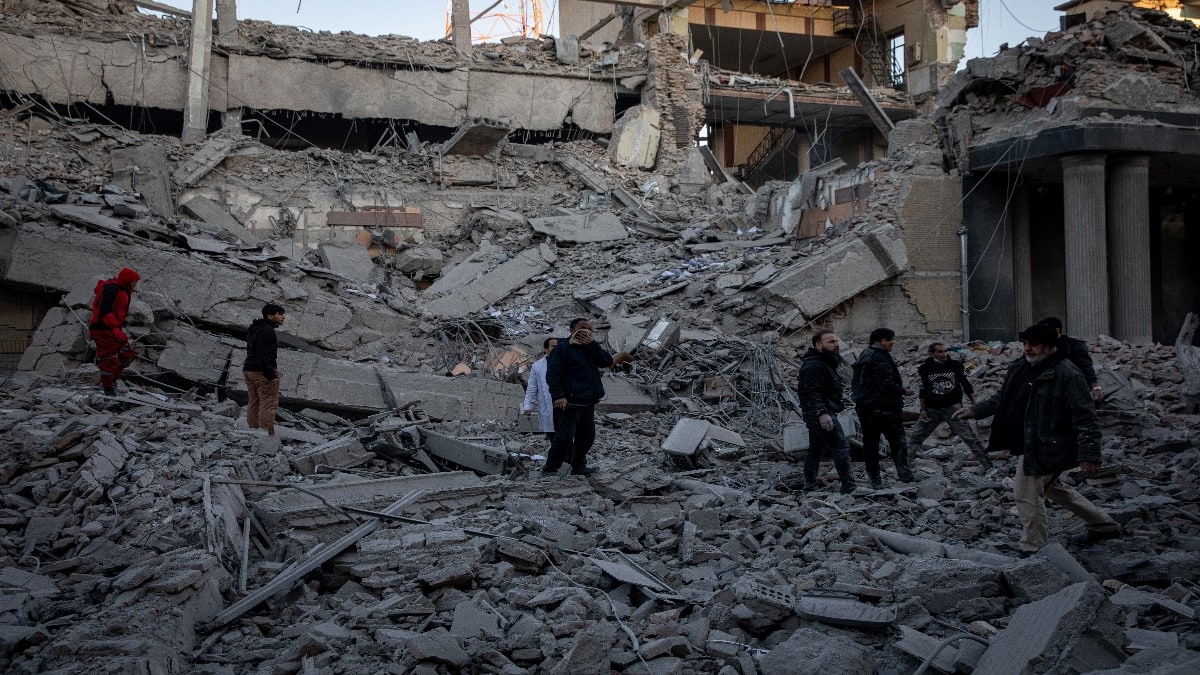
When the sun rose over Hatay the following morning, the debris was cold. Security cordons were established. Men in high-visibility vests and technical gear arrived to whisk away the jagged souvenirs of the night's terror. They poked and prodded at the charred remains, looking for serial numbers, seeking to confirm the origin of the hardware as if the metal itself could offer a confession.
The official reports will eventually be filed. They will use words like "nominal" and "effective." They will emphasize that no lives were lost, which is a miracle worth noting.
But the silence that follows is heavy.
The people who live beneath the "shield" know something that the policy makers often forget. They know that peace isn't just the absence of a direct hit. Peace is the ability to look at the stars without wondering which one is moving too fast.
It is the luxury of a sky that stays where it belongs.
As the geopolitical tensions continue to simmer, and as the "invisible" wars of the Middle East refuse to stay within their borders, more metal will likely fall. We will continue to build better interceptors. We will sharpen our radars and increase our kinetic yields. We will get better and better at breaking things in the atmosphere.
But as the debris in Turkey proves, once you break the sky, you still have to live with the pieces.
The tea has gone cold. The windows have stopped rattling. But in the quiet of the Turkish night, the people stay awake just a little bit longer, listening for the sound of the wind, and hoping it stays just the wind.
Would you like me to research the specific technical specifications of the interceptor systems currently deployed along the Turkish-Syrian border?