The horizon shouldn't be that color.
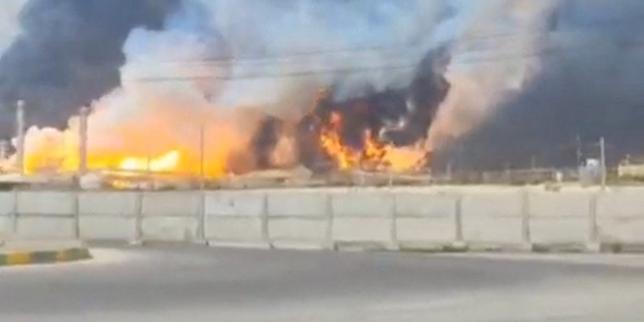
At 3:00 AM on the Persian Gulf, the world is usually a bruised purple, a heavy, salt-slicked silence broken only by the rhythmic hum of offshore machinery. But when the South Pars gas field—the largest concentrated pocket of energy on the planet—decides to bleed, the sky turns a violent, sickly orange. It is a light that doesn't just illuminate. It threatens.
South Pars isn't just a collection of steel platforms and subsea pipelines. It is the beating, pressurized heart of a nation’s economy, a labyrinthine subterranean treasure chest shared between Iran and Qatar. When a leak occurs here, or when the specialized "flaring" systems roar into an uncontrolled frenzy, it isn't just a technical glitch. It is a localized sun born of ancient carbon and modern desperation.
The Weight of Three Thousand Meters
Imagine standing on a platform of cold steel, surrounded by a black expanse of water that stretches toward the horizon in every direction. Beneath your boots, miles of rock and sediment hold back a sleeping giant. The South Pars field contains an estimated 51 trillion cubic meters of natural gas. To visualize that, think of a volume of energy so vast it could power every home in Europe for decades.
But that energy is under staggering pressure.
When news broke of the recent fires at the South Pars facilities, the dry reports spoke of "incidents" and "technical malfunctions." They used sanitized language to describe a primal event. For the engineers stationed on these metallic islands, the reality is sensory. It starts with a vibration. Not a sound, but a shudder in the marrow of your bones. Then comes the roar—a sound like a jet engine held against your ear.
The flames from a major gas leak at sea are not like a campfire. They are pillars of concentrated force. They scream. The heat is so intense that it creates its own weather system, sucking in oxygen and spitting out a shimmering haze that can be seen from orbiting satellites. This is the "fire" the world saw in those graining, terrifying social media clips: the moment man’s grip on the Earth’s crust slipped.
The Invisible Stakes of a Spark
Why does a fire in a remote corner of the Gulf matter to someone sitting in a quiet suburb thousands of miles away? Because South Pars is the ultimate pivot point of global energy security.
Iran sits on the second-largest gas reserves in the world, yet it remains a paradox. It is a country drowning in energy that struggles to keep the lights on in its own capital. Every time a platform at South Pars goes dark or erupts in flames, the precarious balance of regional power shifts.
Consider the "Phase 16" incident. A pipeline rupture or a compressor failure isn't just a repair job; it’s a diplomatic crisis. When the gas stops flowing, the pressure in the national grid drops. Factories in Isfahan shutter. Families in Tehran find their heaters blowing cold air in the dead of winter. The fire on the water is a signal of fragility. It exposes the aging infrastructure of a giant that has been cut off from the global nervous system of spare parts and high-end Western engineering for years.
The tech is old. The pressure is high. The margins for error have vanished.
The Human Cost of the Glow
We often talk about energy in terms of "barrels" or "cubic feet." We rarely talk about the person holding the wrench.
Imagine a technician named Hassan. He is 400 kilometers from his family, living in a dormitory made of shipping containers stacked on a steel deck. His world is defined by the smell of sulfur and the constant, low-frequency thrum of turbines. When the alarms go off—that piercing, undulating wail that signals a high-pressure release—Hassan doesn't have the luxury of "analyzing the situation."
He knows that natural gas is lighter than air, but in high concentrations, it is an invisible suffocant. He knows that a single spark from a dropped tool or a static discharge from a jumpsuit can turn the entire platform into a funeral pyre.
When we see the "images of South Pars on fire," we are looking at the site of a desperate struggle. It is the struggle of workers trying to maintain 21st-century output with mid-20th-century tools. They are fighting the physics of the earth itself. The gas wants to be free. It has been trapped under the seabed for millions of years, and it exits the pipe with a tectonic fury that can shred metal like wet paper.
The Ghost in the Machine
The tragedy of the South Pars fires is that they are often preventable. In a world of "seamless" integration and "cutting-edge" remote monitoring, these platforms should be silent, efficient marvels. Instead, they have become symbols of an isolated industrial complex.
The lack of access to specialized "Total Life Cycle" maintenance means that Iranian engineers are forced into a culture of "jigging"—using makeshift solutions for high-precision problems. If a valve fails and you can't buy a replacement from the original German or American manufacturer due to trade embargoes, you find a way to patch it. You weld. You bypass. You hope.
But gas doesn't care about geopolitics. It doesn't respect borders or sanctions. It only respects the integrity of the seal. When that seal fails, the resulting inferno is a reminder that you cannot cheat physics forever.
A Sea of Burning Glass
There is a specific phenomenon that happens when a gas fire rages over the ocean. The heat is so profound that it can actually begin to calcify the minerals in the air and spray, creating a surreal, glittering effect amidst the smoke. It looks beautiful from a distance. Up close, it is the sound of a nightmare.
The environmental toll is a secondary, silent catastrophe. These fires release massive amounts of methane—a greenhouse gas far more potent than carbon dioxide—directly into the atmosphere. They dump soot and unburned hydrocarbons into one of the most sensitive marine ecosystems on the planet. The dugongs, the sea turtles, and the local fishing communities pay the price for a fire they didn't start and can't put out.
The "cold facts" tell us that South Pars produces roughly 700 million cubic meters of gas per day. But those facts fail to capture the tension of a control room when the pressure gauges start climbing into the red. They fail to describe the grit in the eyes of the crews who have to stand in the heat-wash of a flare to manually override a stuck actuator.
The Fire That Never Truly Goes Out
Even when the visible flames are extinguished, the underlying heat remains. The South Pars field is a microcosm of our global addiction to risk. We have built our entire civilization on the premise that we can keep this dragon in a pipe.
We watch the videos of the Gulf on fire because they touch something primal. They remind us that for all our digital sophistication, we are still a species that huddles around a flame, terrified of the dark. We are dependent on the labor of men on steel stilts in the middle of a black sea, gambling every day against the crushing weight of the earth.
The next time you see a headline about a gas field in flames, don't look at the statistics. Look at the color of the sky.
The orange glow isn't just burning gas. It is the friction of a world trying to move forward while its machinery is grinding to a halt. It is the light of a crisis that is being managed one patch at a time, until the next vibration begins in the bones of the men on the deck.
The dragon is still breathing. The pipes are still thin. And the horizon is waiting to turn orange again.