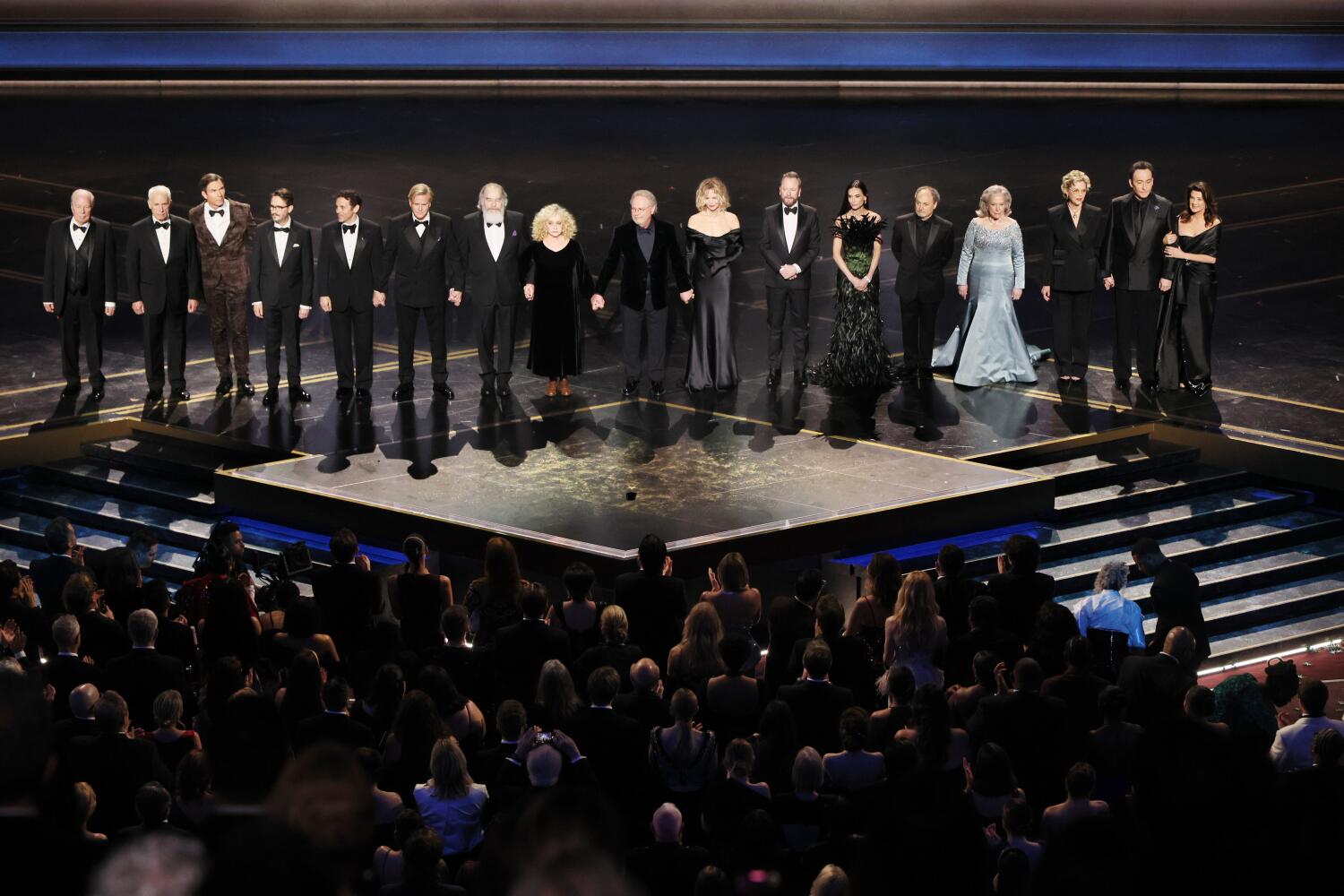
The Dolby Theatre usually smells of expensive lilies and desperation. It is a room built for the high-stakes theater of "The Win," where every smile is practiced and every handshake is a networking opportunity. But there are rare moments, perhaps once a decade, when the machinery of Hollywood stops grinding. The lights dim not for a cue, but for a memory.
Billy Crystal stood in that specific, unforgiving spotlight, looking less like a legendary comedian and more like a man holding a heavy secret. He wasn't there to deliver a monologue or a series of rapid-fire quips about the length of the ceremony. He was there because Rob Reiner—the man who helped define the modern American heart on film—was being celebrated.
But a tribute to Reiner isn’t just a reel of film. It is a roll call of our own lives.
Think about the first time you felt the specific, agonizing itch of a friendship turning into something more. You were likely watching Harry and Sally argue about whether men and women can ever truly be just friends while sitting in a deli. Or remember the first time you realized that "as you wish" was the most profound declaration of love ever uttered. These aren't just movies. They are the emotional scaffolding of several generations.
As Crystal began to speak, the air in the room changed. It shifted from the frigid temperature of a televised broadcast to the warmth of a living room. This wasn't a corporate retrospective. It was a family reunion where the "family" happened to be the most recognizable faces on the planet.
The Princess and the Castle
The first ripple of collective breath-catching happened when Cary Elwes and Robin Wright stepped out. They weren't Westley and Buttercup anymore. Time had etched lines into their faces, but when they looked at each other, the decades seemed to vanish. There is an invisible stake in seeing our cinematic icons age. It reminds us that while the stories are immortal, the vessels are human.
They spoke of The Princess Bride not as a job, but as a miracle. Elwes recounted the days on set where Reiner’s laughter was so loud it would ruin the sound takes. Imagine that. A director so enamored with the joy of his own creation that he becomes its primary obstacle. In an industry often governed by ego and spreadsheets, Reiner governed by the gut. He chose stories that felt like secrets whispered between best friends.
The audience saw the clips—the Fire Swamp, the Cliffs of Insanity—but the real story was in Wright’s eyes as she watched the footage. It was the look of someone remembering a version of herself that no longer exists, preserved forever in amber by a man who believed in fairytales.
The Boys from Castle Rock
Then came the shift toward the bittersweet. Jerry O’Connell and Wil Wheaton walked onto the stage, representing the ghosts of Stand By Me.
The absence of River Phoenix is a wound that never quite closed for Hollywood, or for the audience that grew up alongside those four boys on the tracks. When Reiner directed that film, he wasn't just making a "coming-of-age" movie. He was capturing the exact moment a child realizes that the world is dangerous and that friends are the only shield we have.
Wheaton spoke with a vulnerability that felt uncomfortably real for the Oscars. He talked about how Reiner saw the pain in him as a young actor and gave it a home in the character of Gordie Lachance. This is the invisible labor of a great director. They don't just tell you where to stand. They tell you that you are seen.
The "invisible stakes" here weren't about box office numbers or critical acclaim. They were about the preservation of childhood. As the two men stood there, the height difference and the graying temples served as a jarring contrast to the sun-drenched boys on the screen behind them. It was a reminder that the tracks eventually lead us all to adulthood, whether we’re ready or not.
The Deli Scene and the Truth About Love
When Meg Ryan appeared, the room nearly vibrated.
For years, the public has obsessed over Ryan’s relationship with fame and her physical appearance. But the moment she stood near Crystal, that noise stopped. They were Harry and Sally. The chemistry didn't feel like a performance; it felt like a shared history.
Crystal recounted the filming of the famous Katz’s Deli scene. He described how Reiner’s mother, Estelle, delivered the legendary line, "I'll have what she's having," with the deadpan timing of a seasoned pro. But the human element lay in the rehearsal. Reiner himself had demonstrated the "fake" orgasm to Ryan in the middle of a crowded restaurant to show her it was okay to be ridiculous.
That is the essence of the Reiner touch: the willingness to be the most ridiculous person in the room so that his actors can be the most honest.
Crystal’s voice caught only once. It wasn't during a rehearsed beat. It was when he looked at Reiner in the front row and thanked him for giving him a career, yes, but more importantly, for giving him a brother. The audience wasn't looking at a "celebrity tribute" anymore. They were witnesses to a lifelong debt of gratitude being paid in full.
The Weight of the Few Good Men
The tribute didn't shy away from the gravitas either. References to A Few Good Men brought a different energy to the stage. It reminded the crowd that Reiner wasn't just the king of the "rom-com" or the "indie darling." He was a master of the high-stakes moral drama.
When you hear the line "You can't handle the truth!" it’s easy to credit Jack Nicholson’s volcanic delivery. But the narrative tension—the slow-burn realization that honor and orders are often at odds—is the hallmark of Reiner’s precision. He understands that humans are at their most interesting when they are trapped between what they want to do and what they must do.
Consider the risk of his career. He jumped from the mockumentary absurdity of This Is Spinal Tap to the claustrophobic horror of Misery. He never stayed in one lane because human emotion doesn't stay in one lane. We laugh, we scream, we pine, and we stand by each other. Reiner simply followed the compass of what it feels like to be alive.
The Final Chord
As the stars gathered around Reiner, the artifice of the Oscars finally cracked.
There were no teleprompters for the hugs. There were no rehearsed marks for the way Robin Wright leaned her head on Cary Elwes’ shoulder. This was the "human-centric narrative" in its purest form. We watch movies because we want to feel less alone. We celebrate directors like Rob Reiner because they succeeded in making us feel like part of the group.
The night wasn't about the gold statues or the red carpet. It was about the realization that these stories—these "flickering shadows" as the cynics call them—are the maps we use to navigate our own hearts.
Billy Crystal looked out at the audience, his task complete. He had turned a standard awards segment into a wake for the past and a celebration of the present. He didn't need a punchline to end it.
The real power was in the silence that followed. A room full of the world's most famous people sat in the dark, thinking about their own friends, their own first loves, and the long, winding tracks that lead us all home.
The lights came up. The orchestra began to play. The machinery started moving again. But for twenty minutes, the world was just a little bit warmer, and the "stars" were just people who had shared a very long, very beautiful journey.
The credits eventually roll on everything, but the way a story makes you feel stays in the marrow of your bones long after the theater has emptied.