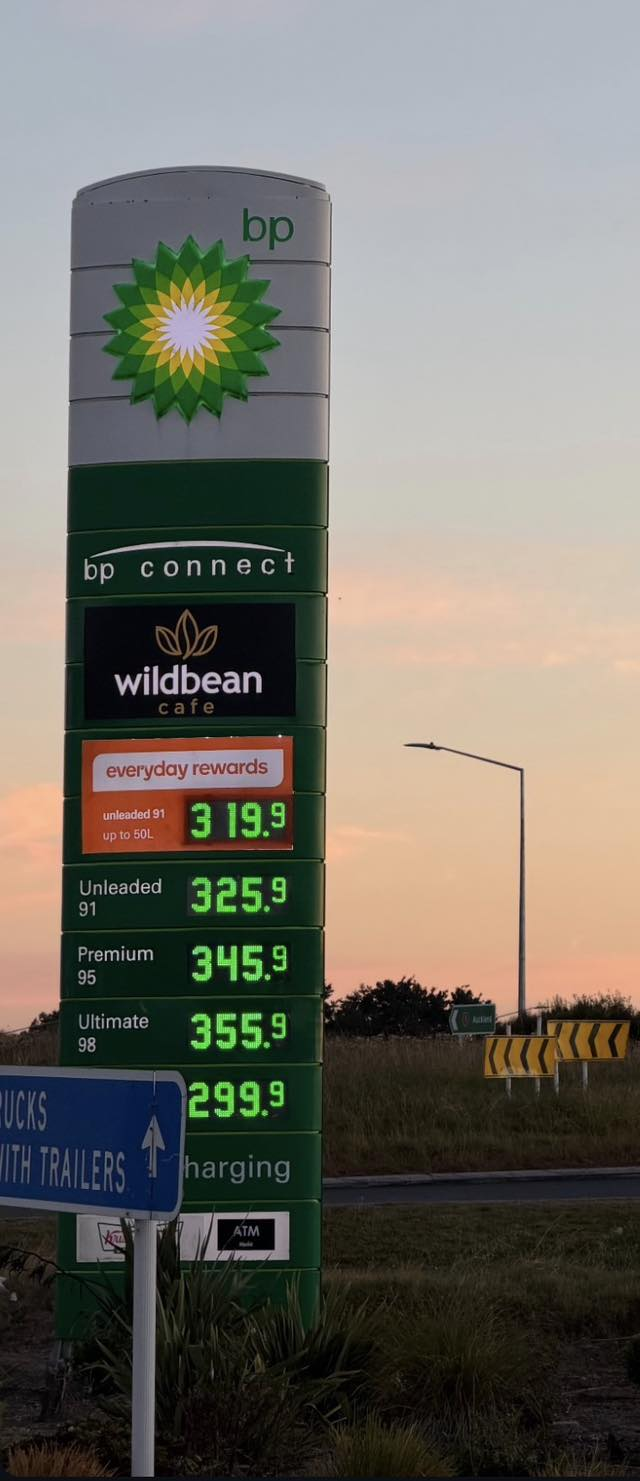
If you think filling up your tank in Sydney or Melbourne is a wallet-draining nightmare, take a look across the Tasman. New Zealanders are currently staring down a fiscal sledgehammer at the bowser. While Australians grumble about prices creeping toward the $2.20 mark, Kiwi motorists have seen the $3.00 barrier shattered with aggressive speed. In some parts of the country, 91 octane is now sitting at a national average of $3.31 per litre. If you’re a fan of premium 95, you’re likely coughing up $3.50 or more.
It’s a brutal reality check. The gap between the two nations has widened into a chasm, leaving New Zealanders wondering why they're paying a "geography tax" that feels more like a heist.
The perfect storm of 2026
The primary culprit is a volatile global market, but that's only half the story. The recent escalation of conflict in the Middle East, particularly around the Strait of Hormuz, has sent crude oil prices on a wild ride. When 20% of the world's oil supply is suddenly under threat, the market doesn't wait for actual shortages to hike the price. It prices in the fear immediately.
New Zealand is uniquely vulnerable here. Since the closure of the Marsden Point refinery in 2022, the country has had zero domestic refining capacity. Every drop of fuel used in New Zealand is imported as a finished, refined product. When global shipping and insurance costs spike due to war, those costs are passed directly to the Kiwi consumer before the tanker even hits the dock.
Australia, while also a net importer, operates on a different scale. With a larger domestic economy and a slightly more diverse supply chain, Australia can often absorb these external shocks with a bit more padding. New Zealand is a small, isolated boat in a very choppy ocean.
The tax man's share
Let's talk about the elephant in the room. Taxes. In Australia, the fuel excise is indexed twice a year. As of February 2026, the Australian excise sits at approximately 52.6 cents per litre. Add 10% GST on top of that, and the government takes a significant, but predictable, bite.
New Zealand's tax structure is a different beast entirely. Between the National Land Transport Fund excise, the ACC levy, and the Emissions Trading Scheme (ETS) costs, the tax component on a litre of Kiwi petrol is roughly 70 cents before you even add the 15% GST.
- Australia: ~52.6c excise + 10% GST.
- New Zealand: ~70c excise/levies + 15% GST.
When the base price of fuel rises, the GST component—calculated as a percentage—balloons. This creates a compounding effect that punishes New Zealanders every time the global price of oil ticks up a dollar.
Why the government won't just cut the tax
Back in 2022, the previous New Zealand government famously slashed 25 cents off the fuel excise to provide relief. Don't expect a repeat of that anytime soon. Finance Minister Nicola Willis has been firm: the books are tight, and a broad tax cut is seen as a "dumb" lever that helps wealthy Porsche drivers as much as it helps struggling families.
The current administration is leaning toward "targeted and temporary" support. This likely means some form of cash injection for low-to-middle-income earners rather than a drop in the price at the pump. From a fiscal perspective, it makes sense. From the perspective of someone staring at a $180 bill to fill a Toyota Corolla, it feels like a slap in the face.
The Australian standard pivot
In a desperate move to secure supply and lower costs, Associate Energy Minister Shane Jones recently announced that New Zealand will temporarily align its fuel standards with Australia’s.
Wait, weren't they already the same? Not quite. New Zealand’s environmental standards for fuel have historically been slightly "cleaner" and tighter than Australia’s. By relaxing these rules for the next 12 months, New Zealand can tap into shipments destined for the much larger Australian market.
It’s a pragmatic, if slightly "dirty," solution. It allows tankers to offload in New Zealand without having to meet niche, country-specific chemical requirements. Will it lower the price? Probably not significantly. But it might stop the "Out of Fuel" signs from appearing at your local Gull station.
What about the diesel drivers
Spare a thought for the trucking industry. Normally, diesel is significantly cheaper than petrol in New Zealand because it doesn't carry the 70c petrol excise at the pump. Instead, diesel users pay Road User Charges (RUC) based on the distance they drive.
Right now, that gap has vanished. Diesel is currently hovering around $3.13 per litre. When you add the RUC on top of that, the cost of moving freight across the country has effectively doubled. This isn't just a "car problem." This is a "everything on the supermarket shelf" problem. Every kilo of apples and every liter of milk is getting more expensive because the truck bringing it to you is burning liquid gold.
Surviving the $3.30 reality
If you're looking for a silver lining, there isn't much of one. The reality is that $3.00+ petrol is likely the new baseline for 2026.
- Use the apps: Gaspy is your best friend right now. The price difference between a station in a wealthy suburb and one five minutes down the road in an industrial zone can be as much as 30 cents.
- Avoid the "Premium" trap: Unless your car’s manual specifically demands 95 or 98, your engine will run just fine on 91. Most modern ECUs can handle it without a hiccup.
- Check your tires: It sounds like something your dad would say, but under-inflated tires can increase fuel consumption by 3%. On a $150 fill-up, that’s five bucks you’re literally throwing away.
The "luck" of the Australians isn't really luck—it's a combination of lower taxes and a larger market. For New Zealanders, the only way out is through. Or, as many are starting to realize, finally trading in the petrol guzzler for something with a plug.
Check your local stations on Gaspy before you head out today. Even a 10-cent difference adds up to a free coffee every time you fill the tank.