The theater lights dim, but the silence isn’t empty. It’s heavy. It’s the kind of expectant hush that usually precedes a miracle or a car crash. In the row in front of me, a seven-year-old girl is vibrating with so much kinetic energy she might actually phase through her seat. She isn’t just waiting for a movie to start. She is waiting to see if the world she feels inside her head—a world of glitching colors and impossible choices—actually exists on the big screen.
Then, the first frame hits.
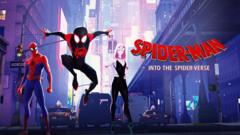
It isn’t the smooth, polished plastic of traditional 3D animation. It’s a riot. It’s a collision of street art, comic book ink, and digital rebellion. This is the world of Miles Morales, and it doesn't just invite you to watch. It demands that you survive it.
The Anatomy of a Visual Fever Dream
Most modern animated films feel like they were processed in a sterile lab. They are mathematically perfect, rendered to a high gloss that feels safe. Miles Morales doesn’t do safe. The animators behind the Spider-Verse saga didn't just push the envelope; they shredded it and used the scraps to create a new language of cinema.
When you look at a frame of this adventure, you aren’t seeing one layer of art. You are seeing a stratigraphic record of human creativity. There are "Kirby Krackle" dots from the Silver Age of comics. There are watercolor washes that bleed into the background when a character feels lonely. There are frame rates that stutter and jump to show a hero who hasn't quite found his footing yet.
Consider the technical audacity required to make a film look "hand-drawn" while using some of the most sophisticated computing power on the planet. The production team had to invent new tools to allow lines to sit on top of 3D models in a way that didn't feel like a cheap filter. They treated every single frame—all 144,000 of them—as a standalone painting.
This isn't just a technical flex. It’s an emotional strategy. By breaking the "perfection" of the image, the creators mirror the fractured, messy, and loud reality of being a teenager in a world that refuses to stop changing.
The Weight of the Mask
We have seen Peter Parker lose Uncle Ben a thousand times. We know the rhythm of the grief. But the story of Miles Morales introduces a terrifying new variable: the Multiverse.
In a standard blockbuster, the Multiverse is a playground for cameos and nostalgia. It’s a "What If" machine. Here, it is a meat grinder. The stakes aren't just about saving a city; they are about the crushing weight of "Canon."
Imagine being told that your life is a script. Imagine being told that the tragedies that define you—the loss of a mentor, the death of a father—are not just accidents, but necessary structural supports for the universe to exist. If you try to save the person you love, you might unravel the fabric of reality.
That is the invisible hook buried in the heart of this "lively, bold" adventure. It asks a question that keeps us up at night: Are we the masters of our fate, or are we just iterations of a pattern we can’t control?
The conflict between Miles and Miguel O'Hara (Spider-Man 2099) isn't a simple fight between good and evil. It’s a philosophical war. Miguel represents the cold, hard logic of the system. He is the algorithm that says some people must suffer so the majority can live. Miles is the glitch. He is the human heart that says, "I don't care about the math. I care about my dad."
A Symphony of Chaos
The music doesn't just sit behind the scenes. It’s a character. Daniel Pemberton’s score is a frantic, beautiful mess of scratching turntables, operatic swells, and punk rock distortion.
When Gwen Stacy enters her home dimension, the world turns into a mood ring. The walls melt into shades of violet and indigo based on her relationship with her father. The music softens, turning into a lonely, echoing synth. Then, when the action kicks back into gear, the beat drops like a physical weight in your chest.
It’s sensory overload, but it’s intentional. We live in an era of constant stimulation, where our phones, our news cycles, and our social lives are all screaming for attention at the same frequency. The Spider-Verse captures that frequency and turns it into art. It acknowledges that life is loud and confusing, and then it tells you that you can still swing through it.
The Ghost in the Machine
There is a moment in the story where Miles is running. Not from a monster, but from a hundred different versions of himself. Every version of Spider-Man you can imagine—a cat, a dinosaur, a cowboy, a Victorian lady—is chasing him down because he refuses to accept the "inevitable" tragedy of his life.
It is a breathtaking sequence, a masterclass in pacing that moves so fast your eyes can barely keep up. But the real tension isn't in the chase. It's in the realization that even in a room full of people who wear the same mask, you can still be utterly alone.
This is where the film transcends being an "animated adventure" and becomes a mirror. We all feel that pressure to conform to the "Canon" of our lives. We feel the pressure to follow the path laid out by our families, our jobs, or our cultures. Breaking away from that path is terrifying. It makes you a target. It makes you an anomaly.
Miles Morales is the patron saint of anomalies.
Why the Colors Bleed
I watched that seven-year-old girl again as the credits rolled. She wasn't vibrating anymore. She was still. She was staring at the screen with a look of profound recognition.
She didn't need to understand the complex physics of "Interdimensional Travel" or the "M-Body Problem." She understood the feeling of being told "no" and deciding that "no" wasn't an answer she was willing to live with.
The brilliance of this narrative isn't just in the bold colors or the frantic action. It’s in the vulnerability of a kid who just wants to go home, even when "home" is a place that hasn't been built yet.
We don't go to these movies to see someone fly. We go to see someone fall, and then decide to get back up while the whole world is screaming at them to stay down. The ink smears, the frames glitch, and the music breaks, because life doesn't happen in high definition. It happens in the messy, blurred lines between who we are and who we are told we have to be.
The screen goes black, but the neon stays behind your eyelids. You walk out of the theater and the streetlights look a little sharper. The city sounds a little more like a song. You realize that the "Spider-Verse" isn't somewhere else. It’s right here, in every choice that refuses to follow the script.
The kid in the row in front of me put on her coat, adjusted a small, plastic mask on top of her head, and stepped out into the rain like she owned the sky.