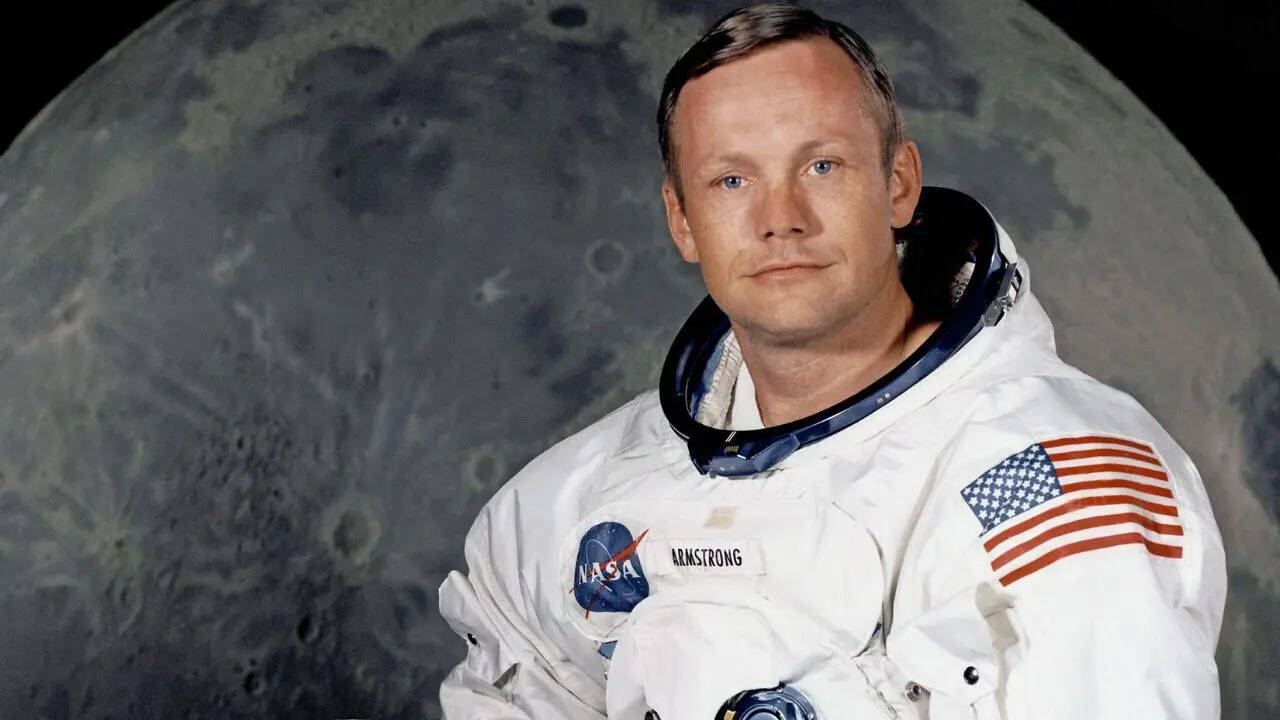
Neil Armstrong didn't just walk on the moon. He understood why we felt the itch to go there in the first place. Most people look at the Apollo missions as a Cold War trophy or a massive engineering flex. But if you listen to what Armstrong actually said about human nature, you realize it was never just about beating the Soviets. It was about an biological imperative that's baked into our DNA.
He famously compared our drive for exploration to salmon swimming upstream. Think about that for a second. A salmon doesn't swim against a brutal current because it wants a better view or a gold medal. It does it because it has to. It's a requirement of its existence. Armstrong argued that humans face challenges because it's in our nature. We don't choose the hard path because we're bored. We choose it because staying still feels like dying.
The biology of the impossible
When Armstrong talked about the "nature of the human being," he wasn't being poetic. He was being practical. If you look at human history, we’re the only species that keeps moving even when the environment tells us to stop. We crossed oceans in wooden boats with no maps. We climbed mountains where the air is too thin to breathe. Space was just the next logical wall to climb.
The "salmon swimming upstream" analogy is the perfect way to describe the Apollo 11 mission. The physics were against them. The technology was primitive by today's standards. Your smartphone has more computing power than the Apollo Guidance Computer, which ran on about 4KB of RAM. They were basically flying a tin can powered by a calculator.
Why do that? Why risk burning up in the atmosphere or drifting into the void?
Because the challenge itself creates the value. If it were easy, it wouldn't define us. Armstrong saw the moon not as a destination, but as a mirror. It reflected our ability to solve problems that seemed impossible a decade earlier.
Why we still need the hard path
We’ve gotten soft. In 2026, we’re surrounded by convenience. You can get food delivered in twenty minutes without moving from your couch. You can talk to anyone on the planet instantly. But there’s a psychological cost to all that ease. We’re losing the "upstream" grit that Armstrong lived by.
The reason that 1969 quote still hits hard today is that it reminds us of what we’re missing. We need big, scary goals. Whether it’s putting boots on Mars or fixing the climate, these aren't just technical hurdles. They’re soul-level requirements. If we stop facing challenges, we stop being the version of humanity that survives the long haul.
Look at the current state of space exploration. Companies like SpaceX and Blue Origin aren't just fighting for market share. They’re tapping into that same salmon instinct. They’re building Starships because the alternative—staying on one planet forever—is a evolutionary dead end. Armstrong knew this intuitively. He didn't see space travel as a luxury. He saw it as a necessity.
The salmon instinct in your daily life
You don't have to be an astronaut to get what Armstrong was saying. The "upstream" mentality applies to everything from starting a business to learning a difficult skill.
Most people quit when they hit the current. They think the resistance means they're doing something wrong. Armstrong’s perspective suggests the opposite. The resistance means you’re exactly where you’re supposed to be. If you aren't feeling the pushback, you're just floating downstream with the debris.
Breaking down the challenge mindset
- Expect the resistance. Don't act surprised when things get tough. It's part of the design.
- Ignore the "why" sometimes. Salmon don't sit around debating the merits of the stream. They just swim. Stop overthinking and start doing.
- Value the struggle over the result. The moon landing was great, but the 400,000 people who worked on the project were changed by the process of solving the problems.
What Armstrong got right about the future
Critics in the 1960s argued that the money spent on Apollo should have been spent on Earth. You still hear that today about Mars missions. It's a common argument, but it misses the point. We don't solve Earth's problems by looking down. We solve them by being the kind of people who can look up.
The technology developed for the moon gave us everything from better heart monitors to the GPS you use to find a coffee shop. But more than that, it gave us a sense of scale. It showed us that we aren't just inhabitants of a town or a country. We're a species that can leave the cradle.
Armstrong was a quiet guy. He wasn't a loud-mouthed visionary. He was a pilot who focused on the dials and the drift. When he spoke about the "nature of the human being," it carried weight because he had actually pushed that nature to its absolute limit. He knew that the moment we stop swimming upstream is the moment we start becoming obsolete.
Stop looking for the path of least resistance. It leads nowhere interesting. Find your own version of the moon. Find the thing that makes you feel like you're swimming against the tide. That’s where the growth is. That’s where you actually find out what you’re made of.
The next time you’re facing a project that feels too big or a goal that feels out of reach, remember the salmon. Don't wait for it to get easier. It won't. Just keep swimming. It's what you were built to do.
Go find a problem that scares you and start solving it. Don't ask for permission and don't wait for the "perfect" time. There isn't one. There’s just the current and your willingness to push back against it. That’s the only way we’ve ever moved forward. That’s the Armstrong way. Move now.