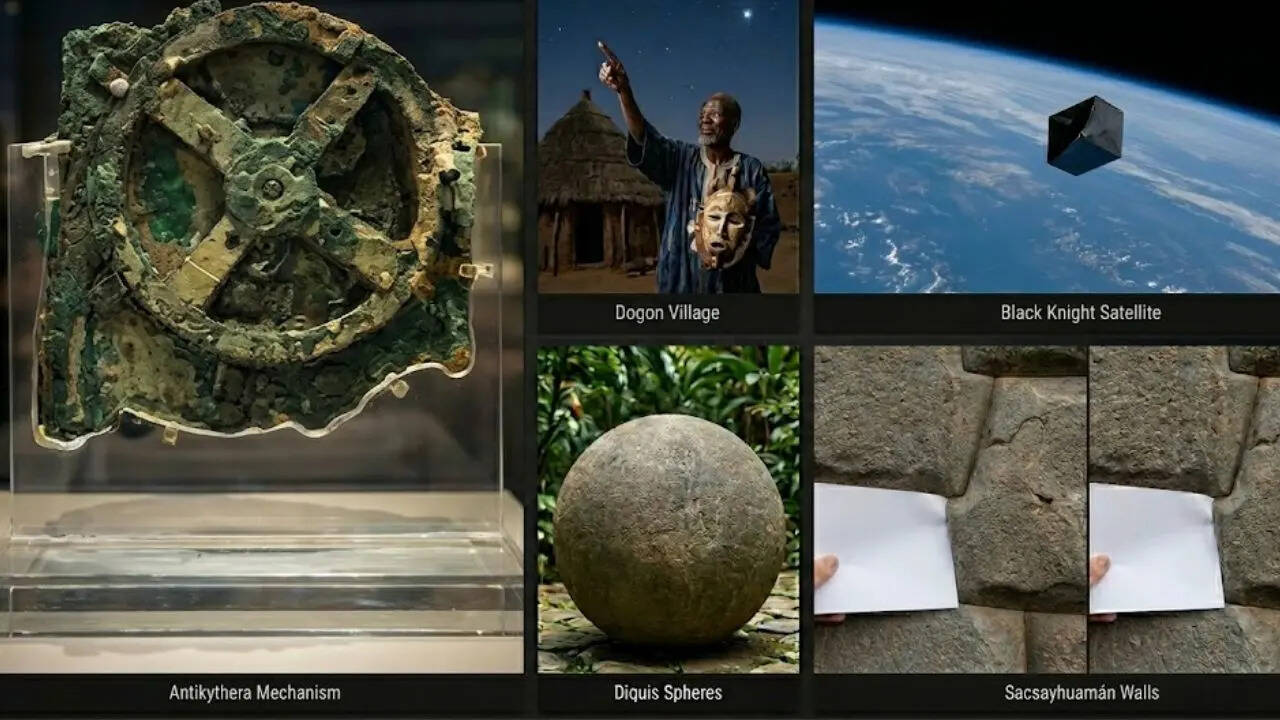
The Soft Bigotry of Low Expectations
Every time a "10 Signs Aliens Visited Earth" listicle goes viral, a historian loses their mind—and for good reason. Most of these arguments aren't based on evidence; they’re based on a profound, almost pathological inability to believe that our ancestors were cleverer than us. We look at the Great Pyramid of Giza or the megaliths at Puma Punku and think, "I couldn't do that with my smartphone and a weekend at Home Depot, so a Neolithic farmer definitely couldn't do it without a laser-guided spaceship."
This is the "God of the Gaps" fallacy rebranded for the sci-fi era. We find a gap in our understanding of ancient logistics, and instead of filling it with rigorous experimental archaeology, we fill it with little green men. It’s lazy. It’s uninspired. And frankly, it’s an insult to human ingenuity.
The "Impossible" Stone Masonry Myth
The most common "evidence" cited for ancient extraterrestrial intervention is the precision of stone cutting. You’ve heard the pitch: "The stones are so tight you can’t fit a razor blade between them."
Here is the truth that the "insiders" won't tell you: Abrasives and time are more powerful than any plasma cutter. When you have a workforce of 20,000 people and a decade to finish a wall, you don't need "advanced technology." You need sand, water, and friction. Experimental archaeologists like Mark Lehner have proven this repeatedly. By using copper saws and desert sand (which contains quartz), you can cut granite. By "scribing and coping"—a technique still used in log cabin building today—you can match irregular stone faces with terrifying precision.
The mystery isn't how they did it. We know how. The mystery is why we’ve become so detached from physical labor that we think grit and patience are "alien" concepts.
The Nazca Lines Are Not Runways
Proponents of the "ancient astronaut" theory love the Nazca Lines. They claim these massive geoglyphs in the Peruvian desert were landing strips for spacecraft.
Think about that for two seconds. If you have the technology to travel across interstellar space, do you really need a dirt runway in the middle of a plateau? If you can manipulate gravity or fold space-time, are you landing a Cessna?
The Nazca Lines were meant to be seen by gods, yes—but the terrestrial kind. They are ritual pathways. Many of them correlate with underground aquifers or water sources in one of the driest places on Earth. They aren't aeronautical charts; they are a desperate, beautiful, large-scale prayer for rain. Using them as "proof" of aliens is like finding a cathedral and assuming it’s a garage for a hover-car because the ceiling is high.
The Piri Reis Map is Not a Satellite Image
You’ll often see the 1513 map by Ottoman admiral Piri Reis cited as evidence of "impossible knowledge" because it supposedly shows the coastline of Antarctica without ice. The logic follows that only an aerial survey from space could have mapped a sub-glacial continent thousands of years ago.
Except it doesn't show Antarctica. It shows a distorted South American coastline that curves to the east. Cartographers of the era frequently guessed at the "Southern Continent" (Terra Australis Incognita) because they believed the globe needed a landmass at the bottom to stay balanced. Furthermore, the notes on the map itself state it was compiled from earlier Portuguese charts. There are no satellites in this equation—just a lot of sailors trying to navigate by the stars and occasionally getting the scale wrong.
The Baghdad Battery is a Paperweight
The "Baghdad Battery" is the darling of the "ancient tech" crowd. It’s a clay jar, a copper cylinder, and an iron rod. If you fill it with vinegar, it produces a tiny electrical charge. "Alien power source!" the headlines scream.
In reality, it’s a mediocre lemon-battery. Even if it produced a current, there is zero evidence of anything to plug it into. No wires. No lightbulbs. No circuit boards. The most likely use? Electroplating jewelry or, more likely, a storage vessel for scrolls that happened to use acidic bitumen for sealing. We have thousands of these jars; we have zero ancient iPhones. The math doesn't add up.
Why We Want to Believe
The obsession with historical alien intervention isn't about science. It's about a deep-seated desire to feel like we are part of a larger, galactic community. It’s a secular religion. If we can prove aliens were here in the past, it guarantees they’re out there in the present.
But when we outsource our achievements to extraterrestrials, we lose our own history. We stop seeing the Great Wall or the Moai of Easter Island as monuments to human endurance and start seeing them as "tech demos" for a superior race.
I’ve spent years looking at "anomalous" data. I've seen how easy it is to cherry-pick a weird-looking petroglyph and call it a "man in a spacesuit" while ignoring the 500 other drawings in the same cave that clearly show hunters with spears. It’s pareidolia on a global scale.
The Fermi Paradox vs. The "Signs"
If aliens were here 5,000 years ago, where is the trash?
Humanity has been in space for less than a century, and we’ve already littered the Moon, Mars, and Earth’s orbit with titanium, ceramics, and radioactive isotopes. If an interstellar civilization was mining gold in Africa or building pyramids in Egypt, we would find more than just "tightly fitting rocks." We would find non-terrestrial alloys. We would find isotopes that don't occur naturally in our solar system. We would find a discarded wrench.
Instead, we find flint. We find copper. We find hemp rope.
The "signs" aren't in the stones. They are in our own lack of imagination. We find it easier to believe in a galactic federation than in the idea that a group of people could move a 70-ton block of granite using nothing but wooden rollers and a lot of singing.
Stop Asking the Wrong Question
The question shouldn't be "Did aliens help build the pyramids?"
The question should be "Why are we so desperate to believe we couldn't have built them ourselves?"
The "Ancient Alien" industry is built on a foundation of Eurocentric bias. Notice how these theories rarely target the Roman Colosseum or the Parthenon? They almost always target the achievements of non-European civilizations. "The Greeks? Oh, they were geniuses. But the Maya? Must have been aliens." It’s a subtle, pervasive form of intellectual colonialism that replaces indigenous ingenuity with "celestial visitors."
The Brutal Truth
We are alone in our history. There was no manual handed down from the stars. There were no "sky gods" teaching us how to farm. There was only us—cold, hungry, and incredibly resourceful.
When you look at a megalithic structure, don't look for the hand of an alien. Look for the calluses on the hands of your ancestors. They did the impossible with nothing. They didn't have lasers; they had something better: a mastery of the physical world that we, in our digital haze, can no longer comprehend.
Stop looking at the sky. Look at the dirt. That's where the real magic happened.
The "10 signs" are just 10 ways we’ve forgotten how to be human.