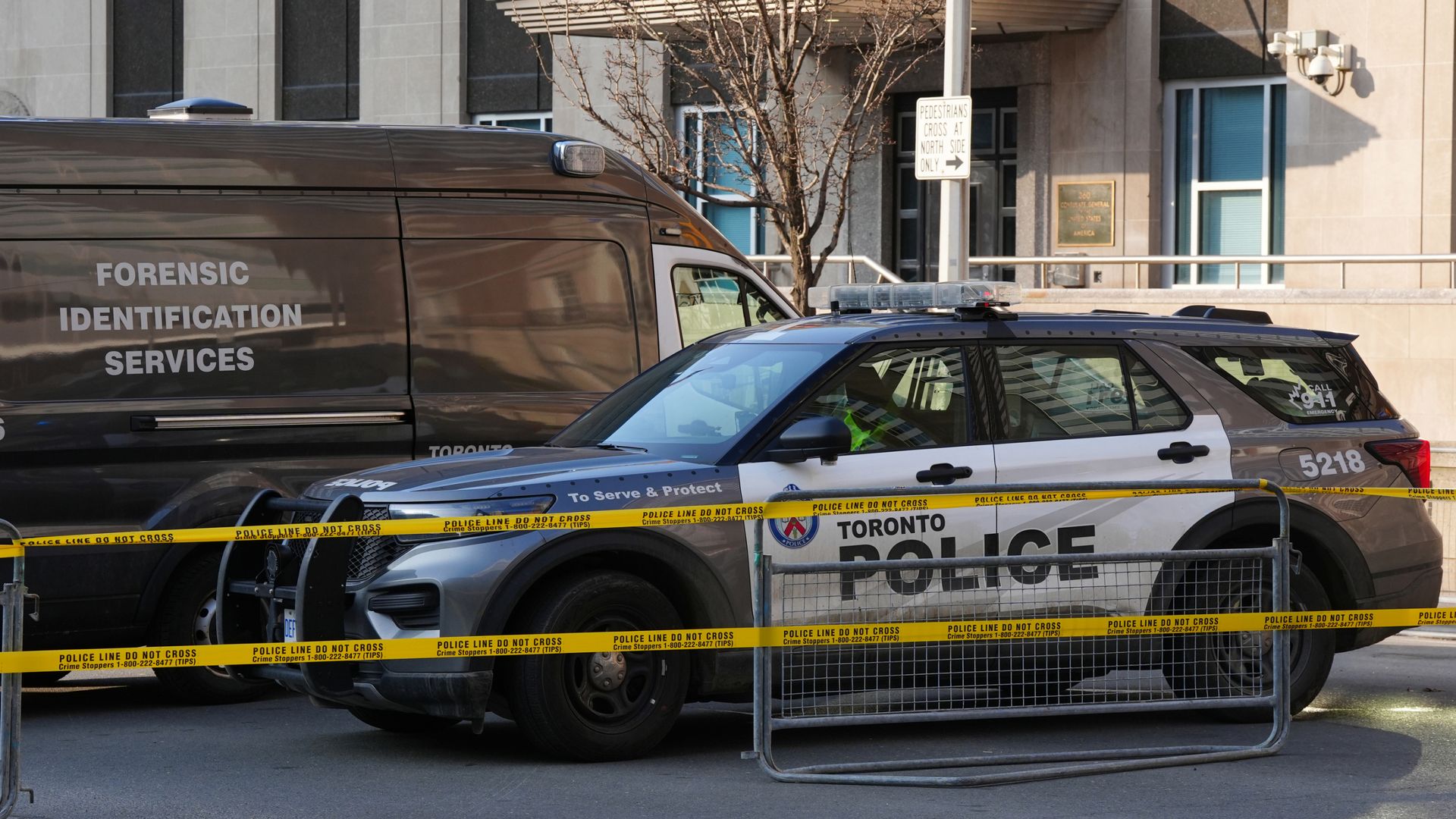
The siren blares. The yellow tape goes up. Within twenty minutes, the "National Security" label is slapped onto the incident like a protective seal of institutional importance.
When shots were fired at the US Consulate in Toronto, the script followed the standard, predictable trajectory. Intelligence agencies mobilized, "security experts" filled the airwaves with speculation about geopolitical fallout, and the public was told to look for a grand, orchestrated threat. This is the lazy consensus. It is a comforting lie that protects the ego of the state by suggesting every act of violence is part of a high-stakes chess match.
It’s time to stop romanticizing chaos.
Labeling every localized act of violence at a diplomatic post as a national security incident doesn't make us safer. It makes us dumber. It obscures the messy, uncoordinated, and increasingly digitized reality of modern radicalization and mental health failure. By treating a lone actor with a firearm like a sovereign threat, we feed the very beast we claim to fight.
The Mirage of the Mastermind
Bureaucracies love the term "national security." It justifies budgets. It expands mandates. It allows for the suspension of normal judicial scrutiny. When the Toronto Police Service and the RCMP pivot to this language, they aren't just describing a crime; they are elevating it.
I’ve spent years watching the intelligence apparatus chew through data, and I can tell you the dirty secret: they would much rather deal with a state-sponsored cell than a bored, isolated individual with an internet connection and a grudge. A state actor is predictable. A state actor has an ROI. A state actor can be deterred with sanctions or back-channel threats.
The "national security" framework assumes a hierarchy and a mission. But look at the data on global diplomatic attacks over the last decade. The shift has moved away from the "spectaculars"—the 1998 embassy bombings or the Iran hostage crisis—toward the erratic. We are seeing the rise of the "Stochastic Terrorist," where vague online rhetoric triggers a random individual to act without a single direct order ever being sent.
When we call this a national security incident, we validate the shooter's delusion. We grant them the status of a soldier in a global war rather than a criminal in a local jurisdiction.
The Security Theater of Consular Walls
Consulates are built like fortresses for a reason, yet they remain inherently vulnerable because they are public-facing. You cannot have a "diplomatic mission" if you are completely sealed off from the population.
The competitor's narrative focuses on the breach—the fact that bullets hit a building. They treat this as a failure of the perimeter. This is a fundamental misunderstanding of how security works in a dense urban environment like Toronto.
A consulate in a major city is a "soft-hard target." It has reinforced glass and armed guards, but it exists on a public sidewalk. If someone wants to pull a trigger from fifty yards away, no amount of "national security" labeling will stop the bullet.
The real failure isn't the physical gate; it’s the predictive intelligence that ignores the "gray zone" between petty crime and high-level terrorism. We spend billions on intercepting encrypted foreign cables while ignoring the person posting manifestos on a public forum because they don't fit the "foreign threat" profile.
The Canadian Myth of Immunity
There is a specific brand of Canadian shock that accompanies these events. "It doesn't happen here," is the refrain. This is the most dangerous misconception of all.
Canada has long positioned itself as the "polite neighbor," a middle power that avoids the ire of global radicals. This is a fantasy. Canada is a G7 nation, a NATO member, and an integral part of the Five Eyes intelligence community. More importantly, it shares a massive, porous digital border with the United States.
The radicalization pipelines do not stop at the 49th parallel. Whether it’s the 2014 Parliament Hill shooting or more recent vehicular attacks, the common thread isn't a foreign directive. It’s the domestic echo chamber.
By framing the Toronto consulate shooting as a "national security" issue, the authorities often try to shift the focus outward. It’s an attempt to find a foreign boogeyman to blame, rather than addressing the fact that Canadian society is just as susceptible to the fragmentation and violent isolation seen south of the border.
Stop Asking Who Sent Him and Start Asking Who Watched Him
The standard press conference asks: "Is there a link to a foreign group?"
This is the wrong question. In the current era, the "link" is a browser history, not a paycheck from a handler.
We need to dismantle the premise that an attack on a consulate is inherently a "security" failure. It is often a "social" failure. When we analyze these incidents through the lens of geopolitics, we miss the behavioral markers that actually matter.
The Profile of the Modern Threat
- Digital Isolation: They aren't in training camps; they are in forums.
- Mimicry: They copy the aesthetics of previous attackers.
- Weapon Accessibility: They use whatever is at hand, often legally acquired or poorly tracked.
- The Need for Scale: They choose symbolic targets—like a consulate—to ensure their name enters the national security record.
By playing along, the media and the government give the attacker exactly what they want: a legacy.
The Economic Cost of the National Security Label
Every time an incident is escalated to "national security," the cost to the taxpayer triples. You aren't just paying for the investigation; you're paying for the "inter-agency coordination," the "specialized task forces," and the "preventative measures" that usually involve adding more concrete barriers to a sidewalk that was already safe.
We are over-investing in the "aftermath" and under-investing in the "environment."
Imagine a scenario where the millions of dollars redirected into a "national security" probe were instead funneled into real-time digital threat assessment that doesn't rely on flagging keywords like "explosive," but instead identifies patterns of escalating social withdrawal and violent intent. That is where the battle is actually won. But that doesn't look as good on the evening news as a tactical team in a high-rise.
The Risk of the Counter-Intuitive Approach
Admittedly, treating a consulate shooting as "just a crime" carries a political risk. If it turns out there was a deeper conspiracy, the administration looks negligent. So they over-correct. They treat every spark like a forest fire because it’s safer for their careers.
But this over-correction has a body count. It creates a "cry wolf" effect. When everything is a national security crisis, nothing is. The public becomes desensitized to the siren, and the actual intelligence analysts get buried under a mountain of low-level "noise" from every lone-wolf incident that gets inflated into a global plot.
Stop Validating the Narrative
The Toronto consulate shooting was a failure of domestic stability and individual sanity. It was not a tactical strike against the United States of America.
When we stop pretending that every person with a gun and a symbolic target is a mastermind, we take away their power. We turn a "national security incident" back into what it really is: a pathetic, violent outburst by someone who wanted to feel important.
Stop giving them the satisfaction. Stop the theater. Treat the crime, ignore the "message," and clear the tape.