A merchant in Tashkent does not look at a map the way a diplomat in Washington or a strategist in Moscow does. To the merchant, the map is a series of walls. To the north, the vast, freezing expanse of Russia. To the west, the jagged, sanctioned barrier of Iran. For thirty years, Central Asia has been a room with only two doors, and both of them are increasingly heavy to push open.
Uzbekistan, Kazakhstan, and their neighbors are "doubly landlocked." This is a sterile geographical term that feels much heavier when you are trying to move a ton of cotton or a crate of electronics to the global market. It means you must cross at least two different borders just to see the ocean. For decades, the only way out was through the old Soviet veins—railways that lead to the Baltic or the Black Sea. But those veins are constricted. War, sanctions, and shifting alliances have turned the traditional routes into a logistical nightmare.
Now, there is a plan to cut a new door. It involves steel, dynamite, and a staggering amount of political nerve.
The Ghost of the Hindu Kush
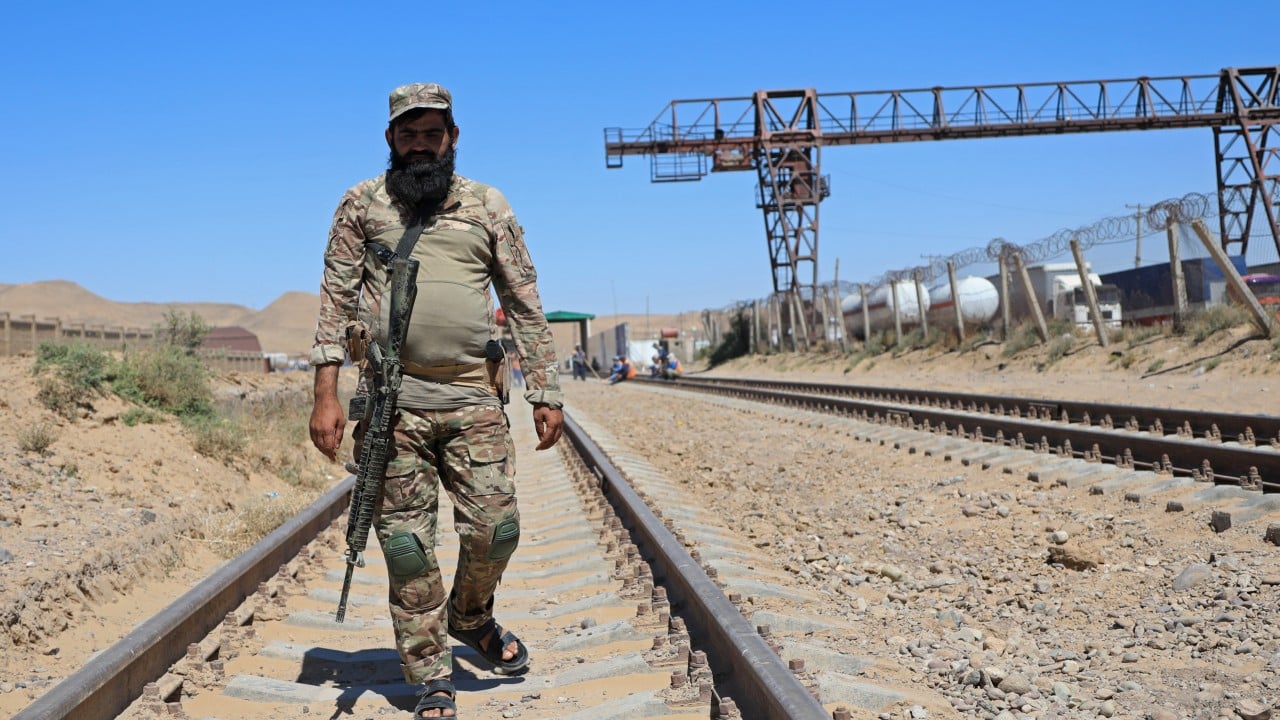
Imagine a surveyor standing on a mountain pass in the Hindu Kush. The air is thin enough to make your head throb. Below him lies Afghanistan—a land that has swallowed empires and defeated the grandest of engineering dreams. This is where the Trans-Afghan Railway is meant to go.
The project is known as the UAP: Uzbekistan-Afghanistan-Pakistan. It is a $5 billion wager that geography can finally be defeated by economic desperation. The goal is to lay 760 kilometers of track from Termez, through the heart of the Afghan mountains, and down into the dusty plains of Pakistan, ending at the Arabian Sea ports of Karachi or Gwadar.
It sounds impossible. In many ways, it is.
To build a railway here, you aren't just laying sleepers and spikes. You are navigating a vertical labyrinth. The trains must climb to altitudes where engines choke and then descend through tunnels that haven't been carved yet. Then there is the human element. For a hypothetical project manager—let's call him Bakhtiyor—the technical challenge is secondary to the security one. Bakhtiyor knows that every mile of track is a target. Every bridge is a potential flashpoint.
Yet, for the first time in history, the people holding the guns in Kabul are the ones asking for the locomotives.
The Price of a Detour
Why take the risk? Why send billions of dollars into one of the most volatile regions on Earth?
The answer is found in the math of a shipping container. Currently, if a businessman in Samarkand wants to send goods to Southeast Asia, the journey can take 35 to 45 days. It is a slow, expensive crawl through a geopolitical minefield. If the Trans-Afghan Railway succeeds, that journey drops to 10 or 12 days.
Costs would plummet by 40 percent.
That is not just a "business advantage." It is a transformation of reality. It is the difference between a small factory in Namangan staying local or becoming a global supplier. When you reduce the cost of distance, you breathe life into cities that history had forgotten. Central Asia isn't looking for a "game-changer"—they are looking for an exit.
The Invisible Chains
Russia has long viewed Central Asia as its "backyard," a phrase that carries the weight of 19th-century imperialism. The railway gauge is a silent witness to this. In the former Soviet Union, the tracks are wide—1520 millimeters. In Pakistan and most of the world, they are narrower. This difference is a physical manifestation of an old wall. At every border, cargo must be lifted from one train and placed on another. It is a slow, rhythmic reminder of who used to be in charge.
By pushing south, Uzbekistan and its neighbors are signaling an end to the monopoly. They are not necessarily turning their backs on Moscow, but they are tired of having only one phone number to call when they need to move freight.
But the path south isn't a simple paved road. Pakistan is currently grappling with an economic crisis that makes $5 billion look like a fairy-tale sum. Afghanistan remains a pariah state in the eyes of the global banking system. Who pays for the steel? Who insures the cargo?
The World Bank and the Asian Development Bank are watching from the sidelines, hesitant to touch a project that involves the Taliban. Into this vacuum steps Qatar and the United Arab Emirates, looking for influence and long-term returns. They see what the West often misses: the center of gravity is shifting.
A Tale of Two Gauges
Consider the logistics of the "break of gauge."
In the hypothetical town of Mazar-i-Sharif, the broad tracks from the north meet the proposed tracks of the south. This is the friction point. It is a place of massive cranes and sweating laborers. It is also where the dream of a "Middle Corridor" faces its toughest test.
If the UAP railway is built, it creates a vertical spine for Eurasia. It bypasses the northern routes that are currently choked by the war in Ukraine. It bypasses the western routes through Iran that are haunted by the specter of sanctions. It creates a straight shot from the heart of the Silk Road to the warm waters of the Indian Ocean.
But the mountains don't care about trade deficits. The Hindu Kush is a wall of granite and ice. To conquer it, engineers must design a path that can withstand tremors, landslides, and the sheer weight of history.
The Stakes of the Silent Majority
We often talk about these projects in terms of "geopolitical pivots," but the real stakes are found in the markets of Peshawar and the warehouses of Tashkent.
There is a young woman in Termez, perhaps, who dreams of exporting silk scarves to Dubai. Right now, her overhead is too high. The transport kills her margin. To her, the railway isn't a strategic masterstroke; it’s a paycheck. It’s the ability to expand. It’s a reason to stay in her hometown instead of migrating for work.
The invisible stakes are the lives of millions who have been sidelined by the accident of geography. Central Asia is a region of immense potential—gas, minerals, agriculture, and a young, hungry population—trapped in a cage of land.
The railway is a gamble that the world can be reordered. It assumes that trade is a stronger force than tribalism. It bets that a Taliban official and a Pakistani general and an Uzbek minister can all agree on the sanctity of a bill of lading.
The Long Road to the Sea
Is it a pipe dream?
Skeptics point to the 19th-century "Great Game," where Britain and Russia used these same mountain passes to checkmate one another. They argue that the terrain is too harsh and the politics too toxic. They might be right. The history of this region is littered with the rusted remains of ambitious projects.
But there is a different energy in the air today. There is a sense of "now or never." The war to the north has proven that relying on a single corridor is a form of slow-motion economic suicide. The isolation of the past few years has acted as a catalyst, turning a "maybe one day" project into an "at any cost" necessity.
Work has already begun on the feasibility studies. Surveyors are out there now, squinting through transit levels at the formidable peaks. They are measuring the distance between where they are and where they need to be.
The map is changing. Not because someone drew a new line on a piece of paper, but because the pressure inside the room has become too great. The walls are finally starting to crack.
High in the Salang Pass, the wind still howls through the rocks, indifferent to the ambitions of men. But soon, if the gamble pays off, that wind will be joined by a new sound. It will be the low, rhythmic thrum of a heavy diesel engine, pulling a mile of steel toward a sea that has been out of reach for a thousand years.