The National Film and Sound Archive (NFSA) has officially inducted the raw news footage of Jack Karlson’s 1991 arrest into its permanent collection. It is a moment of cultural canonization for a video that has spent three decades evolving from a local news curiosity into a global shorthand for anti-authoritarian flair. While the "Succulent Chinese Meal" video is often treated as a punchline, its inclusion in the national vault marks a serious acknowledgement of how digital folklore preserves history more effectively than traditional monuments. The NFSA isn't just archiving a meme; they are preserving a rare specimen of Australian performance art masquerading as a police procedural.
The Anatomy of a Masterpiece
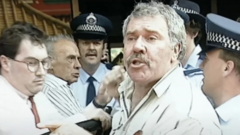
To understand why this footage matters, one must look past the humor. Most people arrested on camera look desperate or defeated. Jack Karlson looked like he was opening a gala. As police wrestled him into a sedan outside the China Sea Restaurant in Fortitude Valley, Brisbane, he didn't scream for a lawyer. He projected his voice to the back of the room, narrating his own arrest with the booming resonance of a Shakespearean lead. Also making headlines in this space: Finland Is Not Keeping Calm And The West Is Misreading The Silence.
"Gentlemen, this is democracy manifest," he bellowed, turning a routine police operation into a critique of the state. He questioned the officers' knowledge of judo. He mourned the interruption of his dinner. He became a folk hero because he refused to let the indignity of handcuffs strip him of his vocabulary.
Why the NFSA Moved Now
The timing of this induction isn't accidental. Australia’s national identity is shifting. The old tropes of "the bushman" or "the ANZAC" are being supplemented by "the online legend." The NFSA recognizes that cultural heritage is no longer strictly about feature films like Mad Max or The Castle. It is found in the accidental captures of the nightly news. Further insights into this topic are explored by The New York Times.
The "Succulent Chinese Meal" clip represents a specific era of Australian media—the grainy, high-contrast video of the 1990s where the lines between reality and farce were perpetually thin. By elevating this footage, the archive acknowledges that our collective memory is built on these shared digital touchpoints. If future generations want to know what it felt like to live in a country that values a "larrikin" spirit even in the face of the law, they won't look at a textbook. They will look at Jack.
The Myth of the Serial Dine and Dasher
For years, the narrative surrounding Karlson was that he was a prolific fraudster who made a career out of eating for free. The reality is more nuanced. Karlson, who passed away in 2024, was a man of many identities, often linked to the colorful underworld of 20th-century Australia. His arrest in 1991 was actually a case of mistaken identity; police believed he was a notorious Hungarian credit card fraudster.
He wasn't. He was just a man trying to enjoy his lunch.
This error adds a layer of genuine tragedy to the comedy. When he shouts about "democracy manifest," he isn't just being theatrical—he is legitimately protesting an unjust detention. The irony of the situation is that the police’s failure to identify their suspect correctly gave birth to the most famous arrest in the history of the southern hemisphere.
Beyond the Catchphrases
The impact of this video on the Australian psyche is difficult to overstate. It has inspired stage plays, orchestral remixes, and thousands of t-shirts. But its most profound legacy is the way it changed how we consume "failure."
In the pre-internet age, an arrest was a mark of shame. In the era of the viral video, Karlson’s arrest became a badge of honor. He showed that you can lose the physical fight—you can be shoved into the back of a car—and still win the rhetorical one. He didn't just resist arrest; he critiqued the aesthetics of it.
A Legacy in the Vault
Placing this footage in the NFSA ensures it will be preserved in its highest possible quality, protected from the bit-rot that claims so much of our early digital history. It sits alongside the first recorded sounds of the lyrebird and the flickering frames of the 1906 film The Story of the Kelly Gang.
It belongs there. Jack Karlson was a man who understood the power of the moment. He knew that when the cameras are rolling, you don't just sit there. You give them a show. You talk about the succulent meal. You ask about the judo. You ensure that thirty years later, a government institution has no choice but to admit that your voice was too big to be silenced by a pair of handcuffs.
The archive has finally caught up to the man. They have him by the metaphor, and they aren't letting go.