The map on the wall of a Pentagon briefing room doesn’t feel the heat of the Syrian desert or the humidity of a transport plane. To the planners in Washington, the Middle East is a series of interconnected nodes, supply lines, and "areas of responsibility." But for the families staring at news tickers in Fayetteville, Killeen, or Watertown, the geography is much more intimate. It is the distance between a dinner table and a video call that may or may not connect.
Recent reports suggesting the U.S. is considering the deployment of up to 10,000 additional troops to West Asia aren't just about geopolitics. They are about the sudden, sharp intake of breath in living rooms across America. When the numbers get that high, the abstraction of "national interests" evaporates. It gets replaced by the very real, very heavy weight of gear bags being pulled out of attic storage.
Strategic shifts often happen in whispers before they manifest in the roar of jet engines. The Pentagon currently maintains a presence that fluctuates, but a jump of 10,000 personnel signals a transition from "monitoring" to "fortifying." It is a massive logistical undertaking. Imagine the sheer volume of water, fuel, medical supplies, and mail required to sustain a small city’s worth of people in a region where the political temperature is as volatile as the climate.
Consider a hypothetical sergeant named Elias. He’s spent the last six months coaching his daughter’s soccer team and finally getting the lawn to look the way he wants. He hears the news not through a formal briefing, but through a notification on his phone while waiting in the checkout line at the grocery store. The 10,000 aren't a monolith. They are 10,000 Eliases. They are 10,000 stories of interrupted lives, paused careers, and the quiet, stoic anxiety of spouses who have learned to live in a state of permanent "maybe."
The official reasoning for such a move usually centers on deterrence. The logic is simple: by placing more pieces on the board, you convince the opponent not to move theirs. It’s a high-stakes poker game played with human lives. The U.S. aims to protect its assets, reassure its allies, and signal to adversaries that the door is barred.
The tension lies in the paradox of presence. Sometimes, adding more troops calms a situation by providing a sense of overwhelming stability. Other times, it acts like a lightning rod, drawing the very fire it was meant to prevent. The historical record is a messy, complicated ledger of both outcomes.
Policy experts debate the "footprint" constantly. A heavy footprint implies a long-term commitment, a signal that the U.S. isn't going anywhere. A light footprint suggests agility but risks being caught unprepared. When the number 10,000 is floated, the scale tips decisively toward the heavy. This isn't a surgical strike team or a handful of advisors. This is an infrastructure of influence.
Behind the scenes, the logistics are a symphony of controlled chaos. Every one of those 10,000 individuals needs a place to sleep, a way to communicate home, and a clear understanding of their rules of engagement. The "dry facts" of a news report rarely mention the procurement officers scrambling to secure short-term leases for heavy lift aircraft or the medics updating thousands of immunization records in a matter of forty-eight hours.
The strain on the force is a shadow that follows every deployment talk. The military has been running at a high tempo for decades. The "revolving door" of deployments wears down the equipment, but more importantly, it wears down the spirit. Resiliency is a buzzword in military circles, but in reality, it’s a finite resource. You can only ask a person to pack their life into a duffel bag so many times before the seams start to fray—not just on the bag, but on the family unit itself.
The regional players in West Asia watch these numbers with a different kind of intensity. For an ally, those 10,000 troops are a security blanket, a physical manifestation of a treaty. For a rival, they are a provocation, a "encirclement" that demands a counter-move. This is how the cycle of escalation begins. One side moves to feel safe; the other side sees that move and feels less safe, so they move in turn.
The cost isn't just measured in the billions of dollars allocated by Congress. The true cost is found in the missed anniversaries, the birthdays celebrated over a grainy FaceTime connection, and the psychological toll of hyper-vigilance. There is a specific kind of silence that settles over a military town when a major deployment is rumored. The local bars are a little quieter. The grocery stores feel a little emptier. The community holds its collective breath, waiting to see whose name is on the manifest.
We often talk about these movements as if they are inevitable, like the weather. But they are the result of choices made in wood-paneled rooms by people who will never have to sleep in a tent in the desert. That isn't a critique of the leadership; it's a fundamental reality of the hierarchy. The distance between the decision and the dirt is vast.
If the 10,000 go, they will go with the professionalism that defines the modern American soldier. They will do the job. They will build the berms, monitor the screens, and maintain the vehicles. They will exist in a state of "readiness," which is a polite way of saying they will spend months waiting for something terrible to happen while hoping it doesn't.
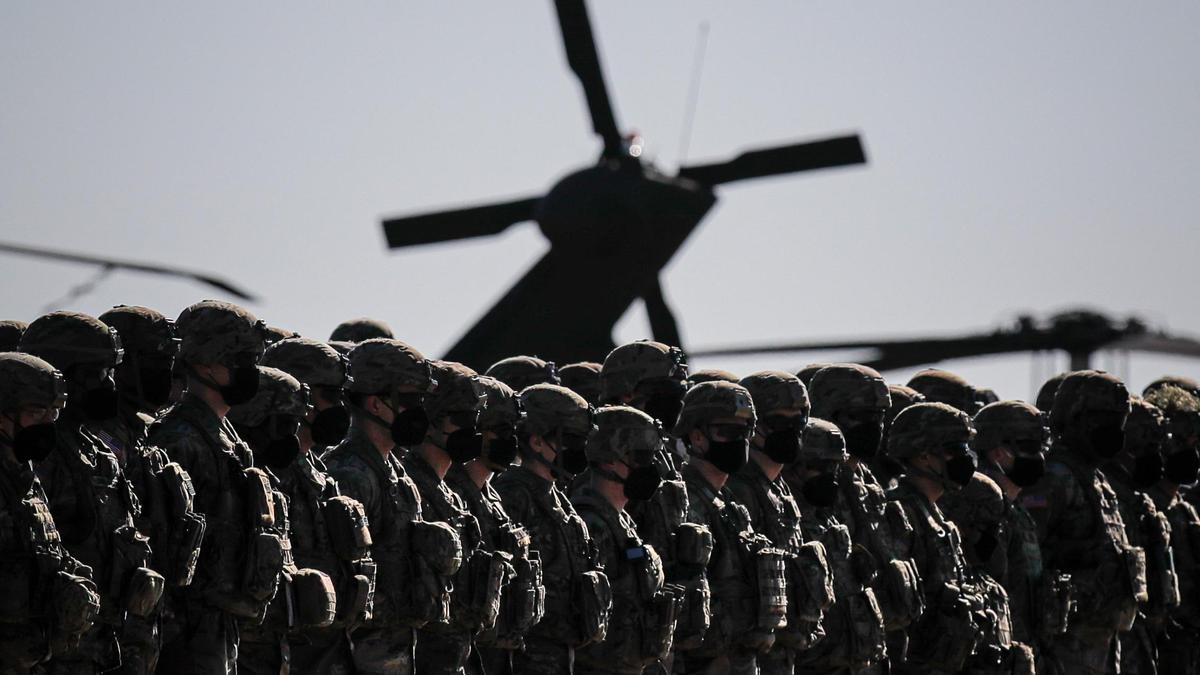
The numbers in a headline are easy to digest. They are round, clean, and clinical. But 10,000 is a stadium. It’s a mid-sized town. It’s a sea of faces, each with a mother, a father, a partner, or a child. When we discuss the "weighing" of sending these troops, we are weighing the stability of a region against the stability of thousands of American homes.
The gear bags stay by the door. The phones stay charged. The map in the Pentagon remains unchanged, its little blue icons representing a force ready to move. But out in the world, the wind is picking up, and the sand is starting to shift under those ten thousand sets of boots.
A single pair of boots sitting by a front door in Georgia tells more about the state of the world than any three-page policy brief ever could.