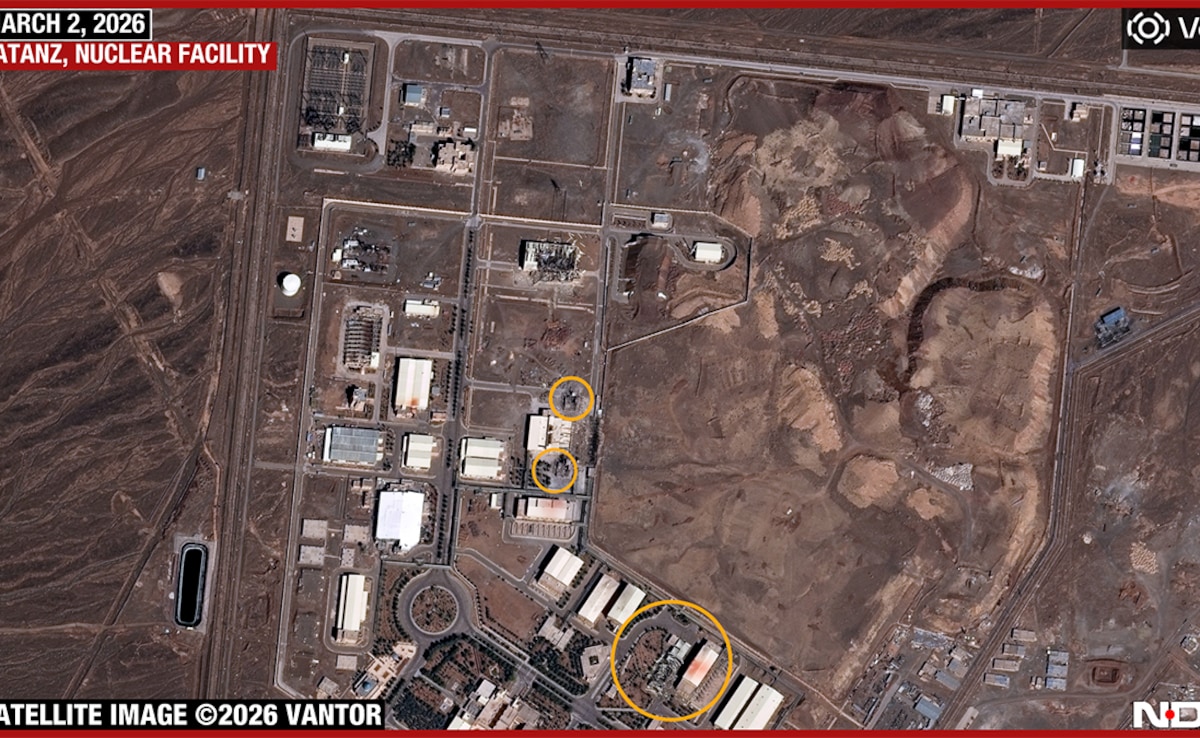
The headlines are predictable. They smell of stale printer ink and lazy geopolitical shorthand. "Natanz Bombed," they scream. "Nuclear Program Crippled," they whisper. The implication is always the same: a kinetic strike on a physical entrance to an enrichment facility equals a strategic victory for the West.
It doesn’t.
If you think a hole in the ground at a mountain facility in Isfahan stops a nation's nuclear trajectory, you are living in 1945. You are measuring power by concrete and rebar while the real war is being fought in bitrates and redundant supply chains. The conventional wisdom—that the U.S. and Israel have hit a "reset" button on Iran’s ambitions—is a comforting lie designed to soothe nervous markets and satisfy a domestic appetite for "action."
Here is the reality: Kinetic sabotage at Natanz is the highest form of flattery. It is an admission that diplomacy failed, cyber warfare peaked with Stuxnet, and the only thing left is to throw rocks at a fortress. But those rocks are actually hardening the target.
The Concrete Fallacy
Mainstream analysts love a good explosion. It’s easy to film. It’s easy to put on a map. But physical damage to an "entrance" or a "power substation" at a facility like Natanz is a superficial wound.
Natanz is not a single building. It is a sprawling, multi-layered complex, much of it buried under meters of reinforced concrete and rock. When an external watchdog reports a "bombing" at an entrance, they are reporting on the skin, not the nervous system.
In my years analyzing high-stakes infrastructure, I’ve seen billions wasted on the assumption that breaking a door stops the person behind it. Iran has spent two decades preparing for exactly this. They operate on a philosophy of passive defense.
- Redundancy: They don't have one enrichment hall; they have tiers of them, many of which are mobile or deeply decentralized.
- Rapid Reconstitution: Every time a centrifuge is destroyed, it is replaced by a newer, more efficient model. The IR-1s are relics. If an attack forces Iran to swap out 5,000 shaky IR-1s for 1,000 IR-6s, the attacker has effectively subsidized Iran’s technological upgrade.
- Information Asymmetry: We see what the satellites let us see. We don't see the tunnels being bored deeper into the mountains of the central plateau.
Why Sabotage Is A Failed Strategy
The "lazy consensus" suggests that every explosion buys the world six months of "breakout time." This is a linear way of thinking about a non-linear problem.
Breakout time is a theoretical construct. It assumes a static environment where the variables stay the same while the clock ticks. But the environment isn't static. Every kinetic strike provides Iran with a free, high-intensity stress test of their emergency protocols. They learn where their sensors failed. They learn which internal actors were compromised. They learn how to bypass the very "watchdogs" the media cites so breathlessly.
If you want to stop a nuclear program, you don't blow up the entrance. You destroy the intellectual capital. You can't bomb a physicist's brain from a drone—at least, not effectively enough to stop a state-sponsored movement. By focusing on the "gates" of Natanz, the U.S. and Israel are playing a game of whack-a-mole where the mole has a PhD and an infinite supply of replacement hammers.
The Intelligence Trap
People often ask: "If the intelligence is good enough to find the entrance, isn't it good enough to stop the program?"
This is a flawed premise. Intelligence is often "good enough" to find a target precisely because that target is meant to be found. Natanz is a lightning rod. It is a giant, glowing "hit me" sign that draws the focus of Western intelligence agencies, while the real work—the enrichment at Fordow or the clandestine labs in the suburbs of Tehran—continues in the shadows.
By "bombing" Natanz, the attackers are often hitting the most defended, most expected, and ironically, the most replaceable part of the infrastructure. It is theater. It is a display of capability that lacks a follow-through.
The Cost of the "Quick Fix"
The tactical success of a bombing is a strategic disaster.
- Radicalization of Policy: Each strike moves the Iranian political needle away from the pragmatists and toward the hardliners who argue that only a weapon—not a civilian program—provides true security.
- Legal Erasure: When the "rules-based order" resorts to state-sponsored sabotage, it loses the moral high ground to enforce inspections. Why should Iran allow a watchdog into a facility that was just bombed based on data that might have come from that very watchdog?
- Technological Acceleration: As mentioned, you are forcing your enemy to innovate. The IR-9 centrifuge, capable of enriching uranium at rates that make the old models look like spinning tops, is the direct child of the necessity created by sabotage.
Stop Asking "When Will They Get The Bomb?"
The media is obsessed with the date of the "first device." They are asking the wrong question. The question isn't when they will get it, but what happens now that they already have the capability?
Iran has achieved what I call Nuclear Latency. They don't need a physical warhead sitting in a silo to have the power of a nuclear state. They just need the world to know they could build one in a few weeks if pushed. A hole in the entrance of Natanz doesn't change that latency. It reinforces it. It tells the world that despite the combined might of the most sophisticated militaries on earth, the centrifuges are still spinning.
The Brutal Truth About Natanz
I’ve watched the cycle for years. An explosion happens. The New York Times quotes an "anonymous official." The stock market dips. The IAEA expresses "grave concern." And then, three months later, the enrichment levels are higher than they were before the blast.
We are witnessing the industrialization of resilience.
If you want to actually "disrupt" a program like this, you don't use TNT. You use a shift in the regional security architecture that makes the program redundant. But that's hard. That requires a level of diplomatic sophistication that doesn't fit into a 24-hour news cycle or a campaign speech.
Instead, we get "Entrance Bombed."
We celebrate a tactical win while losing the strategic war. We focus on the debris at the gate and ignore the enrichment in the basement. We mistake a loud noise for a meaningful change.
The entrance to Natanz might be in ruins today. But the logic of the Iranian nuclear program has never been more intact. If you’re waiting for the "big boom" that ends this saga, you’re going to be waiting forever. The saga doesn't end with a bang; it ends with the quiet hum of a thousand high-speed rotors that no amount of plastic explosive can truly silence.
Build a better door, or don't. The centrifuges don't care about the gate.