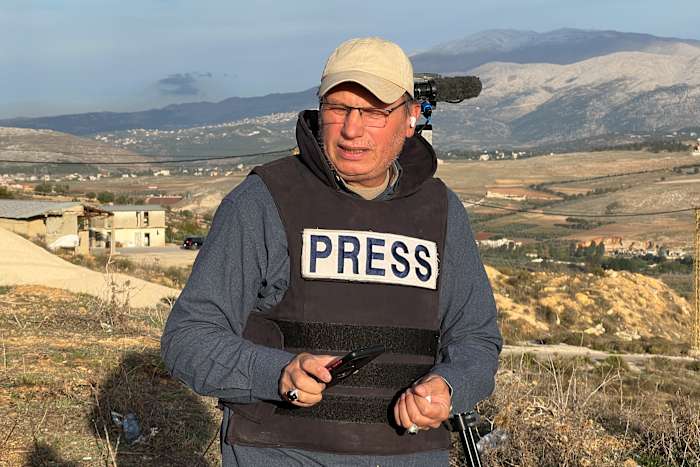
The recent deaths of three media workers in an Israeli airstrike in Hasbaiyya, southern Lebanon, have triggered the standard, automated cycle of international outrage. Human rights groups issue press releases. News anchors lower their voices to a somber pitch. The "Press" vest is held up as a holy relic, a magical garment that should, in theory, create a kinetic-proof bubble around anyone wearing it.
This reaction is based on a foundational lie about modern warfare.
We are clinging to a 20th-century concept of "the journalist" that no longer exists on the ground. The tragedy in Hasbaiyya isn't just about a missile hitting a guesthouse; it is about the total collapse of the distinction between information warfare and kinetic warfare. If you are standing in a conflict zone in 2026, you aren't just an observer. You are a node in a digital intelligence network, whether you like it or not.
The Illusion of the Non-Combatant Signal
The "lazy consensus" suggests that journalists are killed because of a lack of coordination or a blatant disregard for international law. While legal frameworks like the Geneva Conventions are clear on the protection of civilians, they are structurally incapable of accounting for the way modern militaries—specifically the IDF—utilize Artificial Intelligence and Signal Intelligence (SIGINT).
In the old world, a journalist was a person with a notepad. In the current world, a journalist is a walking collection of high-powered radio frequencies.
- The Metadata Death Warrant: Every cellular device, satellite uplink, and "Live" broadcast feed emits a signature. To an automated targeting system, a concentrated cluster of high-bandwidth signals in a high-tension zone doesn't look like a "press junket." It looks like a command-and-control node.
- The Proximity Trap: Armed groups know that Western media presence provides a temporary "human shield" effect. By operating near or within the same structures as media crews, combatants create a blurred target profile.
- The Algorithm's Blind Spot: Systems like "Lavender" or "Where's Daddy?"—AI-driven target generation tools—prioritize efficiency over nuance. An algorithm doesn't read the "PRESS" decal on the roof. It reads the heat signature and the electronic emissions.
The industry insists on "deconflicting" locations by sending coordinates to military forces. I’ve seen newsrooms rely on these "green zones" as if they are physical shields. They aren't. In a high-intensity conflict, a deconflicted coordinate is just another data point in a fluid, shifting target list. If a high-value target moves into the building next door, your "protected" status evaporates in the logic of "proportionality."
The Professionalism Paradox
We need to stop pretending that "neutrality" is a shield. In the eyes of modern state actors, there is no such thing as a neutral observer. There are only friendly information assets and hostile information assets.
When journalists document the aftermath of a strike, they are providing BDA (Battle Damage Assessment) for the other side. When they broadcast live positions, they are providing real-time telemetry. The industry refuses to admit that the very act of reporting has become a tactical variable.
The outrage following the Hasbaiyya strike focuses on the "violation of the press." This is a distraction. The real issue is the technological inevitability of these deaths. If you put a group of people with sophisticated electronic equipment in a strike zone monitored by AI-driven sensors, the probability of a strike approaches 100%. To call it an "accident" is naive; to call it a "target" is often accurate, even if the "target" was the signal, not the person.
The Architecture of the Strike
Let’s look at the mechanics. The journalists were staying in a series of bungalows in a town that had previously been considered safe.
- The Error of "Safe Zones": In 2026, there are no rear lines. The reach of precision munitions and the persistence of drone surveillance means that "out of the line of fire" is a geographical fantasy.
- The Aggregation of Risk: Media outlets often "pool" together in the same hotels or villas. This creates a "fat target." From a SIGINT perspective, twelve journalists in one building look exactly like a tactical headquarters.
I’ve watched media organizations spend millions on armored cars while ignoring their digital footprint. They send reporters into southern Lebanon with iPhones that are constantly pings towers, DJI drones that broadcast their operator's location, and Starlink terminals that act as beacons for electronic warfare units. You are essentially wearing a neon sign that says "Strike Here" in the language of mathematics.
The Hard Truth About Accountability
The calls for "independent investigations" are a performance. No military is going to hand over its raw AI targeting logs to a civilian board. They will cite "sources and methods" and the matter will be buried in a bureaucratic black hole.
The industry is failing its workers by not pivoting to a low-signature reporting model. We are still training journalists to wear bright blue vests and stand in front of cameras, making them the easiest targets on the battlefield.
- Ditch the "Press" Branding: In a world of asymmetrical warfare, a "Press" vest makes you a high-value kidnapping target or a convenient data point for a missile.
- Go Dark or Go Home: If you aren't using military-grade LPI/LPD (Low Probability of Intercept/Detection) communications, you are a liability to yourself and your colleagues.
- Stop Relying on "Deconfliction": If the history of the last decade has taught us anything, it’s that being on a "no-strike list" is a suggestion, not a guarantee.
The Ethics of Presence
We have to ask the question the industry hates: Is the footage worth the life?
The "brave reporter" trope is a marketing tool for networks to win Emmys and gain clicks. In reality, much of the "on-the-ground" reporting in places like Hasbaiyya provides little more than atmospheric "war porn" that could be gathered via remote sensing or local stringers with lower profiles.
By sending large, high-signature crews into active strike zones, media corporations are essentially gambling with their employees' lives for the sake of "brand presence." It is a 1990s solution to a 2020s problem.
The "Press" is not a protected class in the eyes of an autonomous drone. It is just another heat signature. It is just another packet of data. It is just another coordinate.
Stop asking why the missiles are hitting journalists and start asking why we are still sending people to stand under the missiles with beacons in their pockets.