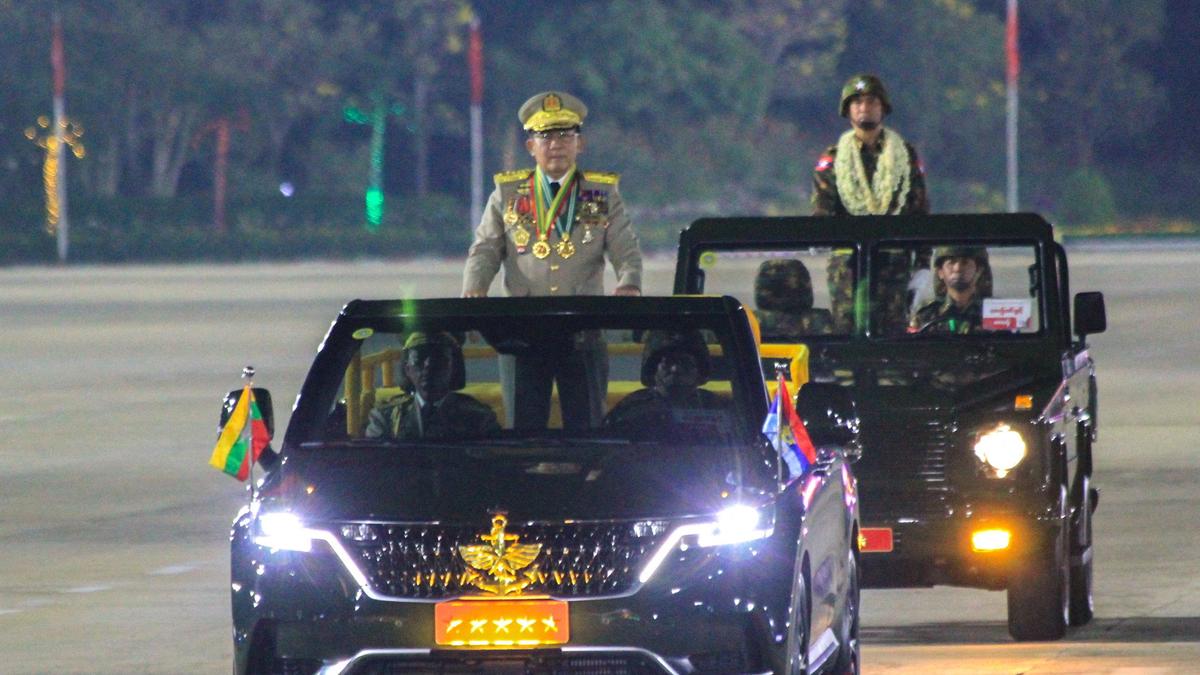
Min Aung Hlaing is not "moving up." He is digging in.
The Western press loves a neat title. They see a headline like "Min Aung Hlaing Elected as Vice-President" and instinctively reach for the "political transition" template. They treat the Naypyidaw bureaucracy as if it were a functioning parliamentary system where titles correlate to power. This is a fundamental misunderstanding of the Burmese military structure (the Tatmadaw) and the desperate math of a failing coup.
Calling this an "election" is a category error. It is a desperate consolidation of a crumbling interior.
The Vice Presidency is a Shield, Not a Seat
The mainstream narrative suggests that Min Aung Hlaing taking the Vice Presidency (and by extension, the acting Presidency) is a sign of his absolute control. In reality, it is a legalistic panic room.
Since the 2021 coup, the junta has operated under a state of emergency that is, even by their own distorted 2008 Constitution, legally shaky. By assuming these titles, Min Aung Hlaing is trying to wrap a thin layer of constitutional veneer around a military dictatorship that is losing territory by the day. He isn't seeking a new office; he is seeking immunity from his own laws.
Most analysts miss the Internal Fracture Theory. In a military junta, the "Commander-in-Chief" is a role of raw power. The "President" is a role of diplomatic utility. When one man holds both, he isn't doubling his power; he is admitting he doesn't trust anyone else to hold the other half. I’ve seen this pattern in failing corporate structures—when the CEO insists on also being the CFO and the Head of HR, it’s not because they are "winning." It’s because the board is revolting and the cash is gone.
The Geography of Failure
While the international community debates the semantics of junta titles, the actual map of Myanmar tells a different story. The "Vice-President" of Myanmar currently lacks authority over more than 50% of the country’s landmass.
Look at the Three Brotherhood Alliance and the 1027 Offensive. The Tatmadaw has lost control of crucial trade routes to China, dozens of battalion headquarters, and entire swaths of the Shan and Rakhine states.
The "lazy consensus" says that the military has the bigger guns, so they eventually win. This ignores the Logistics of Attrition.
- The Air Power Fallacy: The junta still controls the skies, but you cannot hold a village with a MiG-29.
- The Manpower Deficit: Desertion rates are at an all-time high. The junta is now enforcing a 2010 conscription law that targets the very youth who are currently leading the resistance. It’s a self-defeating cycle.
When Min Aung Hlaing "elects" himself to a civilian office, he is shouting into a void. The People’s Defense Forces (PDF) and Ethnic Armed Organizations (EAOs) do not care about his business card. They care about his supply lines.
Why the Business Community is Wrong about Stability
There is a specific brand of "realist" investor who believes that a strongman, no matter how brutal, offers "stability." They look at the junta’s move into the executive branch as a sign that the "dust is settling."
This is a hallucination.
Myanmar’s economy is in a death spiral. The kyat (MMK) has plummeted. Inflation is rampant. By consolidating power, Min Aung Hlaing has effectively killed any hope of a "managed transition" that would allow foreign capital to return without the stain of blood money.
If you are a business leader looking at Myanmar, do not be fooled by the formalization of titles. The junta is currently a predatory entity that survives by cannibalizing the country’s natural resources—jade, timber, and illicit trade. There is no "sovereign" to negotiate with. There is only a warlord with a tailor-made suit.
The Fallacy of the "2025 Election"
The junta keeps dangling the carrot of a general election in 2025. The competitor pieces frame this as a possible "exit ramp."
Let’s be blunt: An election held by a military that is actively bombing its own electorate is not an election. It is a census for targets.
Any "election" conducted under the current regime will exclude:
- The National League for Democracy (NLD), which won the last legitimate election by a landslide.
- The National Unity Government (NUG), the legitimate representative of the people.
- The millions of Internally Displaced Persons (IDPs) who have fled Tatmadaw arson campaigns.
To treat the Vice-Presidency as a stepping stone to a legitimate 2025 presidency is to participate in a farce. The junta’s goal is to create a "disciplined democracy," which is a polite term for a military state with a theater troupe for a parliament.
The Strategy of the Absurd
Why bother with the titles at all? If you have the guns, why do you need the "Vice-President" label?
It’s for ASEAN and China.
Min Aung Hlaing knows that certain neighbors are desperate for a reason to normalize relations. They need a "head of state" to invite to summits. They need a "legal" signatory for infrastructure projects. By taking the Vice-Presidency, he is giving his enablers a technicality to hide behind. It’s the "veneer of statehood."
I’ve negotiated with regimes that operate on this level of theater. They don't expect you to believe the lie; they expect you to accept the lie so that business can continue. Accepting the title of "Vice-President" is a test of international complicity.
Dismantling the "Stability" Argument
People often ask: "Isn't a junta better than a chaotic civil war?"
The question itself is flawed. The junta is the source of the chaos. Since 1962, the Tatmadaw has claimed it is the only institution capable of holding the country together. Yet, under their stewardship, Myanmar has remained one of the longest-running civil wars in modern history.
The military's "stability" is the stability of a graveyard.
If you want to understand the true state of the regime, stop looking at the state-run newspaper, The Global New Light of Myanmar. Look at the black market exchange rate and the price of rice in Yangon. When a "Vice-President" cannot keep the lights on in the commercial capital, he is not a leader. He is a squatter.
The Tactical Error of Centralization
Min Aung Hlaing’s move to the Vice-Presidency also highlights a massive tactical error: Over-centralization.
In counter-insurgency, flexibility is everything. By pulling all administrative and military strings into one office in Naypyidaw, the junta has created a single point of failure. The resistance is decentralized, tech-savvy, and motivated. The junta is a slow-moving, top-heavy dinosaur trying to navigate a swamp.
Every time Min Aung Hlaing gives himself a new title, he adds another layer of bureaucracy that delays decision-making on the front lines. The colonels in the field are waiting for orders from a "Vice-President" who is too busy managing his image to understand that his infantry is starving.
The Inevitable Conclusion of the Strongman Logic
The tragedy of the "Strongman" is that they eventually run out of people to blame.
When the coup happened, it was the NLD's fault. When the economy tanked, it was "foreign interference." Now that Min Aung Hlaing is Acting President, Commander-in-Chief, and Vice-President, the failures belong to him alone.
He has backed himself into a corner where there is no one left to purge. The "Vice-Presidency" isn't a crown; it's a target.
The international community needs to stop reporting on these title changes as if they are political developments. They are symptoms of a regime in a terminal state. The junta isn't evolving; it is fossilizing in real-time.
Stop asking when the election will happen. Start asking how much longer the junta can pay its soldiers in worthless currency before the gates of Naypyidaw are breached from the inside.
The titles don't matter. The guns are running out of bullets. The "Vice-President" is a ghost in a palace built on sand.