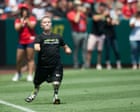
The headlines are predictable. They focus on the shock. They lean into the "how could this happen?" narrative because it sells clicks to a public that loves a tragic paradox. When news broke that former professional cornhole player Peter "Pete" Fink was arrested in connection with the murder of a woman in Kansas, the media immediately pivoted to his former teammate, seeking quotes filled with disbelief.
"I'm shocked," the teammates say. "He was a great guy," the neighbors claim.
Stop buying the script.
The "shock" expressed by the inner circle isn't a testament to the suspect's character; it is a clinical demonstration of the proximity bias that plagues high-stakes competitive environments. We have a pathological need to believe that because someone is an elite athlete—or in this case, a high-achieving "overcomer" in a niche sport—they are fundamentally incapable of dark, divergent behavior. It is a lazy consensus that ignores the psychological reality of the hyper-competitive mind.
The Fetishization of the Overcomer
The media’s obsession with this story hinges entirely on Fink’s physical status as a quadruple amputee. By framing the narrative around his physical limitations, the press infantilizes the individual and creates a false equivalence between physical disability and moral immunity.
This is the "Inspiration Porn" trap.
We are told that because someone has climbed a mountain without legs or won a pro cornhole circuit without hands, they must possess a saint-like temperament. This is a logical fallacy. Grit is not grace. The same internal machinery required to dominate a professional sport despite massive physical hurdles—the aggression, the stubbornness, the refusal to yield—is a neutral engine. It can drive a person toward a podium, or it can drive them toward a cliff.
When you hear a teammate say they are "stunned," what they are actually saying is: "I refused to look at the person behind the performance."
Cornhole is Not a Backyard Picnic
Let’s dismantle the "it’s just a lawn game" argument. Professional cornhole, particularly the circuits run by the American Cornhole League (ACL), has transformed from a drunken tailgate pastime into a high-pressure gambling ecosystem. We are talking about six-figure payouts, national television deals, and intense psychological warfare.
I have spent years observing subcultures where "bar sports" go pro. The transition is rarely clean. You take a demographic used to low-stakes recreation and inject professional-grade stress, sponsorship obligations, and the ego-fragility of public ranking.
The industry wants to market cornhole as "wholesome Americana." It’s a lie. It’s as cutthroat as a Wall Street trading floor, but with less HR oversight. When a "pro" in this environment snaps, it isn’t a mystery. It’s the result of a pressure cooker that the community refuses to acknowledge because they are too busy trying to land the next big brand deal with a light beer company.
The Failure of the Character Witness
Every time a violent crime occurs within a professional sports community, the first move is to interview the "former teammate." This is the least reliable source of information on the planet.
Teammates share a foxhole mentality. They see the "game face." In a sport like cornhole, where doubles teams spend hours in close proximity, a unique form of performative camaraderie develops. You don't know your teammate; you know your teammate's ability to hit a 10-inch hole from 27 feet away under 400-watt lights.
The competitor article relies on these testimonies to build a "fall from grace" narrative. But there was no fall. There was only a mask that finally slipped. To be an industry insider is to recognize that the "great guy" in the locker room is often a stranger at home. Citing a teammate’s shock as evidence of a suspect’s character is like asking a passenger about the pilot’s marriage because they shared a flight to O'Hare. It is irrelevant, distracting, and deeply unprofessional reporting.
The Logic of the Unfathomable
The public asks: "How does a quadruple amputee commit a violent crime?"
By asking the question, you expose your own bias. You are assuming that violence requires a specific physical "landscape" (to use a word I despise, but here it fits the public's flawed view). Crime is a matter of intent and mechanics, not just brute strength.
If we look at the data of domestic and interpersonal violence, the physical stature of the perpetrator is frequently secondary to the power dynamics at play. By focusing on the "shocking" nature of the physical logistics, the media avoids the harder conversation about the actual victim and the circumstances of the case. They turn a murder investigation into a "Ripley’s Believe It or Not" segment.
Stop Asking if the Community is Okay
The standard PR move after a scandal like this is for the league or the teammates to release a statement about "healing" and "the cornhole family."
The cornhole community doesn't need to heal. It needs to grow up.
It needs to stop pretending that its stars are neighborhood heroes and start treating them like the flawed, complex, and sometimes dangerous human beings that exist in every other professional tier. The "shock" is a defense mechanism used to protect the brand of the sport. If Fink was "one of the good ones," then the sport’s image remains intact. If he wasn't, then the "family" has a problem.
The reality is that sports do not build character; they reveal it. Sometimes, what they reveal is ugly.
The Myth of the "Clean" Sport
We see this in golf, in bowling, and now in cornhole. There is a desperate attempt to keep these sports "clean" and "relatable." But relatability is a curated product.
I’ve seen leagues bury internal disputes, substance abuse issues, and erratic behavior just to keep the "wholesome" sponsors happy. When you suppress the reality of the human condition in favor of a polished marketing image, you create the very "shock" you later claim to feel when things go wrong.
The Fink case isn't a "shocker." It is a data point. It is a reminder that professional excellence in a niche field is not a substitute for a psychological evaluation.
Stop looking for the "nuance" in the teammate's disbelief. There is no nuance there—only the sound of a community realizing their "inspiration" narrative just became a liability.
The trial will focus on the evidence. The media will focus on the "tragedy" of a ruined career. Both are missing the point. The only real question is why we were so eager to believe the mask in the first place.
Don't wait for the league to tell you how to feel. Look at the facts of the case and realize that a jersey doesn't make a man, and a disability doesn't make a saint.
Get off the bleachers and look at the blood on the floor.