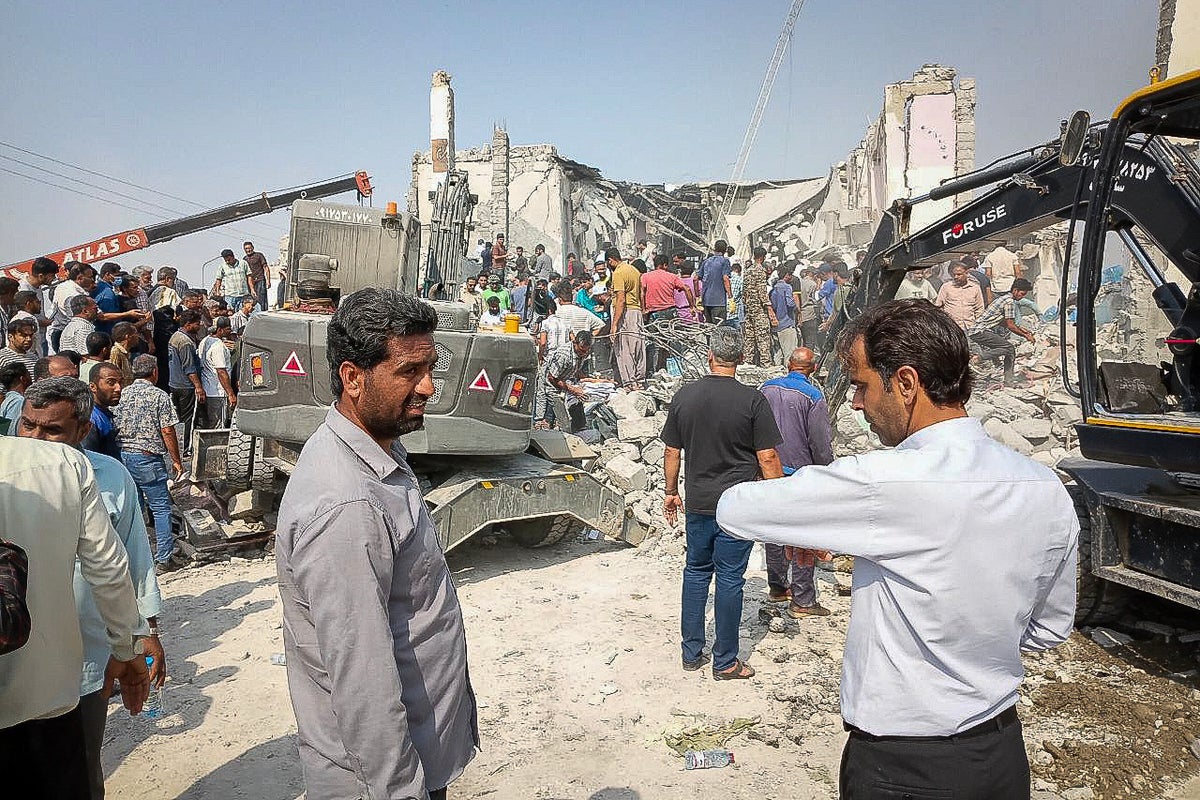
On February 28, 2026, the Shajareh Tayyebeh girls' elementary school in Minab, Iran, ceased to exist. In its place sits a jagged crater, the smell of pulverized concrete, and the remains of 175 people—163 of them children. While the initial blast was instantaneous, the fallout has been a slow-motion collision of geopolitical denial and damning physical evidence.
The primary question haunting the first week of the U.S.-Israeli air campaign is no longer what happened, but who pulled the trigger. While the Trump administration initially gestured toward Iranian "inaccuracy" or a tragic accident, the dirt in Minab tells a different story. Serial numbers don't lie, even when presidents do. Fragments recovered from the ruins, including a satellite data link antenna and actuator motors, bear the unmistakable markings of a Block IV Tomahawk cruise missile. This is a weapon system currently operated only by the United States, the United Kingdom, and Australia.
The Geography of a Massacre
The school was not hit in a vacuum. It sat immediately adjacent to a naval base operated by the Islamic Revolutionary Guard Corps (IRGC). This proximity is the "why" behind the tragedy. Military investigators, speaking on the condition of anonymity, suggest the school was flagged as a valid target based on intelligence that was at least three years out of date. Before 2023, the building was indeed part of the IRGC compound. Since then, it had been walled off, clearly marked, and operated as a civilian educational facility for nearly a decade.
Precision is the great seduction of modern warfare. We are told that we can thread a needle from a thousand miles away, neutralizing "evil" while sparing the innocent. But precision in the hardware is useless if the software—the human intelligence—is rotten. The strike in Minab was, by all technical accounts, a success. The missile hit exactly where it was aimed. The failure was not in the guidance system; it was in the choice of the target itself.
The Triple Tap and the Cost of Rescue
Eyewitness accounts from the ground in Hormozgan province describe a "triple-tap" strike. This is a brutal tactic where a target is hit, and then hit again minutes later as first responders and parents rush to the scene. One father, speaking to international observers, recounted how his daughter survived the initial impact only to be killed when the second missile struck the prayer hall where students had been moved for safety.
The sheer scale of the carnage—175 dead in a single building—makes this the deadliest civilian casualty event of the 2026 conflict so far. It also shatters the narrative of a "clean" war. When a primary school is "precision-bombed" during school hours, the distinction between collateral damage and a war crime becomes a matter of semantics rather than morality.
The Denials and the Data
In Florida this week, Donald Trump suggested the strike could have been carried out by "somebody else," noting that other nations purchase Tomahawks from the U.S. and implying Iran might have possession of the system. This claim lacks any basis in observable reality. While the U.S. does export the Tomahawk, it does so under the strictest State Department oversight. Iran does not have them. To suggest Tehran bombed its own school with a high-end American cruise missile is a level of gaslighting that even the most seasoned analysts find staggering.
Secretary of Defense Pete Hegseth has maintained a more cautious line, stating the Pentagon is "reviewing" the incident while asserting that the U.S. "never targets civilian targets." However, the internal rift is showing. Publicly, the administration points at Tehran; privately, military officials are leaking to the press that the strike was ours.
The Intelligence Trap
The failure in Minab highlights a systemic issue in the current air campaign. When a conflict moves this fast, the demand for targets outstrips the capacity of intelligence to verify them. In the 12-day war of last June, the civilian toll in Iran was also heavy. We are seeing a pattern where "strategic" targets are redefined on the fly, and the distinction between a military clinic and a civilian elementary school is blurred by the smoke of a high-speed offensive.
The UN Educational, Scientific and Cultural Organization (UNESCO) has already labeled the bombing a "grave violation" of international humanitarian law. But the real weight of this tragedy is not in the legal filings. It's in the 163 girls who were blown apart while changing periods at 10:45 a.m.
The United States has spent over $5.6 billion in munitions in the first week of this war. The Tomahawk is a million-dollar missile. It's a marvel of engineering, a pinnacle of precision. But when that precision is aimed at a girls' school in southern Iran, it ceases to be a tool of defense. It becomes a blunt instrument of mass murder.
Final Takeaway
The investigation into the Minab massacre will eventually produce a report. The president has said he is "willing to live with that report." But for the families in Hormozgan province, the report is irrelevant. The evidence—the serial numbers, the satellite data, and the bodies—has already been filed. The myth of the clean war died in Minab on February 28.
Now, the only question is whether the administration will continue to deny the data or finally acknowledge the cost of its "little excursion" into the Middle East.
Would you like me to analyze the specific serial number evidence linked to the Tomahawk parts found at the scene?