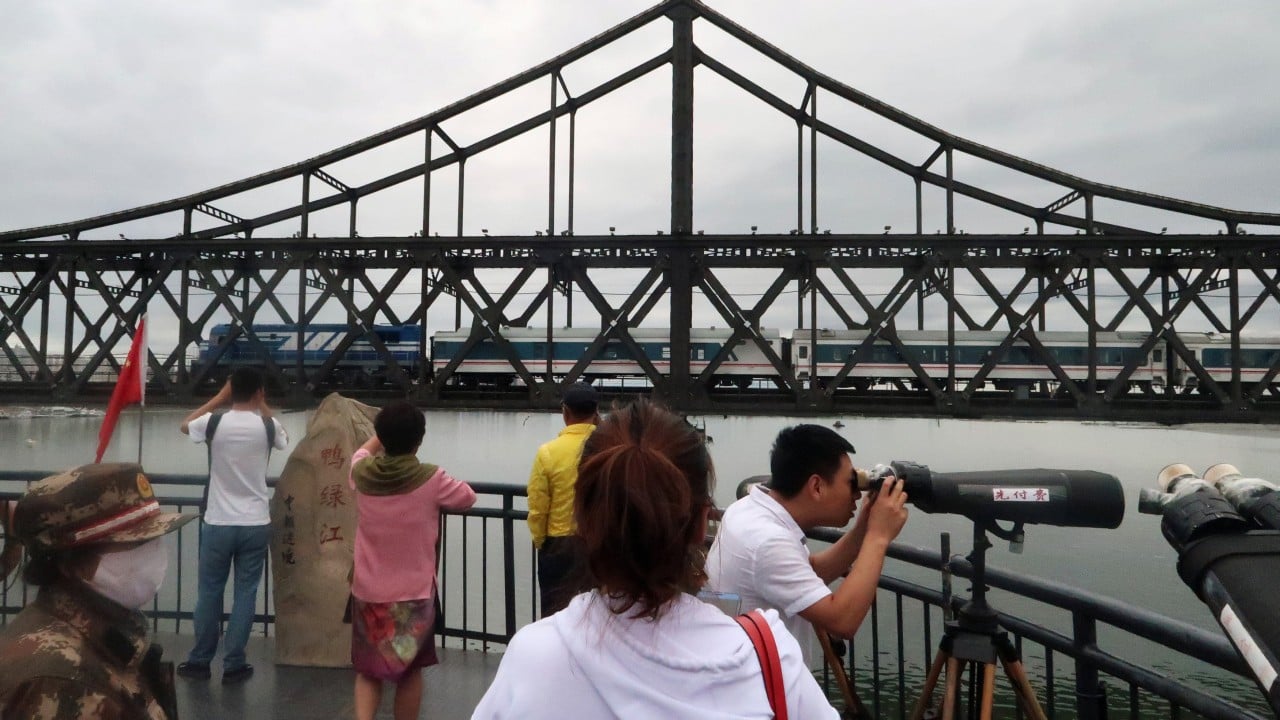
The rusted wheels do not scream. They groan. It is a heavy, metallic sound that carries across the Yalu River, vibrating through the floorboards of the Dandong observation decks where tourists used to pay a few yuan to peer into the "Hermit Kingdom." For years, that sound was missing. The bridge—the Sino-Korean Friendship Bridge—stood as a skeleton of green steel, silent and mocking.
When the engines finally hissed back to life, the noise didn't just signal a logistics update. It signaled the return of a lifeline.
To understand why a few freight cars crossing a border matters, you have to look past the satellite imagery of darkened cities and the sterile briefings from the Ministry of Foreign Affairs. You have to look at the grease on a conductor's hands. You have to think about the phantom weight of an empty bowl. For the people living in the shadow of the Friendship Bridge, the train is not a "bilateral restoration of trade." It is a heartbeat.
The Great Silence
In early 2020, North Korea did something few nations could afford: it bolted the door from the inside. To prevent the spread of a virus that its fragile healthcare system could never hope to contain, Pyongyang severed its most vital artery. The trains stopped. The trucks went cold.
Imagine a house where the electricity is cut, the pantry is taped shut, and the windows are boarded over. Now imagine that house is a nation of twenty-six million people.
The economic fallout was not a slow decline; it was a cliff. North Korea relies on China for more than 90% of its total trade. We are talking about everything from the fuel that keeps tractors moving in the southern rice paddies to the synthetic fabrics used in the garment factories of Pyongyang. When the rail lines went quiet, the price of basic goods like sugar and flour didn't just rise. They vanished.
In Dandong, the Chinese border city that serves as the gateway to the North, the bustling warehouses grew thick with dust. Traders who had made their fortunes moving coal, iron ore, and textiles found themselves staring at a river they could no longer cross. The stakes were invisible to the outside world, masked by political posturing and missile tests, but they were written in the hollowed cheeks of those living along the border.
The Metal Scabs of Diplomacy
Governments often treat trade like a thermostat. You turn it up when you want warmth; you turn it down to signal a chill. But the relationship between Beijing and Pyongyang is less like a thermostat and more like a complicated, begrudging marriage.
China wants stability. It fears a collapse on its doorstep that would send millions of refugees flooding across the Yalu. North Korea wants sovereignty, but it needs a patron.
The restoration of the rail service is a cautious dance. It began with a few "test" runs—locomotives pulling sanitized wagons, supposedly drenched in disinfectant to appease the North’s obsession with viral purity. These weren't just shipments of grain or chemical fertilizers. They were messages.
When the first train rolled into Sinuiju after the long hiatus, it carried a cargo of hope and desperation. It told the world that the "maximum pressure" of international sanctions had a leak. As long as the tracks are clear, the regime has a pressure valve.
Consider a hypothetical trader named Zhang. For twenty years, Zhang moved medical supplies and construction materials across the border. When the bridge closed, his business died. He watched the river every day, waiting for the smoke from the North Korean locomotives. To Zhang, the train's return isn't a victory for communism or a defeat for Western diplomacy. It is the ability to pay his rent. It is the sound of a gear catching after years of spinning in the void.
The Friction of the Tracks
Why did it take so long? If both sides needed the trade, why leave the engines to rust?
The delay reveals the deep-seated paranoia that defines the North Korean state. To Kim Jong Un, the outside world is a vector for more than just a virus. It is a vector for information, for influence, and for change. Every train car that enters Sinuiju is a potential Trojan horse.
The logistical hurdles were immense. China had to build massive disinfection centers. North Korea had to create "quarantine zones" where goods sat for weeks before being distributed. This isn't the "just-in-time" manufacturing of a globalized economy. This is a medieval siege mentality applied to modern logistics.
The complexity of the restoration also highlights a shift in the regional power dynamic. China is no longer just a "big brother." It is the sole provider. By controlling the flow of the rail lines, Beijing holds the remote control to the North Korean economy. They can flick it on to keep the country breathing, or dim it to remind Pyongyang who provides the oxygen.
The stakes are higher than just calorie counts. The rail lines carry the raw materials for the North’s military-industrial complex. While the world watches the launch pads, the real action is happening on the flatbeds of the freight trains. Iron, steel, and fuel move in; minerals and textiles move out. It is a closed loop of survival.
The Ghost of the Cold War
The Friendship Bridge was built by the Japanese and repaired by the Chinese after the Korean War. It is a monument to a conflict that never truly ended. Standing on the Dandong side today, you can see the "Broken Bridge" right next to it—the spans that were blown apart by American bombers in 1950, their twisted girders reaching out over the water like amputated limbs.
The new trains pass these ruins every day. They serve as a reminder that this isn't just a business deal. This is a geopolitical fortress.
There is a specific rhythm to the border now. It is hesitant. It lacks the frantic energy of the early 2000s when "capitalism with Chinese characteristics" seemed poised to seep across the river. Today, the trade is more controlled, more clinical. It is a state-to-state transaction designed to maintain a status quo that neither side particularly likes, but both sides desperately need.
We often talk about "North Korea" as a monolith—a single, bronze statue of a leader. But a nation is a collection of appetites. When the train stops, the appetites go unsated. When the train moves, the tension in the air changes. You can feel it in the markets of Dandong, where the price of North Korean seafood fluctuates based on the morning’s rail schedule. You can see it in the eyes of the North Korean workers who reside in Chinese factories, their salaries a vital source of hard currency for a cash-strapped government.
The Unseen Passengers
The most important things on these trains aren't listed on any manifest.
They carry the weight of a billion-dollar smuggling industry that thrives in the cracks of the official trade. They carry the whispered news of the outside world, tucked into the pockets of the few people allowed to cross. They carry the realization that, despite the walls and the wire, no nation is truly an island.
The rail service is back, but the scars of the silence remain. The three-year shutdown proved that North Korea could survive in total isolation, but at a cost that is still being tallied in the graveyards and the grey markets. The restoration isn't a return to "normal." There is no normal on the Yalu. There is only the fragile, grinding continuity of a relationship built on mutual suspicion and a shared border.
As the sun sets over the river, the silhouette of the bridge looks like a set of teeth. The lights on the Chinese side are a neon explosion—skyscrapers, LED billboards, the hum of a superpower. On the other side, Sinuiju is a smudge of charcoal. A few dim bulbs flicker.
Then, the low whistle of a diesel engine cuts through the evening air.
The ground begins to tremble. A line of black shapes emerges from the Chinese shore, creeping slowly across the water. The steel of the bridge moans under the weight. It is a heavy, rhythmic pulse—the sound of a neighbor finally opening the door, just a crack, to see if the world is still there.
The train does not stop for the view. It moves with a grim, mechanical purpose, disappearing into the dark, carrying the fuel that will keep the lights on for another night.