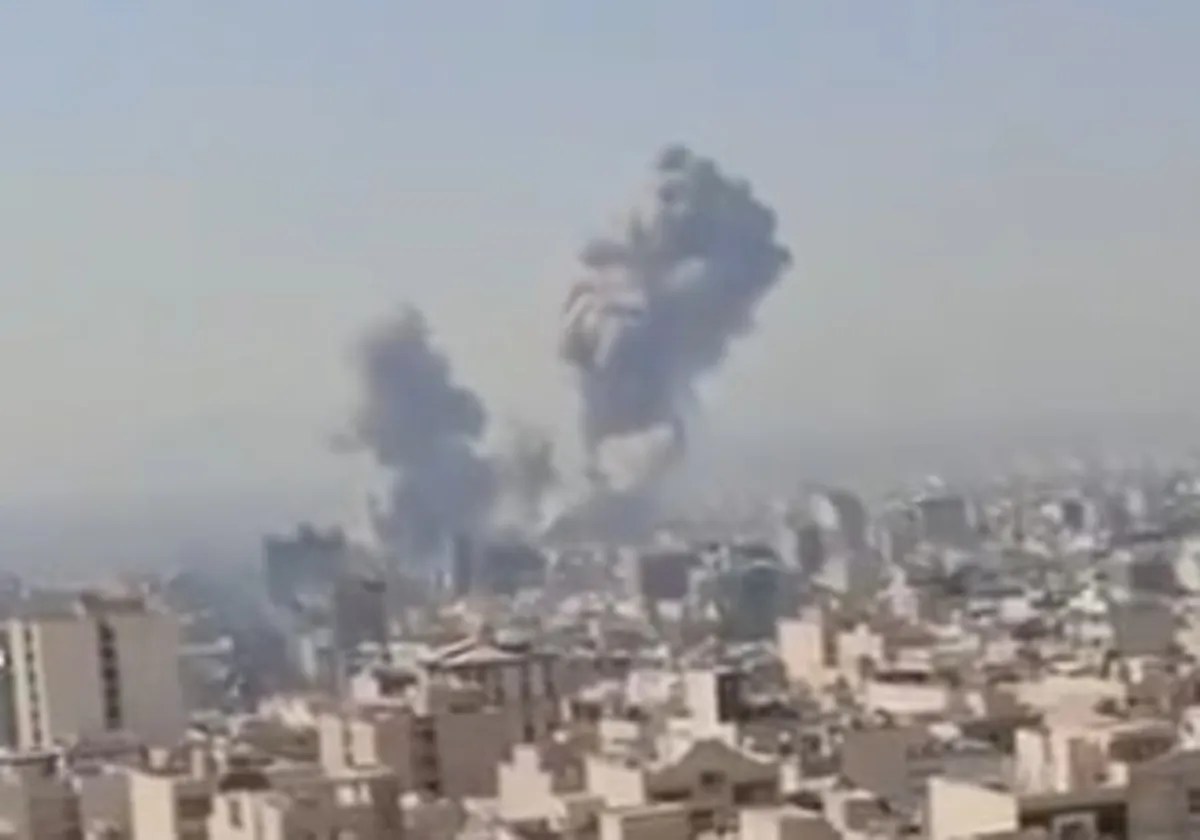
Headline hunters are screaming that the sky is falling. They see a missile launch and scream "World War III." They see a drone strike and predict the end of global trade. The competitor article you just read—the one claiming the U.S. and Israel have officially "started the war" with Iran—is a masterclass in surface-level reactionary journalism. It treats geopolitics like a football match where the only thing that matters is the scoreboard.
They are wrong.
What we are witnessing isn't a "war" in the 20th-century sense of territory and flags. It is a violent, high-stakes audit of the global energy and logistics architecture. If you think this is about religion or ancient grudges, you’ve been blinded by the smoke. This is about the brutal reality of the $100 trillion global economy shifting its weight.
The Myth of the "Unprovoked" Escalation
The "lazy consensus" suggests that these strikes are sudden outbursts of aggression. In reality, we are seeing the logical conclusion of a decade-long shadow conflict. I have spent years tracking the movement of illicit oil tankers and the flow of gray-market microchips. The "attack" didn't start this morning. It started when the traditional maritime insurance markets lost control of the "Dark Fleet" shipping sanctioned Iranian crude.
Israel and the U.S. aren't trying to "conquer" Iran. That’s a logistical impossibility that no general in the Pentagon actually wants. Instead, they are conducting a surgical dismantling of Iran’s ability to project power via proxy.
Think of it as a corporate hostile takeover, but with kinetic munitions. The goal isn't to own the company; it’s to strip the assets until the board of directors (the IRGC) can no longer pay their regional contractors.
Why the "Oil Spike" Panic is a Mathematical Fallacy
Every time a headline mentions "Iran" and "Attack," the markets brace for $150 oil. They’ve been wrong for three years.
The standard narrative ignores the massive structural shifts in energy production. While the media focuses on the Strait of Hormuz, they ignore the fact that the U.S. is now producing over 13 million barrels of crude per day.
- The Permian Basin is a bigger geopolitical weapon than a carrier strike group. * Brazilian and Guyanese offshore production is coming online at a rate that offsets Middle Eastern volatility.
- Global inventories are being managed by AI-driven predictive logistics that the 1970s-era "Oil Shock" theorists can't even fathom.
If you are betting on a permanent energy crisis, you are betting against the most efficient extraction machine in human history. The real risk isn't that oil becomes too expensive; it's that the Middle East becomes irrelevant to the global power grid. That irrelevance is what drives the desperation we see in the headlines.
The Drone Economy: The End of "Superior" Conventional Defense
The competitor piece obsesses over F-35s and sophisticated missile defense. They are missing the democratization of destruction.
I’ve seen how $2,000 off-the-shelf components are being used to bypass billion-dollar defense umbrellas. This is the "Insurgent’s Arbitrage." Iran has mastered the art of the "Cheap Kill." When you can force your opponent to spend $2 million on an interceptor missile to take down a drone that costs less than a used Honda Civic, you are winning the economic war of attrition.
This is the nuance the mainstream misses: Modern warfare is a balance sheet, not a battlefield. The U.S. and Israel are technically superior, yes. But their "burn rate" is unsustainable. The contrarian truth is that the West is currently being out-spent by "primitive" technology. This isn't a failure of bravery; it’s a failure of procurement logic.
The "Regional Stability" Lie
Stop asking when "peace" will return to the region. Peace, in the way 1990s diplomats defined it, is a dead concept. We have entered an era of Permanent Friction.
The People Also Ask: "Will there be a full-scale ground invasion?"
The answer is a brutal "No." No one has the stomach or the treasury for it.
What we get instead is a "Grey Zone" reality:
- Cyber-Kinetic Crossovers: Expect your local gas station's payment system to fail before you see tanks in Tehran.
- Supply Chain Sabotage: The goal is to make your neighbor's shipping costs rise until they stop buying from your enemy.
- Information Saturation: The "attack" headlines are often more effective than the bombs themselves. They trigger algorithmic trading sell-offs that do more damage to an economy than a lucky hit on a refinery.
The Hidden Beneficiary: The "Middleman" States
While everyone watches the U.S., Israel, and Iran, they ignore the players who are actually profiting from this chaos. Qatar, Turkey, and even India are playing a sophisticated game of "Neutrality Arbitrage."
They are the ones refining the "sanctioned" oil, hosting the "back-channel" talks, and providing the logistics hubs that bypass the conflict zones. If you want to know where the power is shifting, don't look at the craters in the desert. Look at the port expansions in Mumbai and the tech hubs in Riyadh.
The Saudi "Vision 2030" isn't a luxury project; it's a frantic race to diversify before the Iranian-Western conflict turns the Persian Gulf into a radioactive insurance nightmare.
The Strategy for the Pragmatic Observer
If you are an investor or a leader, stop reacting to the "Breaking News" banners.
- Ignore the Rhetoric: When a politician says "We will not hesitate," they are hesitating.
- Watch the Insurance Premiums: The true map of the conflict is drawn by Lloyd’s of London, not the CNN newsroom. If the tankers are still moving, the "war" is just theater.
- Hedge for Fragmentation: The "Global" economy is breaking into "Regional" fortresses. Diversify your supply chains away from single-point-of-failure choke points like the Red Sea.
The competitor's article wants you to feel fear. Fear is a commodity sold to people who don't understand the underlying mechanics of power. This isn't a tragedy of errors; it’s a cold, calculated re-ordering of who controls the flow of atoms and bits in the 21st century.
The bombs are just the punctuation marks at the end of a very long, very expensive sentence.
Stop reading the headlines and start reading the ledgers. The war for the future isn't being fought for "freedom" or "religion"—it's being fought to see who gets to be the world's indispensable gas station. And right now, the incumbents are terrified because they realized the world is learning to drive electric.
Everything you’ve been told about "Middle East Stability" was a marketing pitch for the status quo. That status quo is dead.
Burn your old maps.