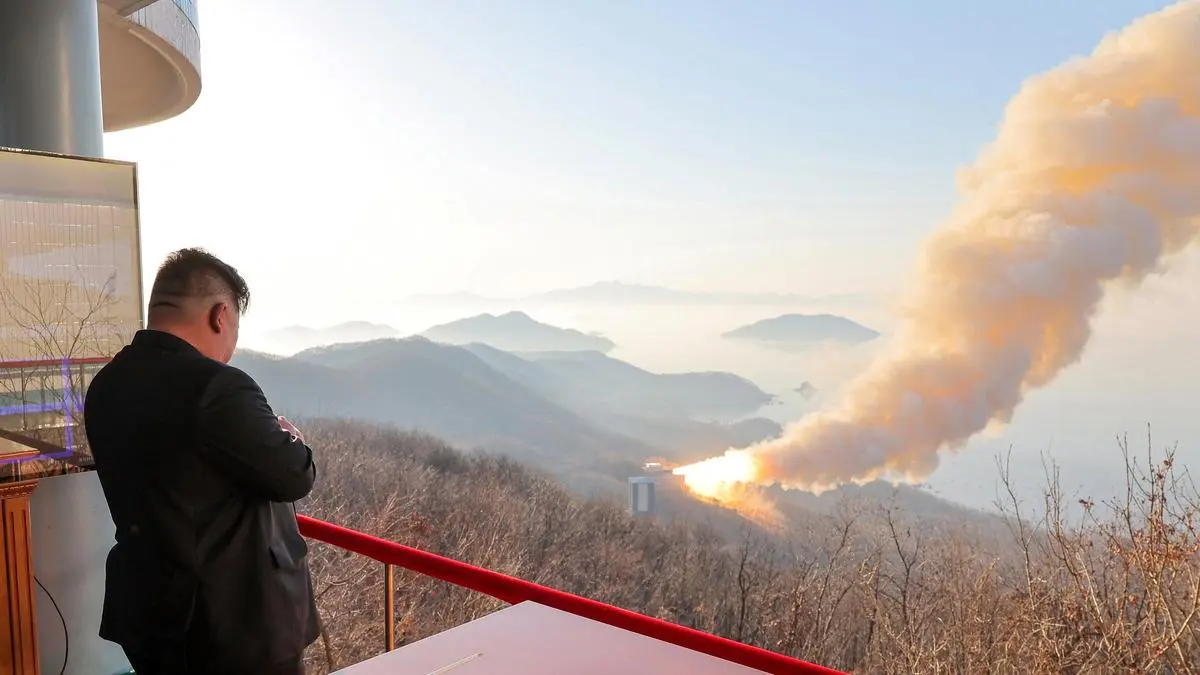
The strategic shift in North Korea’s missile program is not merely a change in hardware; it is a fundamental reconfiguration of the reaction-time window available to US and allied defense systems. The recent testing of a high-thrust solid-fuel engine designed for intermediate and intercontinental ranges indicates a transition from the vulnerable, high-maintenance liquid-fuel systems of the previous decade to a rapid-response, high-readiness posture. This shift effectively compresses the "kill chain"—the sequence of detecting, identifying, and neutralizing a threat—to a duration shorter than many existing satellite-based early warning protocols can reliably manage.
The Technical Transition from Liquid to Solid Propellants
To understand the strategic risk, one must first deconstruct the chemical and logistical constraints of liquid versus solid propulsion. Liquid-fueled missiles, such as the Hwasong-15 or Hwasong-17, utilize hypergolic propellants. These chemicals are corrosive and volatile, requiring the missile to be fueled immediately prior to launch. The fueling process involves a large convoy of support vehicles, creating a significant thermal and visual signature detectable by overhead reconnaissance (GEOINT). This provides a pre-launch warning window of 60 to 90 minutes.
Solid-fuel engines eliminate this window. The propellant—a rubbery mixture of fuel and oxidizer—is cast directly into the missile casing. This creates a state of permanent readiness.
The Structural Integrity of Solid-Fuel Grain
In a solid-fuel motor, the "grain" (the propellant mass) must burn at a precise, predictable rate to maintain stability. The geometry of the hollow center of the grain determines the thrust profile.
- Internal Surface Area: A star-shaped core provides high initial thrust for liftoff (boost phase), while a circular core provides a longer, sustained burn.
- Structural Defects: Any cracks or air pockets in the grain can cause an exponential increase in surface area during combustion, leading to an over-pressurization of the motor casing and catastrophic failure.
North Korea's success in testing a high-thrust motor suggests they have mastered the industrial chemistry required to cast large-diameter grains without structural flaws, a feat previously limited to a few advanced spacefaring nations.
The Operational Advantage of Road-Mobility
The integration of solid-fuel engines into Transporter-Erector-Launchers (TELs) changes the geography of the conflict. Liquid-fueled missiles are often tethered to known fueling sites or hardened silos. Solid-fuel missiles are "cold-launched" from canisters, meaning the missile is ejected by compressed gas before the main engine ignites. This protects the TEL from the heat of the exhaust, allowing the vehicle to be reused and, more importantly, allowing for launches from unprepared surfaces like forest clearings, highways, or tunnels.
This creates a "shell game" for US Indo-Pacific Command (INDOPACOM). The number of potential launch points increases by several orders of magnitude, rendering "Left of Launch" strategies—aiming to destroy missiles before they leave the ground—statistically improbable.
Kinetic Energy and Re-entry Dynamics
The power of the new engine is measured in its specific impulse ($I_{sp}$) and its total vacuum thrust. While liquid engines generally offer higher $I_{sp}$, solid motors provide the massive initial thrust required to loft a heavy payload—such as a Multiple Independently Targetable Re-entry Vehicle (MIRV)—into a high-energy trajectory.
The physics of reaching the US mainland from the Korean Peninsula requires overcoming two primary hurdles:
- The Gravitational Well: Escaping the lower atmosphere requires a thrust-to-weight ratio that can push a 100-ton vehicle to orbital velocities.
- Thermal Protection: A missile capable of hitting the US mainland must survive re-entry speeds exceeding Mach 20. The heat shield must manage temperatures where the kinetic energy of the surrounding air is converted into thermal energy ($Q = \frac{1}{2}mv^2$).
North Korea’s engine tests focus on the first hurdle, but the increased thrust allows for a "lofted trajectory." By firing a missile nearly vertically into space, they can test the high-stress re-entry conditions without physically overflying Japan or hitting the US, gathering the telemetry data needed to refine their ablative heat-shield materials.
The Breakdown of Regional Missile Defense
Current missile defense architectures, such as Terminal High Altitude Area Defense (THAAD) and Aegis Ballistic Missile Defense, are optimized for specific phases of flight.
- Boost Phase: Theoretically the best time to intercept, but currently impossible due to the proximity required to the launch site.
- Mid-course Phase: Where the Ground-Based Midcourse Defense (GMD) in Alaska operates. Solid-fuel missiles can be launched at depressed trajectories, staying below the optimal engagement altitude of some mid-course interceptors.
- Terminal Phase: The final seconds of flight. High-thrust engines allow for greater final velocities, shortening the time a defender has to achieve a kinetic "hit-to-kill" lock.
The introduction of solid-fuel ICBMs forces a shift in defense spending from interceptors to "persistent overhead sensing." Without a constant, unblinking eye over the peninsula provided by Low Earth Orbit (LEO) satellite constellations, the "launch-on-warning" capability of the United States is compromised.
Economic and Material Bottlenecks
A rigorous analysis must acknowledge the constraints on the North Korean program. The production of solid-fuel motors requires specialized chemicals, including ammonium perchlorate (oxidizer) and hydroxyl-terminated polybutadiene (binder). These are dual-use materials subject to heavy international sanctions.
The acceleration of their program suggests one of two scenarios:
- Indigenous Synthesis: They have built a domestic chemical supply chain capable of producing high-purity precursors at scale.
- Sanction Evasion: They are successfully sourcing high-performance carbon fiber (for lightweight motor casings) and chemicals through specialized front companies, likely in the aerospace or mining sectors.
The motor casing itself represents a significant engineering challenge. Steel casings are heavy and reduce the range. Composite casings (filament-wound carbon fiber) are significantly lighter but require high-precision CNC winding machines and specialized resins. The transition from steel to composite casings is a key indicator of a missile program's maturity.
Redefining the Threshold of Deterrence
The strategic intent behind these tests is the decoupling of the US-South Korea alliance. If Pyongyang possesses a survivable, rapid-launch capability that can strike San Francisco or Washington D.C., the "extended deterrence" provided by the US nuclear umbrella is called into question. The psychological weight of the question—"Would the US trade Los Angeles for Seoul?"—becomes a tangible variable in geopolitical negotiations.
This technological advancement moves North Korea away from "symbolic deterrence"—having a few missiles that might work—to "operational deterrence"—having a fleet that can be deployed under fire.
The focus must now shift to the hardening of regional assets and the rapid deployment of the HBTSS (Hypersonic and Ballistic Tracking Space Sensor). Relying on terrestrial radar is no longer a viable strategy against a mobile, solid-fuel threat. The defense priority is no longer just about the interceptor; it is about the sensor fusion required to maintain track continuity from the moment of ignition.
Future naval deployments in the Sea of Japan will likely require a higher density of Aegis-equipped vessels acting in a "forward-pass" capacity, where one ship detects the launch and another, better positioned, fires the interceptor. This necessitates a level of data-link integration and automated command-and-control that currently remains in the testing phase. The window for diplomatic resolution is closing as the technical "breakout" reaches its terminal velocity.
The primary strategic move for allied forces is the immediate expansion of the "distributed lethality" concept—dispersing high-value assets across more locations to force the North Korean targeting logic into a state of paralysis, even as their own launch capability becomes more streamlined and harder to find.