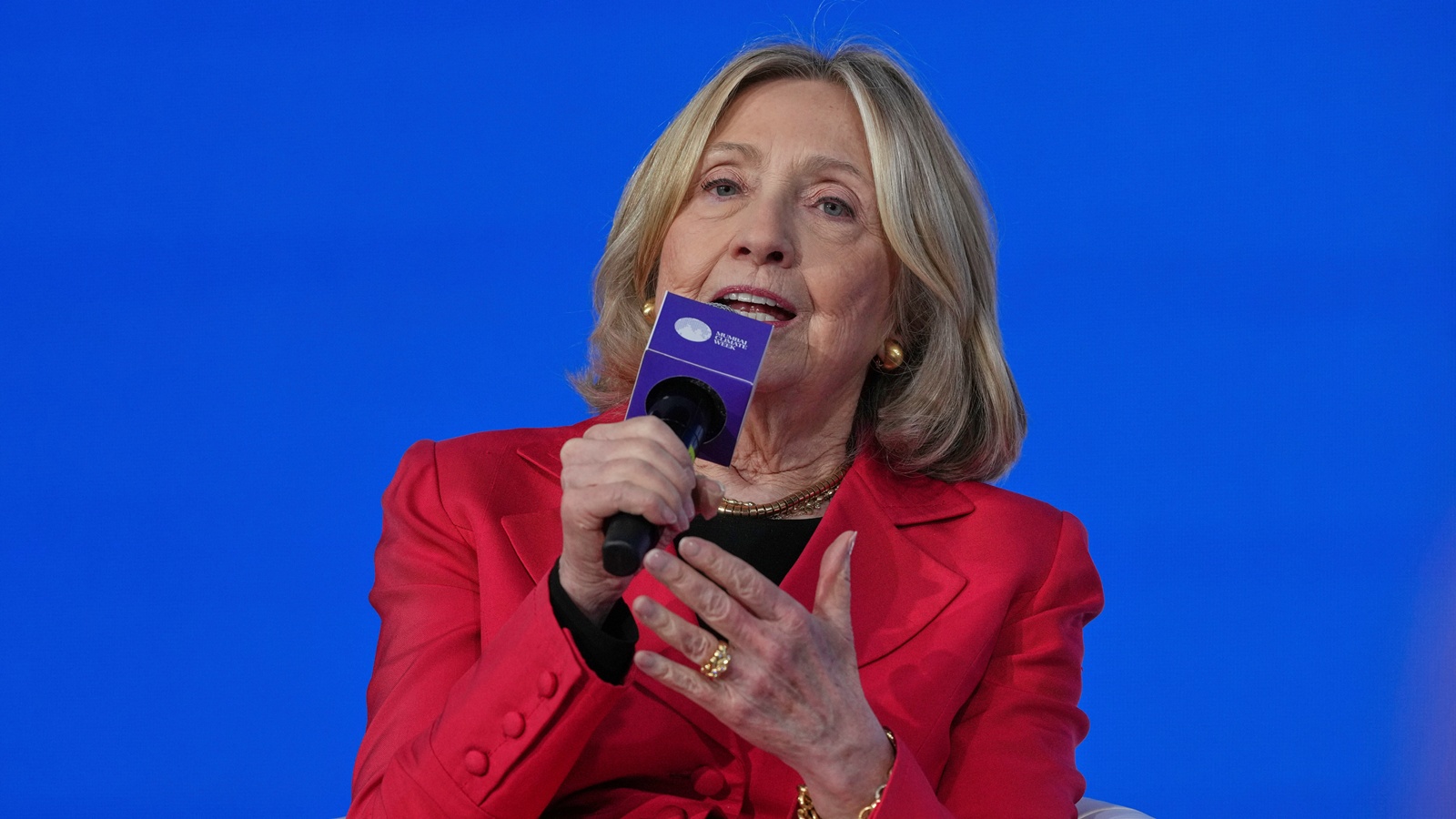
The intersection of high-level political legacy and the Jeffrey Epstein investigative arc represents a case study in the architecture of legal and reputational defense. When Hillary Clinton provided written testimony to the House Committee on Oversight and Accountability, the primary objective was not merely to answer questions, but to establish a definitive, narrow boundary between documented social proximity and actionable forensic involvement. This strategic maneuver relies on three pillars of institutional deniability: the limitation of physical footprints, the compartmentalization of social circles, and the utilization of time-decay in memory as a legal buffer.
The Geography of Proximity versus The Logistics of Participation
In high-stakes investigations, the distinction between a "contact" and an "associate" is defined by the logistics of the encounter. The core of the House panel’s inquiry focused on two specific geographic variables: the private aircraft (the Boeing 727 known as the "Lolita Express") and the private island (Little St. James). These locations serve as the primary filters for legal exposure because they represent "closed systems" where entry and exit were strictly controlled and recorded in flight logs or by security detail. Don't forget to check out our recent post on this related article.
The testimony provided by Clinton utilizes a binary defensive strategy. By stating she never flew on the aircraft and never visited the island, she removes herself from the two environments where the "presumption of awareness" is highest. In legal analysis, an environment is considered a "high-awareness zone" if the activities occurring within it are so pervasive that a visitor cannot reasonably claim ignorance. By negating her presence in these zones, the defense shifts the burden of proof back to the committee to find physical evidence—manifests, DNA, or surveillance—that contradicts a sworn statement.
The Manifest Discrepancy and the Burden of Verification
A common error in evaluating the Epstein files is the conflation of the "Clinton" name on flight manifests. Bill Clinton’s documented travel on Epstein’s aircraft—totalling 26 flights according to unsealed records—creates a proximity risk for Hillary Clinton. However, from a structural analysis of the testimony, the defense leverages the distinction between marital proximity and individual participation. To read more about the background of this, NBC News provides an in-depth breakdown.
The committee’s focus on Hillary Clinton’s knowledge of her husband’s travel introduces the "Knowledge Paradox." To prove she knew of illegal activity, the committee must first prove she was aware of the specific details of the travel, and then prove that the travel itself was the vehicle for illegal activity. Clinton’s written responses navigate this by maintaining a "strategic vacuum" regarding the specifics of Bill Clinton's travel, asserting a lack of direct involvement in his scheduling or flight logistics.
- The Proximity Factor: Being married to a regular passenger creates a social linkage, but it does not meet the threshold of legal complicity without evidence of co-travel.
- The Verification Bottleneck: The committee’s reliance on flight logs presents a technical challenge. If Hillary Clinton’s name does not appear on any known manifest, the committee is forced to rely on "off-manifest" travel, which is notoriously difficult to prove after a decade has passed.
- The Logical Defense: By denying any presence on the aircraft, Clinton forces the committee to find a witness who can place her on the plane—a task that has failed across multiple previous investigations.
The Lifecycle of Congressional Investigations and Political Decay
The House panel’s investigation is governed by the principles of "Information Entropy." As time passes from the events (the early to mid-2000s), the reliability of witnesses decreases while the political utility of the investigation increases. The timing of this probe, occurring years after the primary criminal cases were closed, suggests a transition from a forensic search for evidence to a symbolic search for accountability.
Clinton’s testimony is designed to survive this entropy by being as brief and definitive as possible. A common tactical mistake in congressional testimony is to provide too much context, which creates "surface area" for follow-up questions. By using categorical negatives—"I never," "I did not"—Clinton reduces the surface area of her testimony to zero. There are no "hedging" words like "to the best of my recollection" in these specific denials, which signals a high level of confidence in the absence of a paper trail or physical evidence.
The Role of Ghislaine Maxwell and the Social Perimeter
The second layer of the investigation involves social connectivity through Ghislaine Maxwell. The committee inquired about Clinton’s interactions with Maxwell, specifically regarding the 2010 wedding of Chelsea Clinton. Here, the defense strategy shifts from "physical negation" to "social categorization."
The "Social Perimeter Defense" operates on the premise that interacting with an individual in a professional or high-level social capacity does not imply knowledge of that individual’s private criminal conduct. In the testimony, the interaction with Maxwell is characterized as a standard social inclusion based on Maxwell’s then-standing in the New York social elite.
The second limitation of the committee's approach is the "Transitive Property of Guilt." The committee attempts to link Clinton to Epstein via Maxwell. However, the logic fails if the interaction between Clinton and Maxwell was restricted to public events with high visibility and security. The presence of Secret Service details at the Chelsea Clinton wedding provides a secondary layer of "institutional oversight," as it is highly unlikely that any individual with an active, high-risk criminal profile would be permitted to interact with a protected person without prior screening.
Structural Failures in the House Committee’s Inactive Evidence Model
The House Committee on Oversight and Accountability frequently relies on a "guilt by association" model that lacks the necessary components of a criminal conspiracy case. To elevate this investigation into a Masterclass of Analysis, one must identify the missing variables in the committee's framework:
- The Financial Linkage: There is no documented evidence of direct financial transfers between Hillary Clinton and Jeffrey Epstein, unlike the documented donations to the Clinton Foundation by Epstein (estimated at 25,000 USD). In the hierarchy of evidence, a 25,000 USD donation is considered "low-signal" for a multi-billion dollar foundation, representing a typical social entry fee rather than a deep partnership.
- The Scheduling Conflict: Analysis of Clinton’s public schedule during her tenure as Senator and Secretary of State shows a dense log of activity that correlates poorly with the windows of time Epstein spent at his private residences. The "time-cost of participation" for a high-ranking official is prohibitive; the logistical planning required to bypass a protective detail for a clandestine visit is a significant barrier that the committee has not addressed.
- The Intelligence Gap: The theory that Epstein’s operation was an intelligence gathering or "honey trap" mechanism requires a specific type of target. While Bill Clinton fits the profile of a high-value target with potential for compromise, Hillary Clinton’s public persona and career trajectory were focused on institutional power and policy, making her a less logical target for a sexually-oriented compromise operation.
The Forensic Limitation of Written Testimony
The choice of written testimony over a live hearing is a strategic victory for the Clinton legal team. Written testimony allows for a "scrubbing process" where every word is analyzed for its legal durability. This creates a bottleneck for the committee, as they cannot react in real-time to evasive or vague answers. The absence of "live pushback" means the committee is stuck with a record that is legally sterile.
In this environment, the committee’s only remaining move is the "Documentary Hail Mary." This involves searching for internal communications—emails or memos—that mention Epstein or Maxwell in a context that contradicts the testimony. However, given the prior exhaustive investigations into Clinton’s private servers and Department of State communications, the probability of undiscovered Epstein-related documents is statistically negligible.
The Strategic Recommendation for Future Oversight
For any investigative body to pierce the veil of institutional deniability, the strategy must move away from "historical geography" (asking who was where) and toward "functional mechanics" (asking who did what).
- Shift the Focus to Financial Intermediaries: Instead of asking if a principal was on a plane, investigate the financial intermediaries who facilitated the social connections. The "soft power" nodes are where the evidence of knowledge is most likely to reside.
- Deconstruct the Security Logbook: Compare Secret Service movement logs with Epstein’s flight logs with a focus on "logistical anomalies"—times when the principal’s location is vague or the detail was minimized.
- Analyze the Policy Impact: Investigate whether Epstein’s associates received any favorable treatment or access to policy-making circles that can be tied back to his influence.
The definitive strategic play for the House Committee is to recognize that the Clinton testimony has successfully closed the "physical proximity" door. Any further inquiry that relies on placing Hillary Clinton at the scene of the crime will likely yield diminishing returns. The committee should instead pivot to a broader audit of how Epstein utilized his proximity to political dynasties to insulate his operations from federal oversight, shifting the focus from individual culpability to institutional failure. This approach bypasses the "he-said, she-said" of flight logs and addresses the systemic weaknesses that allowed the Epstein network to operate within the highest echelons of global power.