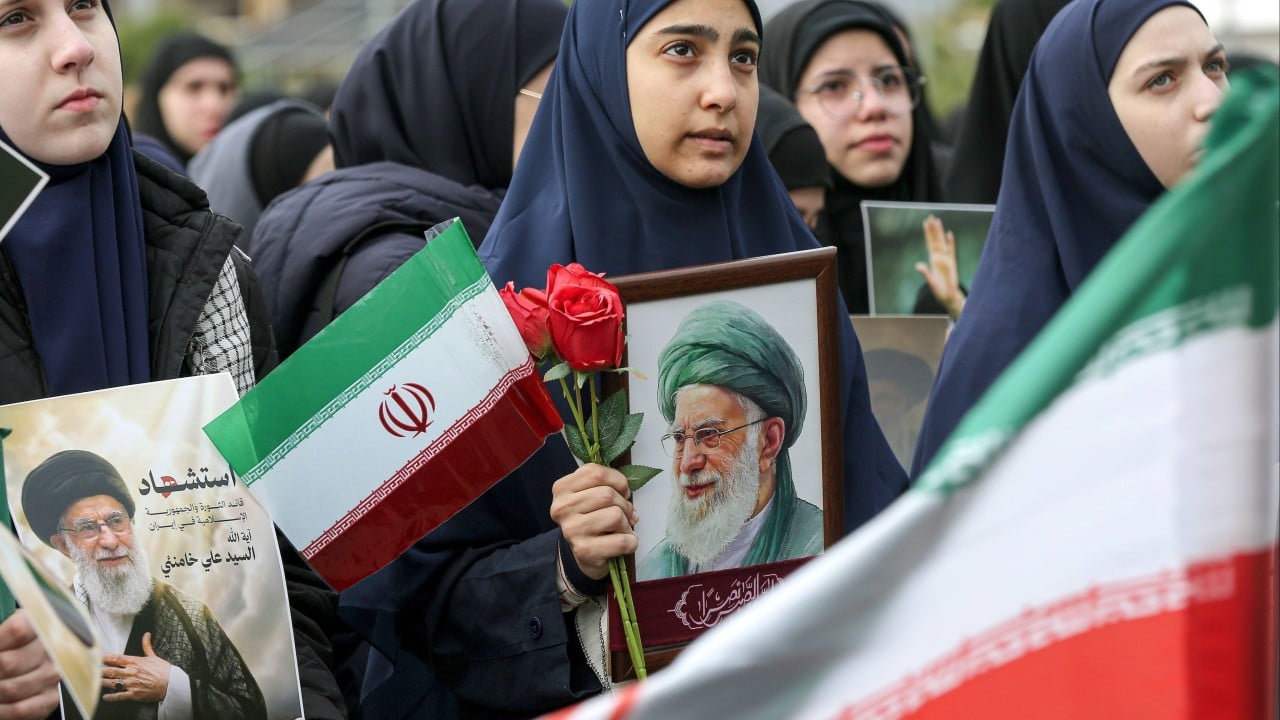
The sudden removal of a supreme leader in a highly centralized theocratic state does not create a simple power vacuum; it triggers a multi-vector systemic shock that tests the elastic limit of every state institution. In the Iranian context, the death of Ali Khamenei represents the failure of the central node in a "hub-and-spoke" governance model. This architecture, designed to prevent horizontal cooperation between elites and ensure all loyalty flows vertically to the office of the Velayat-e Faqih, becomes an existential liability the moment the hub vanishes. Analyzing this transition requires moving beyond anecdotal reports of street celebrations or mourning and instead quantifying the three primary friction points: the legitimacy of the Assembly of Experts, the economic preservation instinct of the Islamic Revolutionary Guard Corps (IRGC), and the kinetic response capacity of the security apparatus under conditions of information asymmetry.
The Institutional Bottleneck of Article 107
The legal mechanism for succession, governed by Article 107 of the Constitution, assumes a level of clerical consensus that no longer exists. The Assembly of Experts is theoretically charged with electing a successor based on "scholarly qualifications" and "political vision." However, the transition is physically constrained by a credibility deficit.
The first limitation is the erosion of traditional Marja (source of emulation) status among the leading candidates. When Khamenei took power in 1989, the constitution was amended to decouple the requirement of being a high-ranking Grand Ayatollah from the political office of Supreme Leader. This created a "political cleric" class. In the event of his death, the assembly faces a binary choice that both lead to instability:
- The Continuity Candidate: Selecting a figure like Mojtaba Khamenei or a mid-ranking cleric who promises status quo stability. This choice risks immediate rejection by the traditional clerical establishment in Qom, who view the further politicization of the office as a threat to the long-term survival of the Shi'a institution.
- The Consensus Candidate: Selecting a weak, "gray" figure intended to lead by committee. This creates a functional opening for the IRGC to transition from a "praetorian guard" to the "sovereign," effectively turning the Supreme Leader into a ceremonial figurehead.
This bottleneck ensures that the immediate aftermath of the death is characterized not by policy shifts, but by intense, closed-door bargaining where the currency is not votes, but the control of strategic foundations (Bonyads) and intelligence files.
The IRGC Economic Preservation Function
The IRGC is not merely a military wing; it is a conglomerate that controls between 20% and 40% of the Iranian economy, including telecommunications, construction (Khatam al-Anbiya), and energy. For the IRGC leadership, the death of the Supreme Leader is an enterprise risk management event.
Their primary objective is the "Sanctity of the Balance Sheet." Any successor who hints at rapprochement with the West or internal liberalization threatens the IRGC’s monopoly on smuggling routes and sanctioned-market arbitrage. We can categorize the IRGC's response into three tactical phases:
- Phase I: Kinetic Containment: Immediate deployment of Basij units to pre-identified "heat maps" of dissent in urban centers like Tehran, Tabriz, and Isfahan. This is a preventative strike to signal that the state's monopoly on violence remains intact despite the leadership void.
- Phase II: Information Blackout: Total throttling of the national information network (NIN). By severing global internet access while maintaining the domestic intranet, the state prevents the coordination of "flash mobs" while allowing internal logistics and banking systems to function.
- Phase III: Political Vetting: Forcing the Assembly of Experts to reach a decision within a 24-hour window to minimize the period of perceived vulnerability.
The relationship between the clerical establishment and the military is symbiotic but tense. The IRGC requires the "divine" legitimacy provided by the clergy to justify its extra-legal activities, while the clergy requires the IRGC’s boots to suppress the demographic reality of a young, secularized population.
Information Asymmetry and the Signaling Problem
In the hours following the confirmation of death, the greatest threat to the regime is not the opposition, but the "Signaling Problem." In a centralized autocracy, local commanders and provincial governors operate on strict hierarchical orders. When the top of the pyramid is gone, a hesitation at the mid-level of the security forces can be perceived by the public as a collapse of will.
This creates a feedback loop. If a local commander in Sistan and Baluchestan or Kurdistan hesitates to fire on a crowd, and that footage reaches a global audience, it signals to other units that the "cost of defection" has dropped. The regime's primary defense against this is "Performative Unity." Expect choreographed displays of grief involving all factional leaders—even those currently under house arrest or marginalized—to project the illusion that the system is self-healing.
The civilian population’s reaction functions on a "Risk-Reward Matrix." For the average citizen, the decision to take to the streets is a calculation of the likelihood of regime change versus the certainty of state retribution. Without a clear "Alternative Government" or a defection of a major military wing, the majority of the population remains in a state of "Rational Apathy," waiting to see which elite faction emerges with the keys to the armory.
Structural Vulnerabilities in the Digital Panopticon
The modern Iranian state relies heavily on facial recognition and digital surveillance to maintain order. However, these systems are vulnerable to internal sabotage during a succession crisis. The "Technical Intelligence" (TECHINT) wings of the various security services (the Ministry of Intelligence vs. the IRGC Intelligence Organization) often withhold data from one another to gain leverage.
This fragmentation creates "Blind Spots" that a decentralized protest movement can exploit. If the Ministry of Intelligence (MOI) identifies a rising protest leader but the IRGC is focused on securing the capital's airports, the coordination gap allows the movement to gain a foothold in the provinces. The efficacy of the "Digital Panopticon" is entirely dependent on the stability of the command-and-control (C2) structure. If the C2 is preoccupied with the succession battle, the automated tools of repression lose their human oversight, leading to inconsistent enforcement and "tactical openings" for the opposition.
The Geopolitical Correction
External actors—specifically the United States, Israel, and Saudi Arabia—face a "Calibration Trap." Overt support for an uprising during the succession window often backfires by allowing the regime to frame the dissent as a foreign intelligence operation, thereby unifying the nationalist elements of the military.
The actual leverage lies in the "Secondary Sanctions Loop." By signaling to the IRGC leadership that their personal assets and international shadow-banking networks will be permanently dismantled unless they refrain from a mass-casualty crackdown, external powers can alter the "Cost-Benefit Analysis" of the generals. The goal is to incentivize a "managed transition" toward a military-led autocracy that is less ideologically driven and more focused on economic survival, effectively trading theocracy for a "security state" model.
Strategic Forecast for Post-Khamenei Stability
The most probable outcome is not a democratic revolution, but a "Janus-Faced" consolidation. The state will likely appoint a clerical figurehead to satisfy the constitutional requirements of the 1979 Revolution while formalizing the IRGC’s role as the ultimate arbiter of both domestic and foreign policy.
This transition relies on the "Speed of Convergence." If the elite factions can agree on a wealth-sharing agreement within 72 hours, the likelihood of a successful popular uprising drops by 80%. If the bickering extends beyond the first week, the "Aura of Inevitability" surrounding the Islamic Republic will vanish, forcing a localized breakdown of authority that the IRGC may not have the manpower to suppress simultaneously across all 31 provinces.
The strategic play for any opposition or external observer is to monitor the "inter-elite friction." The moment a major IRGC commander or a high-ranking cleric publicly questions the legitimacy of the succession process, the "Coordination Cost" for the public to revolt disappears. This is the inflection point where structural fragility becomes a terminal collapse. Success for the regime depends entirely on its ability to hide its internal fractures until the initial wave of public energy is exhausted by the sheer physical pressure of the security apparatus.
The internal directive for the security forces will be the "Saturation Principle": flooding the streets with enough physical presence that the "Physical Space" for a protest cannot form. If the public manages to seize and hold even one significant symbolic location—such as Azadi Square—for more than 48 hours, the psychological shift will force a reassessment of loyalty within the rank-and-file of the regular army (Artesh), potentially leading to a "horizontal split" in the military.
The final move in this sequence is the "Liquidation of the Old Guard." Any successor, to establish their own brand of legitimacy, will likely purge the most visible symbols of the previous era's corruption. This internal cannibalization is a standard feature of autocratic survival, intended to offer the public a "cathartic sacrifice" without changing the underlying power dynamics. Those tracking the transition must look past the identity of the new leader and instead audit the list of who is arrested in the weeks following the funeral. That list will reveal the true winners of the succession war.