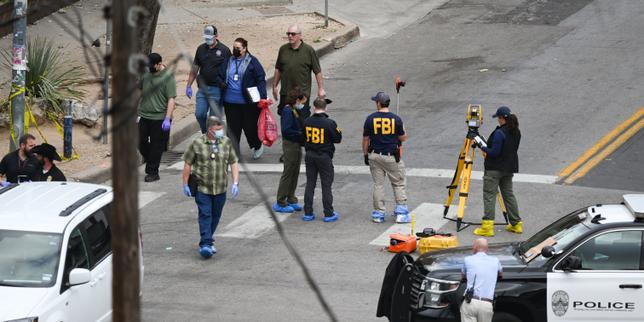
The classification of a mass casualty event as an "act of terrorism" by federal authorities fundamentally alters the legal, financial, and jurisdictional mechanics of the subsequent investigation. When the FBI assumes lead status in a domestic shooting, as seen in the recent Austin incident resulting in two fatalities, the shift is not merely symbolic; it triggers a transition from standard criminal homicide protocols to a high-intensity intelligence-gathering operation. The primary objective moves from establishing simple guilt to mapping a broader ideological network or identifying a self-radicalization pathway that suggests a systemic rather than isolated threat.
The Triad of Federal Jurisdictional Triggers
For an incident to move from a local police matter to a federal terrorism investigation, the Department of Justice evaluates the event against three specific criteria.
- The Intent to Intimidate: The violence must appear calculated to influence the policy of a government or intimidate a civilian population. In the Austin case, the FBI’s early invocation of this term suggests evidence—likely digital or recovered manifestos—that transcends personal grievance.
- Transnational or Domestic Nexus: The Bureau determines if the actor was inspired by or directed by a Foreign Terrorist Organization (FTO) or if the radicalization occurred entirely through domestic channels.
- The Instrumentality of the Attack: While a firearm is the primary tool in this specific instance, the federal government analyzes the logistics of the acquisition to identify potential systemic flaws in background check systems or illegal procurement networks.
Intelligence Aggregation and Digital Forensic Loops
The speed with which the FBI labeled the Austin shooting an "act of terrorism" indicates an immediate extraction and analysis of the suspect’s digital footprint. The investigation of a modern domestic attack requires a three-stage forensic loop.
The initial stage involves the Rapid Triage of Digital Artifacts. Investigators bypass standard warrant wait times through emergency disclosure requests (EDRs) to social media companies and telecommunications providers. This process identifies the suspect’s most recent contacts, search history, and potential encryption tools used to coordinate or signal the attack.
The second stage is the Network Mapping of Ideological Influence. In Austin, the inquiry focuses on whether the perpetrator existed in an "echo chamber" or a "recruitment funnel." The FBI distinguishes between "lone actors"—individuals who radicalize in isolation—and "facilitated actors" who receive indirect logistical support or encouragement through decentralized online forums.
The third stage consists of the Psychological and Behavioral Autopsy. This involves a granular reconstruction of the perpetrator’s life over the 18 to 24 months preceding the attack. Investigators search for "leakage," a term used to describe the communication of intent to a third party before the event. If leakage occurred and went unreported, the investigation may expand to include those who failed to act, raising the legal stakes for the community.
Economic and Societal Cost of Classification
The designation of an event as terrorism carries specific fiscal implications for the host city and the federal government. Under the Terrorism Risk Insurance Act (TRIA), certain insurance payouts are only triggered when the Secretary of the Treasury, in consultation with the Attorney General, certifies an act as "terrorism."
- Public Safety Resource Allocation: The City of Austin must now transition from a tactical response to a protracted security posture. This involves increased patrol density in sensitive areas and the deployment of "fusion center" resources to monitor for copycat activity.
- The Federal Funding Mechanism: Federal classification unlocks specific DOJ and DHS grants for victim compensation and the reimbursement of local law enforcement overtime.
- Infrastructure Stress Tests: The attack forces a re-evaluation of "soft target" security. Investigators analyze the physical architecture of the attack site to determine if structural or surveillance failures contributed to the casualty count.
The Limitation of "Terrorism" as a Legal Catch-all
While the FBI’s use of the term provides a clear signal of the event's gravity, domestic terrorism is not a standalone federal crime that can be charged in court. This creates a functional gap between investigation and prosecution. Prosecutors must instead rely on other statutes, such as:
- 18 U.S.C. § 2332b: Acts of terrorism transcending national boundaries.
- 18 U.S.C. § 922: Firearm-related offenses.
- 18 U.S.C. § 249: Hate crime acts (if the motive targets a protected class).
The disconnect between the "terrorism" label used for public communication and the "homicide" or "weapons" charges used in the courtroom can lead to public confusion regarding the severity of the legal response. This bottleneck necessitates a strategic alignment between the FBI and the U.S. Attorney’s Office during the first 48 hours of the investigation to ensure the narrative of the case supports the ultimate legal objectives.
The Mechanism of Modern Radicalization
The Austin shooting highlights a shift in the mechanics of violence. Traditional terrorism was characterized by hierarchical organizations with top-down command structures. Modern domestic terrorism is characterized by "stochastic terrorism," where demonizing rhetoric is broadcast to a large audience, making it statistically probable that an unstable individual will commit an act of violence, even if the "speaker" never issued a direct order.
The FBI’s involvement in Austin aims to determine the specific "on-ramp" this individual used. The investigation will prioritize identifying the platform or content that served as the final catalyst. This is not just about the two victims in Austin; it is about identifying the structural vulnerabilities in digital moderation and mental health intervention that allowed the event to occur.
Strategic Play for Municipal and Federal Coordination
The immediate requirement for Austin’s leadership and federal partners is the implementation of a Hyper-Local Threat Assessment Team (TAT). This team must bridge the gap between digital intelligence and physical security.
- Immediate Digital De-escalation: Law enforcement must work with tech companies to prevent the viral spread of any manifesto or footage of the attack. Proliferation of this content serves as the "contagion effect" that inspires secondary incidents.
- Infrastructure Hardening: Municipalities must move beyond reactive policing and adopt proactive environmental design. This includes the installation of smart surveillance with behavioral analytics capable of detecting pre-attack indicators, such as unusual loitering or the brandishing of weapons in real-time.
- Victim Advocacy and Resilience: The federal government must expedite the disbursement of funds through the Office for Victims of Crime (OVC). Reducing the economic shock to the survivors and the local community is a critical component of denying the terrorist their objective of societal destabilization.
The Austin investigation will serve as a diagnostic tool for the current state of domestic security. The findings will likely dictate whether the current federal strategy of "disruptive investigation"—intercepting actors before they strike—requires a pivot toward more aggressive monitoring of decentralized digital spaces.