The fluorescent lights in Brussels don't flicker. They hum with a steady, bureaucratic clinicality that masks the high-stakes drama unfolding beneath them. In these rooms, maps are spread across mahogany tables, and the ink is still wet on a concept that sounds like a logistics solution but feels like a ghost story: the "return hub."
For years, the European Union has wrestled with a math problem that refuses to resolve. Thousands arrive; only a fraction leave when their paperwork says they must. The system is clogged. The politics are toxic. Now, the solution being whispered—and increasingly shouted—is to create a series of waystations outside the bloc’s borders. Places that aren't quite home, but aren't quite Europe.
Think of it as a waiting room for the dispossessed.
The Architect and the Traveler
To understand the "return hub," you have to look at it through two sets of eyes.
First, there is the policy architect. Imagine a woman named Elena, sitting in an office overlooking the Parc du Cinquantenaire. To her, the hub is a triumph of efficiency. It solves the "pull factor." It signals to the world that the back door to Europe is locked. If an asylum seeker’s claim is rejected in Rome or Berlin, they aren't simply given a letter and asked to please leave. They are moved to a facility in a third country—perhaps Albania, perhaps elsewhere—where their final deportation is managed.
To Elena, this is about the survival of the Schengen Area. If the borders aren't managed, the center cannot hold. The logic is ironclad. It is sterile. It is necessary.
Then there is Hamid. He is our hypothetical traveler, but his story is stitched together from ten thousand real ones.
Hamid sold a patch of land in a province he can never return to. He spent six months moving through shadows, crossing seas in a boat that smelled of gasoline and salt. When he reaches the shore, he isn't met with a job or a home, but with a legal labyrinth. When the "No" finally comes, Hamid doesn't just disappear into the black market of a European city. Instead, he is placed on a bus.
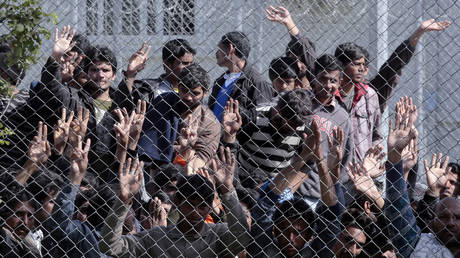
He crosses another border, but this time, he is going the wrong way. He ends up in a hub. It is clean. There is food. There are fences. He is in a geopolitical limbo, a space that exists on a map but offers no path forward and no way back.
The Logistics of Limbo
The European Commission is currently exploring "innovative ways" to increase the rate of returns, which currently hovers at a dismal 20%. The "return hub" is the centerpiece of this new, hardened stance. It is a pivot toward the externalization of migration management—a fancy way of saying "not in my backyard."
The mechanical reality of these hubs involves complex bilateral agreements. Italy has already blazed the trail with its deal with Albania. The idea is to process people in centers that are technically under Italian jurisdiction but physically located on Albanian soil. It’s a legal sleight of hand that seeks to bypass the sluggishness of domestic courts while maintaining a veneer of European standards.
But the friction lies in the details.
Who runs the hub? What happens if the home country—the place Hamid actually fled—refuses to take him back? The hub then becomes a warehouse. It becomes a permanent temporary home. History shows us that "temporary" is the most dangerous word in the migrant lexicon. From the camps on the Greek islands to the offshore processing centers used by Australia, these sites have a tendency to become black holes of human rights and mental health.
The Invisible Stakes
We often talk about migration in terms of "flows" and "surges," as if we are describing a river or a storm. We use liquid metaphors to dehumanize a human crisis. But the real stakes aren't just about numbers or border security. They are about the soul of the European project.
Europe was built on the ruins of a century that specialized in displaced persons and guarded borders. The right to seek asylum is a cornerstone of its post-war identity. When we move the "return" process to a third country, we aren't just moving people; we are moving our accountability.
It is much harder to protest a violation of dignity when it happens in a fenced compound three borders away. Out of sight, out of mind, out of the headlines.
The economic cost is also staggering. Building and maintaining high-security facilities in foreign countries, paying those countries for their cooperation, and chartering the flights required to move people back and forth is an astronomical investment. Some estimates suggest it costs tens of thousands of Euros per person.
Is this the most "robust" way to spend the continent's resources? Or is it an expensive theater designed to calm an angry electorate?
The Psychology of the Fence
There is a specific kind of silence that exists in a detention center. It is the sound of thousands of people waiting for a life that has been put on hold.
In a return hub, that silence is amplified by the lack of hope. In an asylum center, there is at least the glimmer of a "Yes." In a return hub, the only outcome is a "No" that is being enforced.
Consider the psychological impact on the staff, the guards, and the local communities. To host a return hub is to host a monument to failure. It is a place where the dream of a better life goes to be dismantled. It creates a friction that ripples outward, affecting how we view the "other" and how we view ourselves as gatekeepers.
The argument for these hubs is that they will serve as a deterrent. The theory is that if Hamid knows he will end up in a fenced camp in a third country, he won't get on the boat in the first place.
But hope is a resilient thing. It doesn't follow the laws of deterrence. A man who believes he will die if he stays put will always take the one-percent chance of survival, even if that path leads to a return hub.
The Map of the Future
As the EU leaders gather to finalize these plans, the map of the world is being redrawn. We are seeing the emergence of "buffer states"—countries that are paid to act as the world’s waiting rooms.
This isn't just a European story. It’s a global shift. The border is no longer a line on the ground; it is a series of checkpoints, digital databases, and offshore facilities. It is a fragmented, decentralized wall.
The "return hub" is the latest brick in that wall. It is a pragmatic response to a political crisis, but it is also a gamble. It gambles that we can outsource our problems without losing our values. it gambles that Hamid will eventually give up and go home, even if home is a place that no longer exists for him.
The lights in Brussels will stay on long into the night. The papers will be signed. The hubs will be built.
But the people in them won't be numbers on a spreadsheet. They will be men and women staring at a horizon that looks exactly like the one they left behind, wondering at what point the journey stopped being about moving forward and started being about disappearing.
The ink on the map is dry, but the path home is still a jagged line through the dark.
Would you like me to research the specific legal challenges currently being brought before the European Court of Justice regarding these offshore return centers?