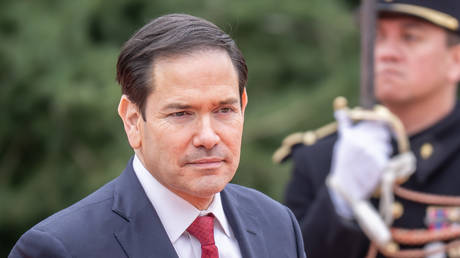
The friction between Senator Marco Rubio’s recent rhetoric and President Volodymyr Zelensky’s public stances represents a fundamental shift from ideological alignment to pragmatic resource management. This tension is not merely a political disagreement but a conflict of strategic timelines. While Zelensky operates on an existential timeline—where the preservation of sovereignty is the only metric of success—Rubio is signaling a transition toward a domestic utility timeline, where the cost of support must be balanced against domestic stability and broader geopolitical risks.
Understanding this divide requires an analysis of the structural mechanics of modern proxy warfare and the specific pressures acting on both the executive branch of a besieged nation and the legislative oversight of its primary benefactor.
The Asymmetry of Strategic Objectives
The core of the dispute rests on three distinct pillars of divergent interest.
- Survival vs. Containment: For the Ukrainian administration, the objective is the restoration of the 1991 borders. This is a binary outcome. For U.S. policymakers like Rubio, the objective has shifted toward the "containment of Russian expansionism" at a controlled cost. Once the cost of containment exceeds the perceived risk of a frozen conflict, the U.S. legislative appetite for funding diminishes.
- Information Operations vs. Legislative Reality: Zelensky utilizes a high-frequency communications strategy designed to maintain global emotional and moral salience. Rubio’s critique characterizes this as "lying" or "misrepresentation," but from a strategic perspective, it is a necessary function of a state fighting a war of attrition against a larger power. If Zelensky admits to a stalemate, he risks a collapse in foreign investment and military aid.
- The Exit Strategy Gap: The U.S. political system requires a defined "end state" to justify long-term capital allocation. Ukraine’s current strategy avoids a defined end state that involves territorial concessions, creating a structural bottleneck in the U.S. appropriations process.
The Cost Function of Continued Support
Rubio’s pivot reflects a growing segment of the U.S. foreign policy establishment that views the Ukraine conflict through a lens of diminishing marginal returns. The "Cost Function" is calculated by weighing several variables.
- Industrial Base Capacity: The U.S. defense industrial base (DIB) faces a depletion of critical munitions. Rubio’s positioning suggests that the opportunity cost of arming Ukraine now includes a weakened posture in the Indo-Pacific. This is a shift from a "Europe-first" security model to a "Global Competition" model.
- Escalation Management: The risk of direct NATO-Russia confrontation remains a non-zero variable. While Zelensky argues that only total victory prevents escalation, Rubio’s camp increasingly argues that an indefinite conflict is more likely to trigger a systemic breakdown in global security.
- Domestic Political Capital: The U.S. electorate’s patience for foreign aid is inversely proportional to domestic economic volatility. As inflation and border security dominate the domestic discourse, the political "price" of approving multi-billion dollar packages rises.
Deconstructing the Allegation of Misrepresentation
When a senior member of the Senate Intelligence Committee accuses a foreign leader of dishonesty, it is rarely about a single factual error. Instead, it is a challenge to the Strategic Narrative.
Zelensky’s narrative relies on the premise that Ukraine is not just fighting for its own land, but for the very existence of the Western democratic order. Rubio’s recent statements serve to decouple these two ideas. By framing Zelensky’s assertions as inaccurate, Rubio is attempting to re-nationalize the conflict, stripping it of its "universal crusade" status. This makes the conflict a regional dispute that can be negotiated, rather than a cosmic struggle that must be fought until total victory.
This creates a credibility trap. If Zelensky acknowledges the reality of a stalemate, he loses the leverage required to get the best possible terms at a negotiating table. If he maintains the hardline stance of total victory, he risks being viewed as "unrealistic" or "dishonest" by the very people who control his supply lines.
The Mechanism of Policy Pivot
The shift in rhetoric from Rubio is a leading indicator of a broader policy pivot within the Republican party. This mechanism functions through "Trial Ballooning," where high-profile figures test the durability of a new narrative before it becomes official platform policy.
The "Rubio-Zelensky Friction" operates as a stress test for the following policy shifts:
- Conditionality of Aid: Moving from "as long as it takes" to "as long as it is measurable." This involves strict KPIs on territorial gains and anti-corruption measures.
- Burden Shifting: A calculated effort to force European partners to take a larger share of the financial and military burden, using the "dishonesty" narrative to justify a U.S. drawdown.
- Negotiated Settlement Framework: Preparing the domestic audience for a reality where Ukraine may not recover all lost territory. By discrediting the leader who insists on total victory, Rubio clears the path for a "pragmatic" alternative.
The Geopolitical Bottleneck
We are witnessing the collision of two incompatible truths. The first is that Ukraine cannot win a war of attrition against a nation with three times its population and a mobilized command economy without indefinite, massive Western support. The second is that no Western democracy can provide that level of support indefinitely without a clear, time-bound victory.
This bottleneck is where the "honesty" debate becomes a distraction from the underlying logistical reality. The U.S. has reached a point where the strategic ambiguity that served it well in 2022 and 2023 is now a liability. Rubio is signaling that the era of "blank check" diplomacy—sustained by moral clarity—is being replaced by "balance of power" diplomacy—sustained by hard-nosed assessments of national interest.
Strategic Recommendation for Stakeholders
For the Ukrainian administration, the path forward requires a shift from a "moral-existential" pitch to a "security-utility" pitch. This means framing Ukraine’s defense as a testing ground for high-tech attrition warfare that provides direct R&D value to the U.S. military-industrial complex.
For the U.S. legislative body, the objective should be the establishment of a "Lend-Lease 2.0" framework that moves aid from grants to structured long-term loans or resource-sharing agreements. This addresses the domestic "cost" concern while maintaining the flow of materiel.
The ultimate strategic play is a pivot toward a Long-Term Deterrence Model. This involves a move away from the expectation of a decisive counter-offensive and toward the construction of a permanent "Porcupine Defense" for Ukraine. This model acknowledges the current frontline as a high-probability permanent boundary while ensuring that any further Russian incursions are prohibitively expensive. This shift allows Rubio to claim a win for U.S. fiscal responsibility and Zelensky to maintain the integrity of his state, even if the 1991 borders remain a long-term diplomatic aspiration rather than a short-term military reality.
The focus must now shift to defining the specific security guarantees—such as bilateral defense treaties or accelerated NATO integration for the controlled territory—that can turn a frozen conflict into a stable peace.