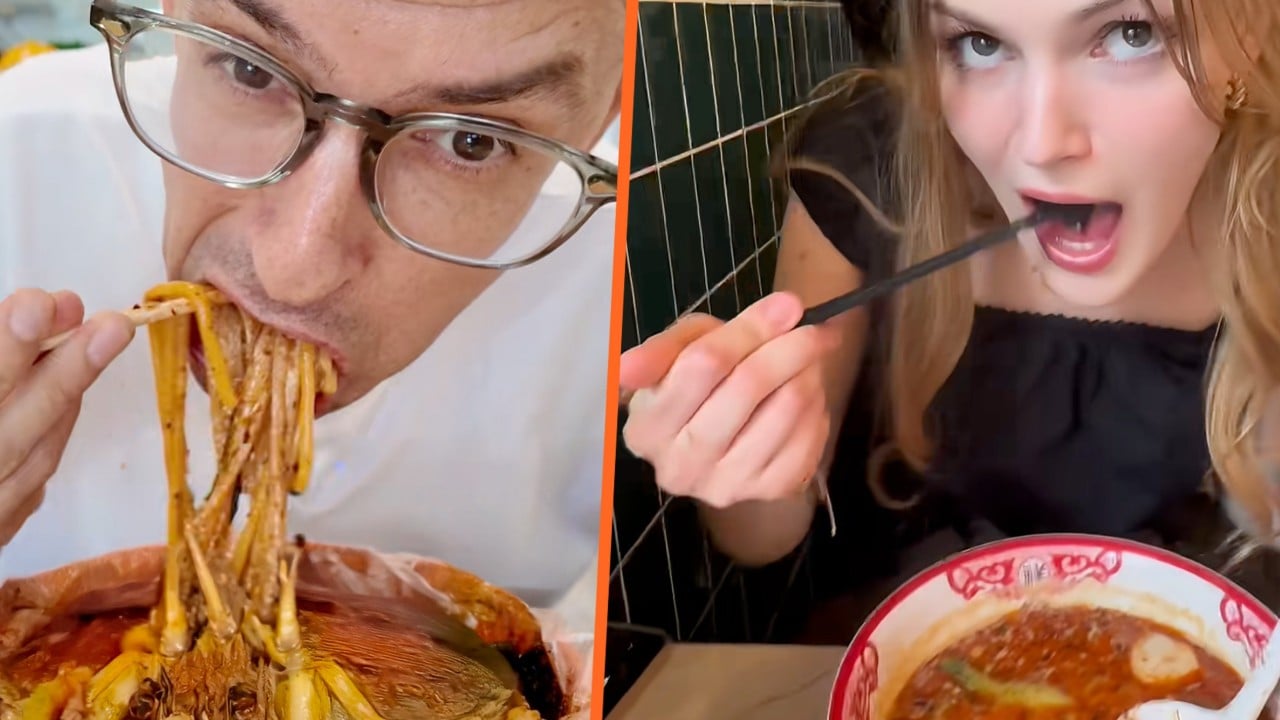
The international proliferation of Chinese malatang—specifically the "dry" and "creamy" variants popularized by chains like Yang Guofu and Zhangliang—is not a fluke of culinary fashion but a masterclass in modular consumer agency. Unlike traditional hot pot, which requires a communal time commitment and a high entry barrier for the uninitiated, malatang functions as a high-frequency, low-friction entry point into the Sichuan flavor profile. The phenomenon of "foreigners flocking" to these eateries is driven by a specific intersection of customized dietary control, perceived nutritional transparency, and the gamification of the selection process.
The Three Pillars of Malatang Scalability
To understand why this specific street food has transitioned into a global retail powerhouse, one must analyze the structural advantages it holds over traditional Western "build-your-own" concepts like Chipotle or Subway.
1. Granular Personalization and the Endowment Effect
Psychologically, the "pick-your-own" tray system triggers the endowment effect. Because the customer physically selects each lotus root slice, wood ear mushroom, and beef roll, they develop an immediate sense of ownership over the meal. This minimizes the risk of buyer's remorse. In a standard restaurant, the chef dictates the ratio of ingredients; in malatang, the customer is the architect. This appeals particularly to the "Gen Z" demographic and health-conscious professionals who demand total transparency regarding macronutrient sourcing.
2. The Efficiency of Unified Thermal Processing
From an operational standpoint, malatang solves the "bottleneck" problem of custom orders. Most bespoke food models require sequential assembly. Malatang uses a parallel-to-serial processing model:
- Parallel Input: Multiple customers select ingredients simultaneously at a refrigerated display.
- Unified Processing: All ingredients, regardless of their disparate cook times, are processed in a single high-temperature blanching cycle.
- Serial Output: The final seasoning—usually a bone broth base or a spicy dry mix—is applied at the end.
This allows a single kitchen unit to maintain a high "Throughput per Square Meter," a metric where malatang often outperforms ramen or pho shops by 30% to 40% due to the reduced prep time per bowl.
3. The "Healthy" Halo Effect of Bone Broth
The perception that malatang is "healthy" stems from the visual of raw, green vegetables being boiled in a collagen-rich broth. While the caloric density of the sesame paste and spicy oils can be significant, the consumer focuses on the Bioavailability of Nutrients. The brief blanching process preserves the texture and color of vegetables better than long-term stewing, leading to a "health-coded" dining experience that satisfies the modern desire for "clean" eating without sacrificing the umami-rich "comfort" factor.
The Economics of the Malatang Birthday Trend
The rise of "Malatang Birthdays" among non-Chinese demographics represents a shift in the Value-to-Novelty Ratio. Traditionally, birthday dinners are high-stakes, high-cost events. Malatang disrupts this by offering "Low-Stakes Socialization."
The birthday trend is fueled by three specific social mechanisms:
- Visual Shareability: The "wall of ingredients" is inherently cinematic. For social media-driven marketing, this provides free, high-volume user-generated content (UGC).
- Dietary Inclusivity: In a group of ten people, there may be three vegans, two keto adherents, and one person with a gluten allergy. Malatang is the only dining format that accommodates every single restriction without requiring the kitchen to change its workflow. Each guest creates their own "micro-ecosystem" on their tray.
- Cost Predictability: Because malatang is sold by weight, the price is transparent. There are no hidden "splitting the bill" anxieties that often plague large group dinners at traditional sit-down restaurants.
Deconstructing the "Rich Soup" Myth
A recurring theme in consumer feedback is the belief that the "milky white" soup base is a health tonic. It is vital to distinguish between the Organoleptic Properties (taste and mouthfeel) and the Nutritional Reality.
The white color in malatang broth is an emulsion of fats and proteins. While bone broth contains minerals and collagen, the commercial versions often rely on high-pressure extraction or the addition of emulsifiers to achieve that signature opacity. The "health" of the soup is highly variable, depending on:
- The Sodium-to-Volume Ratio: The high palatability of the soup often leads to total consumption of the liquid, which may exceed daily recommended sodium intakes.
- Oil Saturation: The "Ma" (numbing) and "La" (spicy) components are lipid-based. Consumers who opt for "dry stir" (ma-la-xiang-guo style) are consuming a higher ratio of refined oils compared to those opting for the clear or bone-broth soup versions.
The belief that the soup is healthy functions as a Psychological Permission Slip. It allows the consumer to indulge in high-calorie proteins because they are "balanced" by the presence of a nutrient-dense broth and fresh greens.
The Geographic Bottleneck of Supply Chains
Despite its popularity, the global expansion of malatang faces a significant logistical hurdle: Ingredient Standardization.
The "core identity" of malatang relies on specific processed items—frozen fish balls with roe, seaweed knots, specific tofu derivatives, and sweet potato glass noodles. Domestic Chinese chains have mastered the cold-chain logistics for these items. However, international franchisees often face a "Quality-Cost Tradeoff." They must either:
- Import high-cost authentic ingredients, which inflates the price per gram and alienates the budget-conscious segment.
- Substitute with local equivalents, which risks diluting the "authentic" brand identity that attracts the "foodie" demographic in the first place.
This creates a competitive advantage for chains that can vertically integrate their supply chains or those that can develop a "Localization Strategy" that uses local produce (like kale or western mushrooms) while maintaining the proprietary flavor profile of the base sauce.
Strategic Framework for Global Market Penetration
To move from a "viral trend" to a permanent fixture in the global fast-casual market, malatang brands must optimize their operations around the following three vectors.
Data-Driven Inventory Management
The open-shelf model of malatang leads to high levels of "shrinkage" (waste) if not managed precisely. Successful operators utilize real-time weight-tracking to monitor which ingredients have the highest turnover. By adjusting the "bin size" for low-turnover items, they can maintain the visual "abundance" of the display while minimizing the loss of perishables.
The Hybrid Model: Retail vs. Dining
There is a massive untapped opportunity in Retail SKU Diversification. The "malatang experience" is being compressed into "instant" formats (self-heating pots). The brick-and-mortar eateries serve as the "showroom" for the brand, while the high-margin growth lies in getting their proprietary sauces and instant noodles onto the shelves of local grocery stores.
Redefining the "Healthy" Narrative
As global health regulations regarding sodium and saturated fats tighten, brands that proactively offer "Low-Sodium" or "Plant-Based Broth" options will capture the longevity-focused consumer. Transitioning the narrative from "rich and creamy" to "functional and restorative" aligns the product with the trillion-dollar global wellness economy.
The malatang model proves that the most successful global food exports are those that provide a rigid flavor framework (the sauce) while allowing for total anarchy in the ingredient selection. It is the ultimate expression of "Mass-Produced Individuality."
To capitalize on the current momentum, operators should shift focus from "Cultural Authenticity" to "Operational Excellence." The goal is not just to be a Chinese eatery that foreigners visit, but to become a global standard for customized, rapid-fire nutrition. This requires a pivot toward high-tech food prep surfaces that automate the weighing and payment process, effectively removing the last point of friction in the customer journey. Brands that can integrate an app-based "pre-select" feature—allowing users to build their tray virtually before arriving—will dominate the urban lunch market by solving the "choice paralysis" that currently slows down the weighing stations during peak hours.