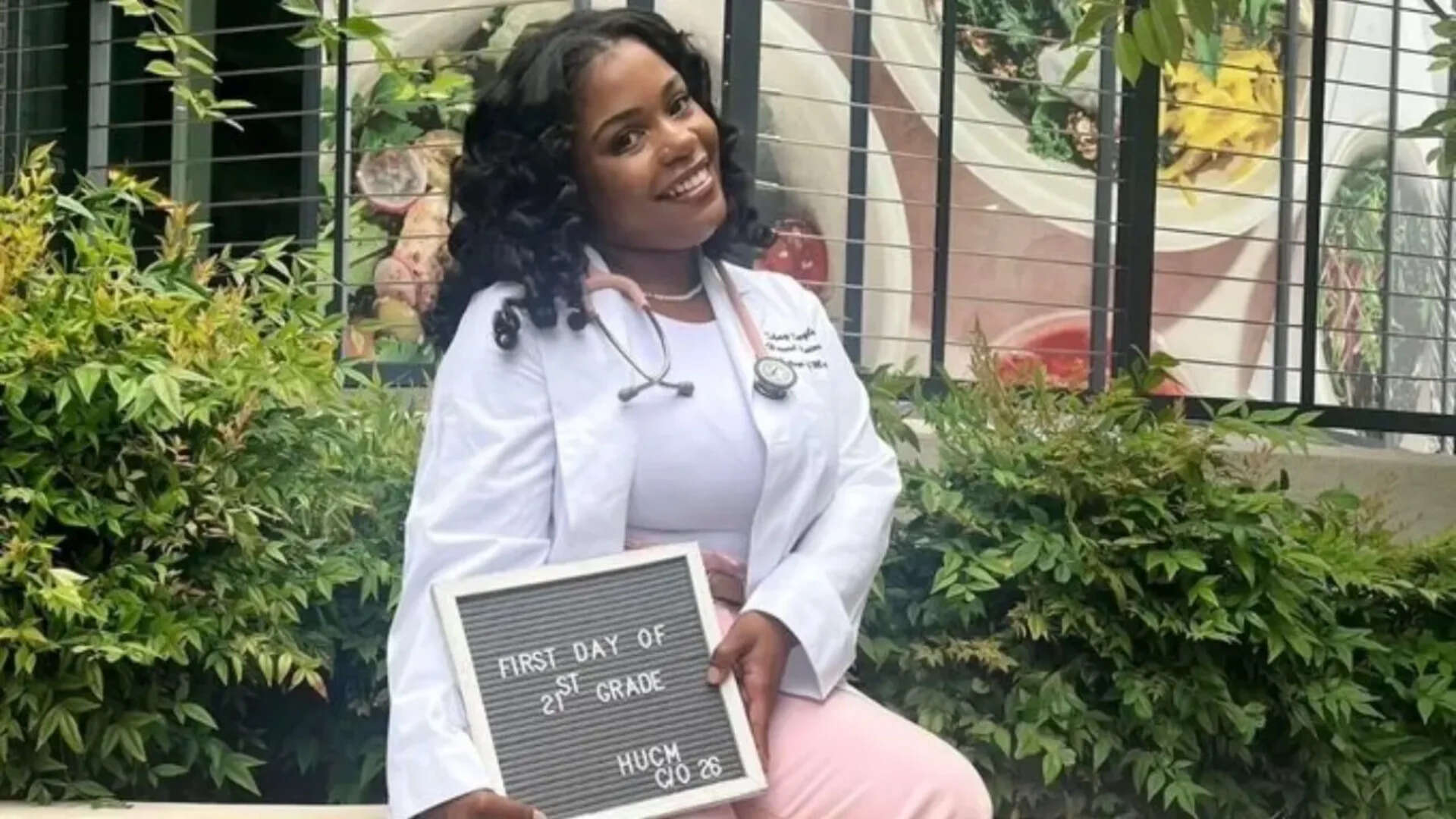
The smell of industrial-grade floor wax has a way of clinging to the back of your throat. It is a sterile, chemical scent that signals order, but for those who spend their lives pushing the buffer, it is the scent of invisibility. For ten years, that was the primary sensory data of Janna Derryberry’s world.
She knew the hospital floor by its scuffs. She knew which rooms held the grief that stayed quiet and which ones held the kind that wailed. While the surgeons and residents hurried past her, their white coats billowing like sails, Janna moved in the opposite direction, armed with a mop and a bucket. She was the person who cleared the way so that healing could happen, yet in the rigid social hierarchy of a medical center, she was often little more than a ghost in a blue uniform.
Ten years is a long time to watch a world you aren't allowed to join. It is 3,650 days of emptying sharps containers and wiping down surfaces that others have touched with trembling hands. Most people would look at a decade of custodial work and see a ceiling. Janna Derryberry saw a vantage point.
The transition from janitor to physician is not a leap. It is a slow, grueling crawl through the mud of exhausted nights and the jagged glass of self-doubt. To understand how a woman goes from scrubbing the floors of Northwest Arkansas Council (NWAC) to diagnosing the patients within its walls, you have to look at the invisible stakes of the American dream. We often talk about "upward mobility" as if it’s an escalator. It isn't. It’s a mountain, and for Janna, the mountain was made of organic chemistry textbooks and 12-hour shifts that bled into 4-hour study sessions.
Imagine the mental friction of cleaning a breakroom where the very people you aspire to be are complaining about their grueling schedules. You are cleaning their coffee spills while your own brain is buzzing with the Krebs cycle. You are replenishing the paper towels while silently reciting the cranial nerves. This isn't a hypothetical struggle. This was the lived reality of a woman who decided that her current station was a foundation, not a tomb.
The grit required for this kind of transformation is rare because it requires a specific type of ego—one that is strong enough to hold a vision but humble enough to keep doing the "lowly" work until the vision catches up. Janna didn't quit her job the moment she got into medical school. She didn't walk away with a dramatic flourish. She stayed. She worked. She balanced the bucket and the book.
There is a deep, psychological cost to being invisible. It is a weight that stays with you even after you've changed your clothes. When Janna returned to that same hospital as Dr. Janna Derryberry, she didn't just bring her medical knowledge. She brought the thousand invisible lessons learned from the perspective of a mop.
Consider what happens next: a patient is lying in a bed, terrified, watching the doorway. A doctor walks in. The white coat is a symbol of authority, yes, but for many, it is also a symbol of distance. It can be a barrier. But Dr. Derryberry knows what the view looks like from the bottom. She knows what it feels like when the doctor walks past you without making eye contact.
When she enters a room now, her stethoscope is a tool of medicine, but her past is a tool of connection. She is not just a healer of symptoms. She is a witness to the humanity that exists in the corners of a hospital—the places the "dry, standard" news stories forget to mention. She is the embodiment of a quiet, relentless power that doesn't need to shout to be felt.
The medical system is often criticized for its coldness, its sterile efficiency. It is easy to forget that hospitals are also repositories of human stories, of intersections where lives are saved and lost in the same breath. Dr. Derryberry’s story is a disruption of that coldness. It is a reminder that the person emptying your trash might be the person who one day saves your life. It is a reminder that the most profound expertise often comes from the most unlikely sources.
But the real problem lies elsewhere. It’s in our collective inability to see the potential in the people we've categorized as "service workers." We build walls between the "skilled" and the "unskilled," forgetting that the only difference between a janitor and a doctor is often a decade of opportunity and an iron-clad will. Janna Derryberry didn't magically become a different person the day she received her MD. She was always Dr. Derryberry. She was just a Dr. Derryberry who happened to be holding a mop.
The quiet rise of a woman from the custodial staff to the medical staff is a story of more than just a job change. It is a story of a person who refused to let the scent of floor wax be the final word on her life. It is a story of a woman who understood that the longest shift isn't the one on the clock—it's the one you work within yourself.
She is back in the same halls now. The light reflects off the floors she once polished. She still smells that industrial wax, but now it doesn't cling to her throat with the weight of invisibility. It is just the background noise of a world where she finally, undeniably, belongs.
The scuffs on the floor are still there. But now, she's the one walking over them, her stride firm, her eyes on the next room, her hands ready to do a different kind of work.
One woman. Two uniforms. A lifetime of invisible stakes finally made clear in the light of a new day.