The four-hour wait times currently paralyzing major US international gateways are not merely a byproduct of increased passenger volume; they are the result of a fundamental misalignment between federal staffing models, biometric technology integration, and the physical constraints of legacy infrastructure. When executive orders or high-level policy shifts attempt to "solve" these bottlenecks without addressing the underlying queuing theory or the labor-supply elasticity of Customs and Border Protection (CBP) officers, the result is often a secondary layer of friction. To understand why recent interventions have failed to shorten queues, one must deconstruct the three variables governing throughput: arrival distributions, processing latency, and the failure of current "expedited" programs to scale.
The Cost Function of Border Processing
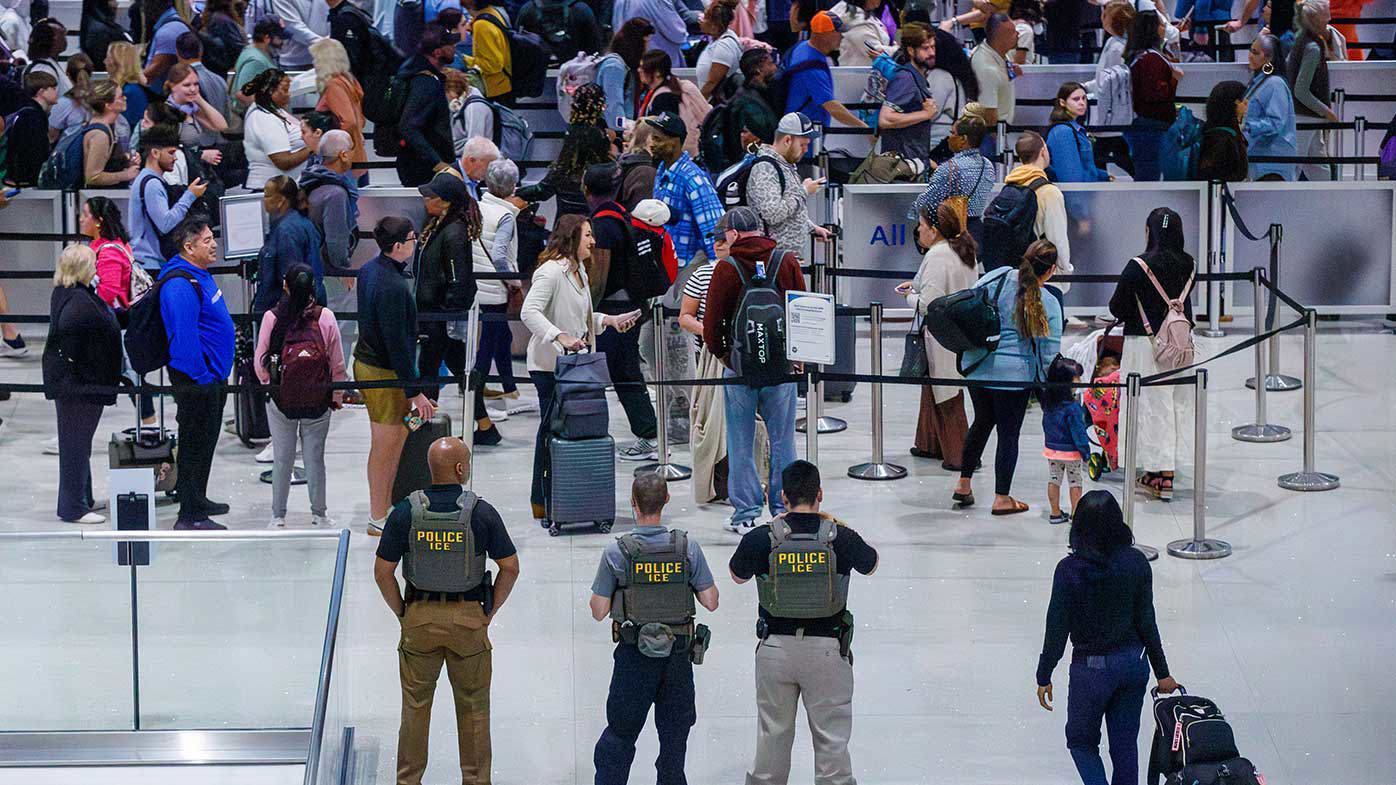
The primary driver of terminal congestion is the Stochastic Arrival Profile. Unlike a manufacturing line where inputs are controlled, an airport terminal receives "burst" inputs—multiple wide-body aircraft landing within the same sixty-minute window. A single Boeing 777-300ER can introduce 350 to 400 passengers into a hall simultaneously. When four such aircraft arrive at an international terminal like JFK or LAX within a tight margin, the system is hit with 1,500 units of demand.
The efficiency of the border is defined by a simple capacity constraint:
$$C = n \times \mu$$
Where $C$ is the total capacity, $n$ is the number of active inspection booths, and $\mu$ is the mean service rate per passenger.
Current policy failures stem from an inability to increase $n$ or $\mu$ in real-time. Staffing levels for CBP are governed by rigid federal budgetary cycles and union-negotiated shift patterns, meaning $n$ remains static even when demand spikes. Furthermore, the mean service rate ($\mu$) has actually decreased in recent years due to heightened document verification requirements and the inconsistent performance of facial recognition systems. When $\mu$ drops, even by ten seconds per passenger, the cumulative delay for a queue of 1,000 people increases by nearly three hours.
The Biometric Bottleneck and Technical Debt
The transition to Biometric Entry-Exit systems was marketed as a frictionless solution to manual passport inspection. In practice, the implementation has created a "Technical Debt" loop. The current hardware frequently suffers from lighting sensitivity and matching errors, particularly with diverse demographics or aging travelers.
- The Reversion Penalty: When a biometric gate fails to identify a passenger, that individual does not simply "try again." They are diverted to a manual inspection lane. This creates a double-processing cost where the passenger has already consumed the time at the kiosk and now consumes the time of a human officer.
- System Jitter: High-traffic periods often coincide with peak loads on federal databases. Latency in the "ping" between a local airport terminal and the central biometric database adds five to fifteen seconds of idle time per transaction.
- Hardware Scarcity: Many terminals are physical "landlocked" spaces. Adding more biometric kiosks requires removing seating or narrowing walkways, creating safety hazards that limit the total number of units that can be deployed regardless of budget.
The Policy-Operational Gap
Executive interventions often focus on "extreme vetting" or heightened security posture. While these goals are politically defined, their operational impact is a direct increase in Mean Processing Time (MPT). If an executive order mandates an additional three questions per traveler or a 10% increase in secondary inspections, the throughput capacity of the entire terminal drops by a corresponding percentage.
The "Trump solution" often referenced in recent critiques involves a focus on physical border security and strict enforcement protocols. While these measures aim to deter illegal entry, applying the same high-friction logic to legal, high-volume ports of entry creates a massive economic drag. The logic of "more scrutiny equals more safety" ignores the Diminishing Marginal Returns of Inspection. Beyond a certain point, the extra minute spent questioning a low-risk tourist does not yield a linear increase in security, but it does yield a linear increase in queue length.
The Failure of Expedited Programs to Scale
Programs like Global Entry and TSA PreCheck were designed to segment the passenger population into "Trusted" and "Unknown" cohorts. The strategic failure here is the Saturation Threshold. As more people join Global Entry to escape four-hour lines, the "Trusted" lanes themselves begin to experience congestion.
- Infrastructure Parity: Most airports did not build enough dedicated Global Entry kiosks to handle 30% or 40% of an arrival load.
- The "False Trusted" Problem: As the barrier to entry for these programs remains purely financial or involves a one-time interview, the risk profile of the "Trusted" pool changes over time, leading to more frequent "random" secondary triggers that slow down the expedited lanes.
- Resource Diversion: To staff the Global Entry kiosks during a surge, CBP often pulls officers from the "General" lanes. This creates a feedback loop where the general queue grows exponentially, forcing even more people to apply for Global Entry, further clogging the expedited system.
The Physical Constraint: Terminal Geometry
Most US international arrival halls were designed in the 1970s and 1980s. They were built for an era of smaller aircraft and lower global mobility.
The Staging Problem
When a queue exceeds the physical capacity of the zig-zag "tensile" barriers, it spills into the hallways where passengers disembark from planes. This creates a safety risk and prevents the efficient flow of the next arriving flight. Airport operators respond by "throttling" the planes—keeping passengers on the aircraft at the gate because there is physically no room for them in the customs hall. This turns a terminal problem into a flight-delay problem, as the aircraft cannot be cleaned, refueled, or reloaded for its next leg while passengers are still on board.
The Thermal and Psychological Load
Longer queues lead to increased ambient temperature and CO2 levels in enclosed spaces. This increases passenger irritability and medical incidents, which in turn requires CBP officers to stop processing to manage "disturbances." The psychological fatigue of a four-hour wait also leads to more errors during the interview process, as both the traveler and the officer are operating under cognitive strain.
The Hidden Economic Cost of Queue Latency
The impact of four-hour queues extends beyond traveler inconvenience; it is a direct tax on the US aviation and tourism sectors.
- Missed Connections: A four-hour delay at a primary port of entry like Dulles (IAD) or Miami (MIA) leads to thousands of missed domestic connections. Airlines must then rebook these passengers, often at their own expense, and provide overnight hotel vouchers.
- Reduced Repeat Tourism: High-value international travelers often choose destinations based on the "Ease of Entry." If the US becomes synonymous with a grueling arrival process, transit hubs like Dubai (DXB), Singapore (SIN), or even London (LHR) capture the layover traffic and the associated spending.
- Operational Friction for Crews: Flight crews are subject to the same queues or must be processed through separate, often understaffed, lanes. If a crew times out due to a two-hour wait at customs, the subsequent flight is canceled, impacting hundreds of other passengers who were never even in the customs hall.
The Structural Path Forward
Resolving the terminal crisis requires a departure from "Security Theater" and a move toward Data-Driven Flow Management.
The first step is the decoupling of the inspection process from the physical booth. Moving toward "Pre-Clearance" at more international departure points is the only way to flatten the arrival spikes at US gateways. By moving the $n \times \mu$ equation to the point of origin, the US effectively expands its border and prevents the "burst" input problem.
The second step is the implementation of Dynamic Staffing Algorithms. CBP staffing should not be fixed; it must be elastic, mirroring the real-time transponder data of incoming flights. If three flights are delayed and arrive simultaneously, the "Standby" officer pool must be activated immediately, bypassing the current rigid shift-change protocols that often see half the booths close just as a wave of aircraft lands.
The final strategic move is a total overhaul of the biometric interface. The goal should be "Walking Pace Identification," where cameras identify passengers as they walk through a corridor, rather than requiring them to stop at a fixed kiosk. This shifts the processing model from a Discrete Transaction to a Continuous Flow, fundamentally changing the math of the queue. Until these structural changes are prioritized over high-level executive rhetoric, the four-hour queue will remain a permanent feature of the American travel experience.