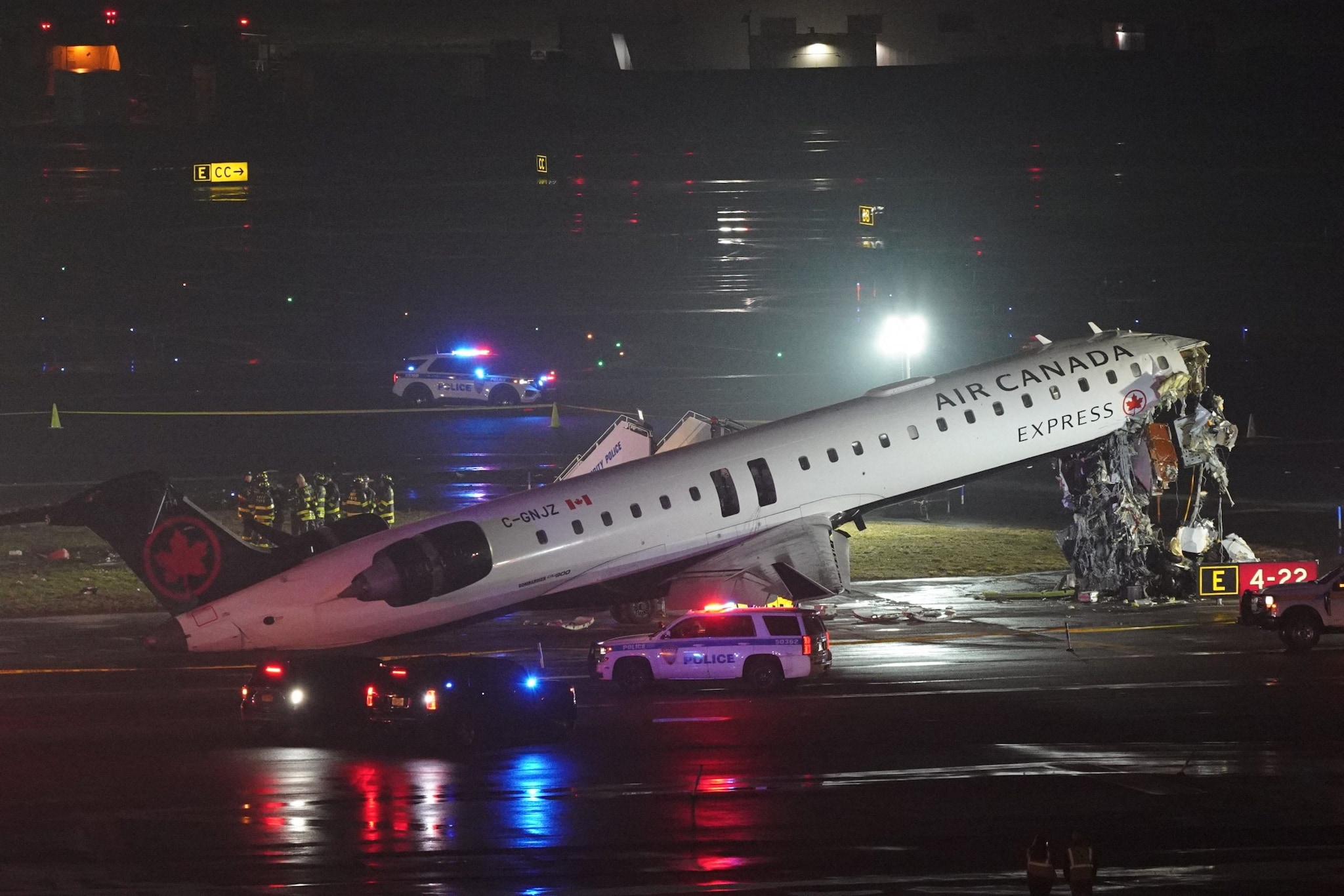
The investigation into the recent Air Canada surface incident at LaGuardia Airport has moved beyond a simple inquiry into pilot error or mechanical failure. National Transportation Safety Board (NTSB) investigators are now focusing on the systemic breakdown of communication and technology within the control tower. This was not a random stroke of bad luck. It was the predictable result of a strained National Airspace System (NAS) operating on the edge of its safety margins. While the headlines focus on the close proximity of the aircraft, the real story lies in the data gaps and human fatigue that allowed two multi-ton machines to occupy the same space at the same time.
For decades, the gold standard of aviation safety has relied on a "Swiss Cheese" model of redundant layers. On the night of the LaGuardia collision, those layers did not just align; they vanished. We are looking at a scenario where ground radar, visual observation, and radio protocol all failed simultaneously.
The Myth of the Modern Control Tower
Public perception of air traffic control (ATC) is often shaped by movies featuring glowing green screens and high-tech automation. The reality at older, high-volume hubs like LaGuardia is far grittier. Controllers are often working with Airport Surface Detection Equipment (ASDE-X) that, while sophisticated, is prone to "ghosting" or signal lag in certain weather conditions or high-density traffic periods.
When an Air Canada jet clips another aircraft on a taxiway or runway, the immediate question is why the automated alarms didn't scream. The answer often lies in the "nuisance alarm" problem. Controllers at busy airports frequently deal with false positives from ground safety systems. Over time, this creates a dangerous psychological phenomenon known as alarm fatigue. If a system cries wolf a dozen times an shift, the one time it flashes red for a real emergency, the human response is delayed by a fraction of a second. In aviation, that fraction of a second is the difference between a minor insurance claim and a mass casualty event.
Labor Shortages and the Fatigue Tax
You cannot discuss the LaGuardia probe without addressing the staffing crisis within the Federal Aviation Administration (FAA). We are currently facing a decade-long low in fully certified professional controllers. This shortage forces the existing workforce into mandatory six-day work weeks and grueling ten-hour shifts.
Fatigue is a physiological poison. It impairs spatial awareness and slows cognitive processing to levels comparable to legal intoxication. The NTSB is currently scrutinizing the shift logs for the controllers on duty during the Air Canada incident. They aren't just looking at who was in the chair, but how many hours that person had worked in the preceding seven days. When a controller is juggling thirty arrivals an hour on a cramped airfield like LaGuardia—often described as "a postage stamp with runways"—there is zero room for a tired brain.
The Concrete Geometry of LaGuardia
LaGuardia is unique among major American airports for its physical constraints. It is hemmed in by water and dense urban development, leaving no room for the wide, forgiving taxiways found at Denver or Dallas-Fort Worth.
- Runway 4-22 and 13-31 intersections: These are some of the most complex pieces of pavement in the world.
- Wingtip clearance: The margin for error for larger narrow-body jets, like the Airbus A321 often used by Air Canada, is measured in inches, not feet.
- Line of sight: Despite the height of the tower, certain "blind spots" exist where physical structures or terminal geometry can obscure a controller’s direct view of a taxiing aircraft.
If the ground radar undergoes a momentary "sweep lag," the controller is flying blind for several seconds. If the pilot is also distracted by complex "after-landing" checklists, the safety net is gone.
Beyond the Cockpit Voice Recorder
The NTSB will inevitably pull the Cockpit Voice Recorder (CVR) and the Flight Data Recorder (FDR) from the Air Canada aircraft. But the most damning evidence likely resides in the landline recordings between the tower and the TRACON (Terminal Radar Approach Control).
These recordings often reveal the "vibe" of the room—the level of stress, the speed of delivery, and whether instructions were being clipped or rushed to keep up with a backlog of flights. There is a specific cadence to a tower under pressure. When that cadence breaks, or when it becomes too frantic, errors happen. We need to stop asking if the pilots followed instructions and start asking if the instructions were physically possible to execute given the traffic density at that moment.
The Equipment Gap
While the airline industry has seen a massive influx of private capital and new aircraft, the infrastructure they land on is crumbling. The FAA's NextGen modernization program has been plagued by delays and budget overruns for years.
Many airports still rely on ground markings and lighting systems that haven't changed significantly since the 1970s. While some runways have "Stop Bars"—red lights embedded in the pavement that only turn off when a controller grants clearance—many taxiway intersections do not. We are effectively trying to run a 2026 flight schedule on a 1985 operating system.
Accountability Versus Litany
The standard response to these incidents is a "Notice to Air Missions" (NOTAM) or a brief retraining session for the crew involved. This is insufficient. If the NTSB finds that the LaGuardia ground movement safety system failed to trigger, or that the controller was on their twelfth consecutive hour of duty, the blame cannot rest solely on the shoulders of the individuals in the cockpit or the tower.
True accountability requires a hard look at the FAA’s funding model and the airline industry’s relentless push for higher frequency of flights. Airlines want more "slots"—the permission to land or take off at a specific time. More slots mean more revenue, but they also mean less time for the "postage stamp" to breathe.
The Technical Failure Points
Investigators are looking at several specific technical possibilities:
- Transponder Multipath Interference: Where signals bounce off terminal buildings, creating a false position for the aircraft on the controller's screen.
- Frequency Congestion: Where a pilot's "read back" of an instruction is stepped on by another radio transmission, leading to a misunderstood clearance.
- Surface Lighting Malfunction: Whether the "taxiway centerline lead-off lights" were functioning correctly to guide the Air Canada pilot away from the active runway edge.
The Economics of a Near Miss
A collision on the ground is a financial nightmare for an airline, but it is also a data point that the industry tries to "smooth over" to maintain consumer confidence. Air Canada, like all major carriers, operates on razor-thin margins where aircraft utilization is key. A plane sitting in a hangar for repairs after a wingtip strike is a plane that isn't generating cash.
This financial pressure trickles down to the flight deck. Pilots are encouraged to keep taxi speeds up to clear runways quickly and keep the "turnaround" on schedule. When you move a 150,000-pound machine at 20 knots in a crowded environment, physics eventually catches up with policy.
Redefining Surface Safety
The LaGuardia probe must result in more than a paper report that sits on a shelf in Washington. We need an immediate mandate for enhanced surface situational awareness tools in every cockpit, not just in the tower.
Currently, pilots rely heavily on what they see out the window and what they hear on the radio. Modern tablets (Electronic Flight Bags) can show an aircraft's position on a digital map of the airport, but many of these systems do not show other aircraft in real-time with high precision. Integrating ADS-B (Automatic Dependent Surveillance-Broadcast) data directly into a "moving map" for taxiing would provide pilots with the same view the controller has.
This technology exists. It is not a matter of "if" we can implement it, but "when" the cost of doing so becomes lower than the cost of a catastrophic hull loss.
The Human Element in a Tech-Obsessed World
We have spent billions trying to automate the flight itself, yet we have neglected the most dangerous part of the journey: the transition from the gate to the sky. The LaGuardia incident is a warning shot. It is a signal that the human-machine interface is fraying under the weight of record-breaking passenger numbers and aging equipment.
The NTSB will likely find "contributing factors" ranging from weather to terminology. But the root cause is a system that asks for perfection while providing substandard tools and exhausted personnel. Until the FAA addresses the controller shortage and the equipment lag with the same urgency they apply to mid-air collisions, the pavement at LaGuardia will remain the most dangerous place in the sky.
Aviation safety is not a static achievement. It is a continuous, expensive, and often exhausting fight against entropy. Every time we ignore a "minor" clip or a "slight" runway incursion, we are essentially betting that the next mistake won't be the big one. At LaGuardia, the house almost lost that bet.
Demanding an immediate audit of the ASDE-X alarm logs across all Tier 1 airports is the only way to determine if this was an isolated glitch or a systemic failure of our ground-safety logic.